
Graphics Processing Unit | 20 Feb 2026
Why in News?
The Graphics Processing Unit (GPU) has evolved over 2.5 decades from a discretionary gaming component—originally developed by Nvidia in 1999 as the GeForce 256 to enhance video game graphics—into the core infrastructure of the digital economy.
- GPU is now essential for artificial intelligence, machine learning, and high-performance computing due to its unique architecture designed for massive parallel processing.
What is a Graphics Processing Unit?
- About: A GPU is an extremely powerful number-cruncher built to perform many simple calculations simultaneously. Unlike CPU (central processing unit), designed for fewer complicated tasks with fast task-switching, GPUs excel at large repetitive workloads.
- A 1920×1080 screen has 2.07 million pixels per frame; at 60 frames/second, the GPU updates over 120 million pixels per second—each pixel's colour depending on lighting, textures, shadows, and material properties.
- Working of GPU: To render a scene, a video game sends the GPU a list of objects made of triangles, which the GPU processes through a four-step sequence called the rendering pipeline:
- Vertex processing: Using matrix mathematics to determine where each triangle's vertices appear on screen (rotating objects, applying camera perspective)
- Rasterisation: Converting triangle geometry into pixel candidates by determining which pixels each triangle covers
- Fragment/pixel shading: Determining final colour by looking up textures, calculating lighting, applying shadows, adding reflections
- Writing to frame buffer: Finished pixel colours stored in memory area read by display system.
- Shaders, and VRAM: Shaders are small programs that perform calculations on many vertices or pixels in parallel, enabling the GPU to rapidly read and write large volumes of data, including 3D models, textures, and final images.
- To achieve this speed, GPUs use dedicated high-bandwidth VRAM (video RAM) for massive data movement, while smaller, faster caches and shared memory help prevent memory access from becoming a bottleneck by reducing the need to repeatedly fetch the same data.
- GPU Location: The GPU is either a separate chip mounted on the motherboard or graphics card—surrounded by VRAM chips under a heat sink or integrated on the same die as the CPU in systems-on-a-chip common in laptops and smartphones.
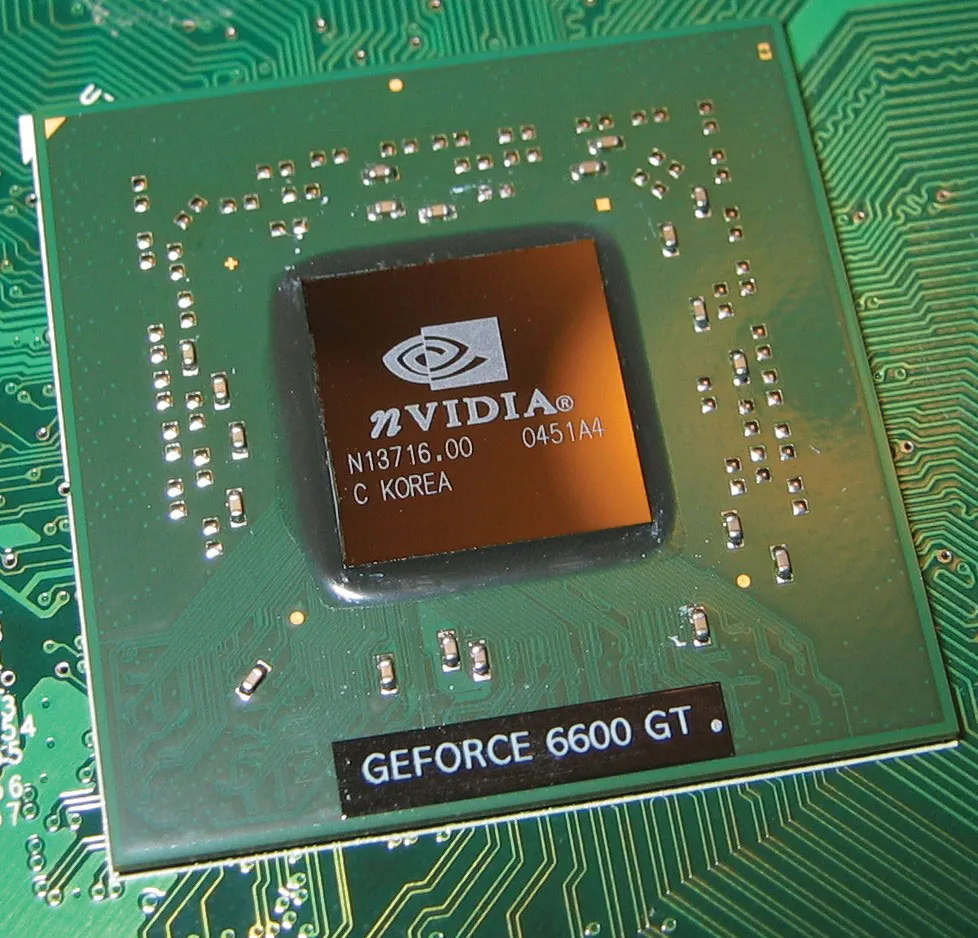
- GPUs vs CPUs: GPUs and CPUs use the same silicon transistors and fabrication nodes (e.g., 3-5 nm class), but differ in microarchitecture. CPUs dedicate die area (bare piece of silicon chip) to complex control logic and cache for decision-making, while GPUs allocate more space to repeating compute blocks, wide data paths, and supporting hardware like memory controllers.
- Consequently, high-end GPUs often contain more total transistors and are physically large, with some packages placing high-bandwidth DRAM close to the die for rapid data transfer. This architecture ensures GPUs can efficiently process massive volumes of data in parallel.
- Global Players: Nvidia does not technically hold a monopoly on GPUs, but it enjoys near-complete dominance in certain markets, holding roughly 90% share in discrete GPUs sold for use in personal computers while AMD and Intel comprise the rest. In data centers, Nvidia's position is strengthened by hardware performance and its CUDA software platform, which enables general-purpose computation on its GPUs.
India’s Initiatives to Develop GPUs
Frequently Asked Questions (FAQs)
1. What is a Graphics Processing Unit (GPU)?
A GPU is a parallel-processing semiconductor chip designed to execute thousands of simple computations simultaneously, ideal for graphics rendering and AI workloads.
2. How does a GPU differ from a CPU?
CPUs handle complex sequential tasks with strong control logic, whereas GPUs allocate more cores for parallel execution of repetitive mathematical operations.
3. What is CUDA and why is it significant?
CUDA is Nvidia’s proprietary parallel computing platform that enables general-purpose processing on GPUs, creating ecosystem dependence in AI development.
UPSC Civil Services Examination Previous Year Question (PYQ)
Q. With the present state of development, Artificial Intelligence can effectively do which of the following? (2020)
- Bring down electricity consumption in industrial units
- Create meaningful short stories and songs
- Disease diagnosis
- Text-to-Speech Conversion
- Wireless transmission of electrical energy
Select the correct answer using the code given below:
(a) 1, 2, 3 and 5 only
(b) 1, 3 and 4 only
(c) 2, 4 and 5 only
(d) 1, 2, 3, 4 and 5
Ans: (b)