
Governor and Lieutenant Governor Appointment in India | 06 Mar 2026
Why in News?
The President of India President Droupadi Murmu recently announced a major reshuffle of Governors and Lieutenant Governors across several states and union territories.
- Former Tamil Nadu Governor R.N. Ravi has been appointed as the new Governor of West Bengal. The Kerala Governor Rajendra Vishwanath Arlekar was given the additional charge of Tamil Nadu.
- Taranjit Singh Sandhu, has been appointed as the new Lieutenant Governor (LG) of Delhi.
What is the Appointment Process of the Governor?
- Article 153 (Governors of States): It mandates that there must be a Governor for every state.
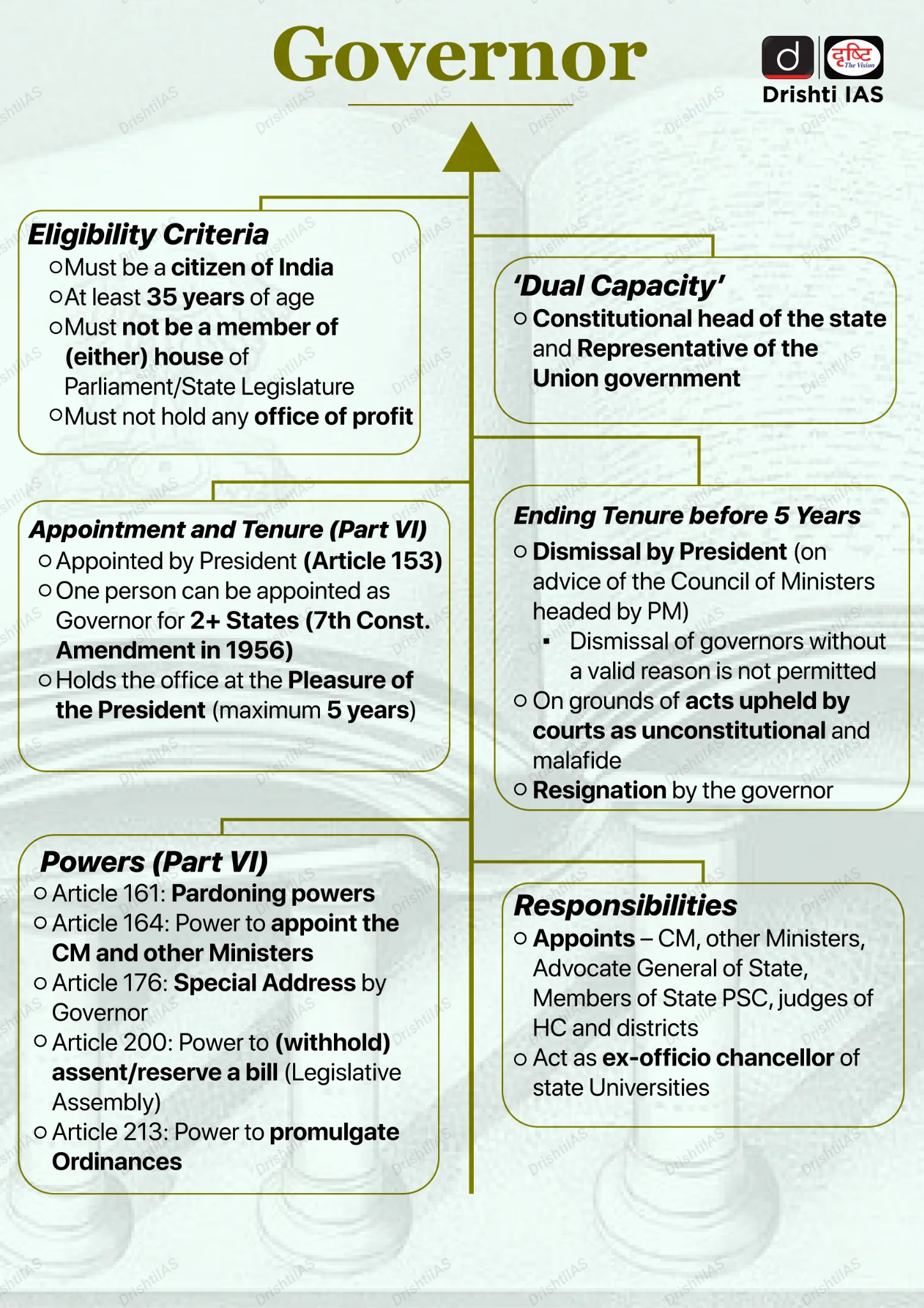
- The 7th Constitutional Amendment Act of 1956 facilitated the appointment of a single Governor for multiple states simultaneously.
- Article 154 (Executive Power of State): The executive power of the state is officially vested in the Governor.
- Article 155 (Appointment of Governor): The Governor is appointed directly by the President of India.
- The appointment is formalized by a warrant under the hand and seal of the President, establishing the Governor as a nominee of the Union Government.
- Article 156 (Term of Office): The Governor holds office during the pleasure of the President of India.
- The Constitution does not specify any grounds for the removal of a Governor. They can be removed or transferred by the President at any time.
- Subject to the pleasure of the President, the standard term of office is five years from the date of assuming charge. A Governor will continue to hold office even after the five years expire, until a successor formally takes over.
- The Governor can resign at any time by writing a resignation letter addressed directly to the President.
- The Constitution does not specify any grounds for the removal of a Governor. They can be removed or transferred by the President at any time.
- Article 157 (Qualifications for Appointment): The individual must be a citizen of India and must have completed thirty-five years of age.
- Article 158 (Conditions of Office): The Governor cannot be a member of either House of Parliament (Council of States or House of the People) or a House of the State Legislature (Legislative Assembly or Legislative Council).
- If a sitting member is appointed, they are legally deemed to have vacated their seat on the day they assume the office of Governor.
- The Governor is strictly prohibited from holding any other office of profit.
- The Governor is entitled to an official residence without payment of rent, along with emoluments, allowances, and privileges determined by the Parliament of India.
- If the same person serves as the Governor of two or more states, the financial emoluments are shared among the respective states in a proportion determined by an order from the President.
- Furthermore, these emoluments and allowances cannot be reduced during the Governor's term of office.
- Article 159 (Oath or Affirmation): Before entering office, the Governor must take an oath or affirmation to faithfully execute the office; to preserve, protect, and defend the Constitution and the law; and to devote themselves to the service and well-being of the people of the state.
- This oath is administered by the Chief Justice of the concerned High Court, or in their absence, the senior-most judge of that particular court.
- Established Conventions:
- Outsider Rule: The Governor is usually appointed from outside the state to ensure neutrality and avoid involvement in local politics.
- Consultation with Chief Minister: The President is expected to consult the State’s Chief Minister before appointment to ensure smooth functioning of the constitutional system, though this practice is often not followed.
What is the Appointment Process of the LG?
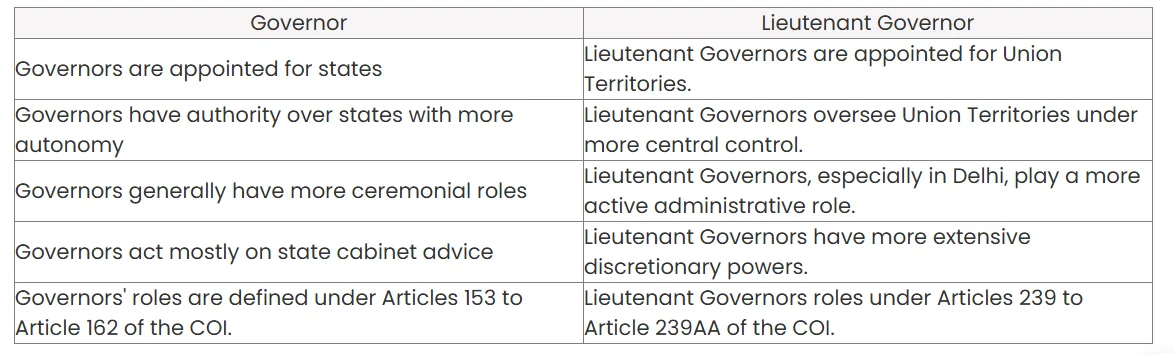
- Article 239: Unlike Governors (who are covered under Part VI of the Constitution), the administration of Union Territories is dealt with under Part VIII (Articles 239 to 241).
- Article 239 of the Constitution states that every Union Territory shall be administered by the President of India acting through an "Administrator" appointed by him, with such designation as the President may specify.
- Designation: The President specifies the designation of this administrator.
- In five UTs ((National Capital Territory (NCT) of Delhi, Puducherry, Jammu and Kashmir, Ladakh, and Andaman and Nicobar Islands), they are designated as Lieutenant Governors (LGs).
- In Chandigarh, Lakshadweep, and Dadra & Nagar Haveli and Daman & Diu, they are simply called "Administrators".
- Article 239AA: Specifically dictates that the Administrator of the NCT of Delhi shall be designated as the Lieutenant Governor.
- Appointment Process: The Lieutenant Governor is directly appointed by the President of India by a warrant under their hand and seal.
- Since the President exercises their powers on the aid and advice of the Union Council of Ministers (Article 74), the LG is effectively chosen and recommended by the Central Government.
- Term of Office and Removal: Like a state Governor, the LG holds office during the "pleasure of the President."
- The Constitution does not specify grounds for the removal of an LG. The Central Government can advise the President to transfer, remove, or demand the resignation of an LG at any time.
Why are Governors Appointed Rather Than Elected in India?
- Prevent Conflict: During the drafting of the Constitution, the Constituent Assembly opted for an appointed Governor (the Canadian model) rather than an elected one (the American model).
- An elected Governor might clash with the elected Chief Minister, leading to a parallel power centre and constitutional deadlocks.
- Nominal Head: Since the state follows a parliamentary system where the Chief Minister is the real executive, spending money and energy on a statewide election for a nominal head was deemed unnecessary.
- National Unity: An appointed Governor serves as a vital link between the Centre and the State, helping to ensure national stability and integration.
- Preserving the Neutrality of the Office: An elected Governor would necessarily have to run on a political party ticket or rely on party machinery to win a statewide election.
- This would compromise their ability to act as a neutral umpire, especially during critical times like hung assemblies or the imposition of President's Rule.
Key Recommendations Regarding Appointment of the Governor
- Sarkaria Commission (1983): The appointee should be an eminent person from outside the State. They must not have been in active politics in the recent past.
- It should be constitutionally mandated to consult the Chief Minister of the state, the Vice-President of India, and the Speaker of the Lok Sabha before making the appointment.
- Recommended that Governors must not be removed before completion of their five-year tenure, except in rare and compelling circumstances.
- Punchhi Commission (2007): Recommended deleting the "pleasure of the President" doctrine.
- Recommended that a Governor should only be removed through a resolution passed by the state legislature (similar to the impeachment process of the President).
- Venkatachaliah Commission (2002): Recommended that Governors should normally complete their five-year term, and if removed earlier, the Central Government should consult the concerned Chief Minister.
Frequently Asked Questions (FAQs)
1. Which constitutional articles deal with the appointment and role of the Governor?
Articles153 to 159 of the Constitution of India outline the appointment, powers, qualifications, and oath of the Governor.
2. Who appoints the Governor of a state in India?
UnderArticle 155, the President of India appoints the Governor through a warrant under their hand and seal.
3. What is the tenure of a Governor in India?
According toArticle 156, the Governor normally serves a five-year term but holds office at the pleasure of the President.
4. What is the “Outsider Rule” in the appointment of Governors?
It is a convention that the Governor should beappointed from outside the concerned state to maintain political neutrality.
5. What reforms have been suggested regarding the removal of Governors?
ThePunchhi Commission (2007) recommended removing the “pleasure of the President” doctrine and suggested removal through a state legislature resolution.
UPSC Civil Services Examination, Previous Year Question (PYQ)
Prelims:
Q. Consider the following statements: (2018)
- No criminal proceedings shall be instituted against the Governor of a State in any court during his term of office.
- The emoluments and allowances of the Governor of a State shall not be diminished during his term of office.
Which of the statements given above is/are correct?
(a) 1 only
(b) 2 only
(c) Both 1 and 2
(d) Neither 1 nor 2
Ans: (c)
Q. Which of the following are the discretionary powers given to the Governor of a State? (2014)
- Sending a report to the President of India for imposing the President’s rule
- Appointing the Ministers
- Reserving certain bills passed by the State Legislature for consideration of the President of India
- Making the rules to conduct the business of the State Government
Select the correct answer using the code given below:
(a) 1 and 2 only
(b) 1 and 3 only
(c) 2, 3 and 4 only
(d) 1, 2, 3 and 4
Ans: (b)
Q. Which one of the following statements is correct? (2013)
(a) In India, the same person cannot be appointed as Governor for two or more States at the same time
(b) The Judges of the High Court of the States in India are appointed by the Governor of the State just as the Judges of the Supreme Court are appointed by the President
(c) No procedure has been laid down in the Constitution of India for the removal of a Governor from his/her post
(d) In the case of a Union Territory having a legislative setup, the Chief Minister is appointed by the Lt. Governor on the basis of majority support
Ans: (c)