
Good Governance Day | 25 Dec 2025
For Prelims: Good Governance Day, Good Governance Index, National Centre for Good Governance, Mission Karmayogi
For Mains: Concept and principles of good governance, Challenges to good governance in India,Citizen participation: Jan Andolan vs Jan Bhagidari
Why in News?
Good Governance Day, observed on 25th December, commemorates the birth anniversary of Atal Bihari Vajpayee and underscores his ideals of accountability, transparency, and inclusive governance.
Summary
- Good Governance Day reflects Atal Bihari Vajpayee vision of accountable, transparent, and inclusive governance, which continues to guide India’s institutional and administrative reforms.
- While India has made progress through digital governance, performance indices, and citizen-centric delivery, persistent challenges such as corruption, judicial delays, weak decentralisation, and trust deficits underline the need for deeper citizen participation, ethical leadership, and empowered local governance.
What is Good Governance?
- About: According to UNESCAP, governance is the process of decision-making and the manner in which decisions are implemented (or not implemented), while good governance refers to the effective, fair, and accountable exercise of power to manage economic, political, and social resources in the public interest for development.
- It involves not just the government, but also legislature, judiciary, civil society, private sector, media, and other formal and informal actors.
Governance + Transparency + Accountability + Rule of Law → Good Governance
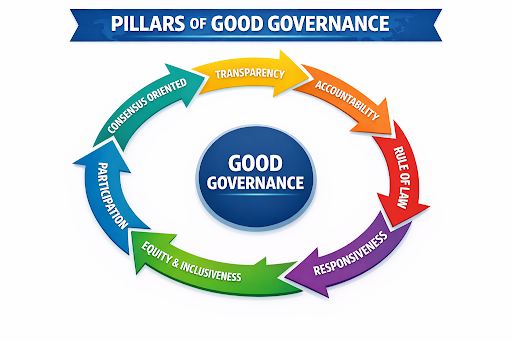
- Core Characteristics of Good Governance: According to global institutions like the UN and World Bank, good governance is characterised by:
- Participation: Active involvement of citizens, including women and marginalised groups
- Rule of Law: Fair, impartial laws enforced by an independent judiciary
- Transparency: Free and accessible flow of information
- Responsiveness: Timely and effective service delivery
- Consensus-Oriented: Mediation of diverse interests for collective welfare
- Equity and Inclusiveness: Equal opportunities for all sections of society
- Effectiveness and Efficiency: Optimal use of resources for desired outcomes
- Accountability: Answerability of government, private sector, and civil society
- Significance: Good governance minimises corruption, protects human rights, and ensures transparent and accountable administration, thereby building public trust in institutions.
- It also promotes equitable access to opportunities, especially for the poor and vulnerable, and accelerates inclusive and sustainable economic and social development by reducing regional and social disparities.
- It also reinforces ethical governance values such as integrity, probity, compassion, fairness, and responsibility, which are core to ethical public administration.
How is India Promoting Good Governance?
- Digital and e-Governance Initiatives: Platforms like UMANG, DigiLocker, GeM, and e-Office enable paperless, transparent, and time-bound service delivery while reducing discretion and corruption.
- Transparency and Accountability Frameworks: The Right to Information Act 2005, Citizen Charters, grievance redressal portals, and social audits strengthen public oversight and administrative accountability.
- Performance Measurement and Monitoring: Tools such as the Good Governance Index (GGI) benchmark governance outcomes across States, encouraging competitive federalism and evidence-based reforms.
- Department of Administrative Reforms & Public Grievances (DARPG) and National Centre for Good Governance (NCGG) lead governance reforms, and strengthen institutional grievance redressal systems.
- Administrative Capacity Building: Mission Karmayogi and the iGoT platform focus on continuous skill upgradation of civil servants for a professional and future-ready bureaucracy.
- Rural Development: DAY-NRLM has mobilised over 10.29 crore rural households into SHGs, enabling access to finance and sustained livelihood support, while the Lakhpati Didi initiative signals a shift from subsistence to diversified, income-secure livelihoods.
- Investments in housing (PMAY-G) and connectivity (PMGSY) have reduced isolation and expanded access to markets and services, while skill development (DDU-GKY) and social security (NSAP) provide a safety net for youth and vulnerable groups.
- Digitalisation links rural producers to markets and improves Panchayat transparency through eGramSwaraj and BharatNet.
- Independent Constitutional Bodies: Institutions like Comptroller and Auditor-General of India (CAG), Election Commission of India, UPSC, and Finance Commission ensure financial accountability, free elections, merit-based recruitment, and fiscal federalism.
- Citizen-Centric Service Delivery: National e-Governance Plan, Direct Benefit Transfer (DBT), single-window clearances, and mobile-based platforms improve last-mile delivery and reduce leakages.
- MyGov Platform encourages citizen participation in policymaking and feedback.
- The adoption of Sevottam Model set service standards and institutionalized time-bound, accountable public service delivery.
- Judicial and Legal Reforms: Expansion of e-Courts and fast-track courts to improve access to justice and reduce pendency.
- Decentralisation and Local Governance: By strengthening Gram Panchayats, Self-Help Groups, and community-based institutions, governance is brought closer to citizens, enabling participatory planning and more responsive outcomes.
Good Governance Index (GGI)
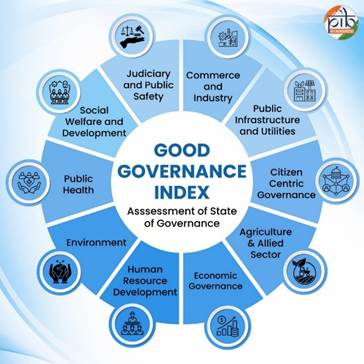
- About: The DARPG introduced the GGI on 25th December 2019, to evaluate governance performance across states and union territories and encourage improvements.
- Coverage: GGI 2020–21 assesses governance across 10 sectors and 58 indicators.
- Categories Under the GGI: To ensure fair comparison, jurisdictions are grouped into four categories (Group A States, Group B States, North-East and Hill States, and Union Territories).
- Top Performers in the GGI 2020–21:
- Group A States: Gujarat, Maharashtra, Goa
- Group B States: Madhya Pradesh, Rajasthan, Chhattisgarh.
- North-East & Hill States: Himachal Pradesh, Mizoram
- Union Territories: Delhi.
- Top Performers in the GGI 2020–21:
What are the Major Challenges to Good Governance In India?
- Economic and Social Insecurity: High unemployment (5.2% in October, 2025) and inequality reduce citizen participation and weaken trust in public institutions.
- According to the World Bank, India’s Gini Index stands at 25.5, making it the fourth most equal country in the world.
- Ineffective Policymaking: Top-down policy design often ignores local realities, leading to poor implementation and uneven outcomes.
- Criminalization & Nexus: The Association for Democratic Reforms (ADR) data shows that around 45% of MLAs across states have declared criminal cases against them.
- The growing number of legislators with pending criminal cases creates conflicts of interest, while the politician–bureaucracy–business nexus distorts policy priorities, weakens institutions, and erodes democratic governance.
- Institutional Corruption: Corruption and weak institutional capacity reduce governance efficiency.
- Nearly 20% of India’s GDP is spent on public procurement, which the Central Vigilance Commission (CVC) identifies as a sector highly vulnerable to corruption.
- India ranked 96 out of 180 countries in the Corruption Perceptions Index (CPI) for 2024, eroding public trust.
- Judicial Delays: Over 4 crore pending court cases undermine the rule of law and timely justice delivery.
- Poor Accountability Mechanisms: Weak monitoring and grievance redressal affect the effectiveness of schemes such as MGNREGA and Public Distribution System.
- The CAG flagged serious irregularities in Pradhan Mantri Kaushal Vikas Yojana (PMKVY) implementation, including fake bank details, duplicate photos, non-functional training centres, and unpaid dues for over 34 lakh candidates.
- Together, these lapses point to weak oversight and corruption, undermining accountability, outcomes, and value for public money.
- Political Resistance To Reforms: Reluctance to decentralise power and strengthen local governance slows systemic reforms.
- Trust Deficit: Delays in welfare delivery and lack of transparency reduce citizens’ confidence in governance systems.
- Populism vs Structural Reform: Political parties often prioritise a freebie (revadi) culture to win elections, diverting scarce public resources away from long-term investments in infrastructure, health, and education.
What Measures are Needed to Strengthen Good Governance In India?
- Deepen Citizen Participation: Move from Jan Andolan (people’s movement) to Jan Bhagidari (active people’s participation) and strengthen Jan Chetna (public Awareness) by institutionalising social audits across all major Schemes.
- This can be done through regular public consultations, open feedback platforms, and deeper participatory governance at the grassroots level.
- Focus on the Marginalised: Realise Sarvodaya through Antyodaya by first uplifting the most vulnerable.
- Prioritising women, SC/STs, minorities, the elderly, farmers, and aspirational districts ensures that inclusive social and economic justice becomes the foundation for welfare of all.
- Empower Local Governments: Promote democratic decentralisation by empowering Panchayats and Urban Local Bodies with adequate funds, functions, and functionaries (3Fs).
- Simplify Governance Processes: Re-engineer procedures through single-windows like Kerala’s FRIENDS (Fast Reliable Instant Efficient Network for Disbursement of Services), time-bound service delivery laws, and robust feedback mechanisms to reduce citizen interface costs and curb corruption.
- Strengthening the Sevottam Model and expanding e-governance can further improve efficiency, transparency, and quality of public service delivery.
Minimum Government + Maximum Governance → Citizen Empowerment → Good Governance
- Promote Ethical Governance: Enforce zero tolerance for corruption, uphold integrity norms, protect whistleblowers, and strengthen vigilance institutions to rebuild public trust.
- Implement the 2nd Administrative Reforms Commission’s focus on "Ethics in Governance"—moving from a "Culture of Secrecy" to a "Culture of Service."
- Judicial Capacity Enhancement: Under e-Courts Phase III, scale up AI-based case management and automated scheduling.
- Virtual courts for petty offences can help reduce the backlog of pending cases and allow judges to focus on complex matters.
- Gati Shakti for Bureaucracy: Apply the "Gati Shakti" (Integrated Planning) approach to administrative workflows to break inter-ministerial silos and improve coordination, efficiency, and policy outcomes.
- Move from Rule based to Role based (from Babu culture to seva culture) approach (Mission Karmayogi).
- Introduce 360-degree appraisals (as suggested by the 2nd ARC) and lateral entry at mid-to-senior levels to bring in specialized domain expertise.
.png)
Key Facts About Atal Bihari Vajpayee
- Early Life: Atal Bihari Vajpayee was born on 25th December 25, 1924, in Gwalior, Madhya Pradesh.
- Participated in the Quit India Movement (1942) during his student days.
- Journalism and Political Journey: Atal Bihari Vajpayee began his public life as a journalist before joining the Bharatiya Jana Sangh in 1951, the predecessor of the Bharatiya Janata Party (BJP), and went on to play a foundational role in shaping BJP and National Democratic Alliance (NDA) politics.
- He is a veteran parliamentarian, he served as Prime Minister three times (13 days (1996), 11 months (1998–99), and a full term (1999–2004)) and held key roles including External Affairs Minister and Leader of the Opposition.
- Awards and Honours: He was conferred Padma Vibhushan (1992) and Bharat Ratna (2015) for his lifelong service to the nation. In 1994, he was named India's 'Best Parliamentarian.'
Role in Nation-Building
- Transformational Governance: He delivered landmark reforms in telecom (New Telecom Policy, 1999), power sector (Electricity Act, 2003), fiscal discipline (FRBM Act, 2003).
- Connectivity-led Development: He viewed connectivity as a growth enabler, launching the National Highways Development Project (NHDP) and Pradhan Mantri Gram Sadak Yojana (PMGSY) to integrate markets, villages, and cities.
- Human Capital and Social Upliftment: Initiatives like Sarva Shiksha Abhiyan expanded primary education.
- Science, Technology, and Strategic Autonomy: Vajpayee asserted India’s global standing through Pokhran-II (1998), and announced Chandrayaan-I, laying foundations for India’s space and nuclear ambitions.
- Foreign policy and global voice: He elevated India’s diplomacy with balanced assertiveness, advocated India’s UN Security Council aspirations, and projected India’s civilisational ethos—famously addressing the UN General Assembly in Hindi.
Conclusion
Good governance is the backbone of inclusive development and democratic legitimacy. India’s governance reforms, and digital initiatives show progress, but sustained citizen participation, institutional strengthening, and ethical leadership remain crucial to achieving equitable and accountable governance.
|
Drishti Mains Question: Good governance is as much about institutions as it is about citizen participation. Examine this statement in the Indian context. |
Frequently Asked Questions (FAQs)
1. What is meant by good governance according to UNESCAP?
It refers to the effective, accountable, transparent, and inclusive exercise of power in managing public resources for development.
2. Why is Good Governance Day observed on 25th December?
It marks the birth anniversary of Atal Bihari Vajpayee and promotes citizen-centric, accountable governance.
3. What is the Good Governance Index (GGI)?
Introduced by DARPG in 2019, it assesses governance performance of States and UTs across multiple sectors and indicators.
UPSC Civil Services Examination Previous Year Question (PYQ)
Mains
Q. E-governance is not only about utilization of the power of new technology, but also much about the critical importance of the ‘use value’ of information. Explain. (2018)
Q. The Citizens’ Charter is an ideal instrument of organizational transparency and accountability, but it has its own limitations. Identify the limitations and suggest measures for greater effectiveness of the Citizens’ Charter. (2018)