
FDTL Norms and India’s Aviation Sector | 08 Dec 2025
For Prelims: UDAN, Digi Yatra, Foreign Direct Investment, Aviation Turbine Fuel, Sustainable Aviation Fuel, Directorate General of Civil Aviation, Airports Authority of India
For Mains: Aviation safety regulation and pilot fatigue management, Development of India's Aviation Industry, Challenges in India's Civil Aviation and Possible Reforms, Regional Connectivity and Inclusive Growth
Why in News?
IndiGo Airlines has come under scrutiny after mass flight cancellations triggered by the implementation of revised Flight Duty Time Limitation (FDTL) norms left thousands of passengers stranded, prompting the Directorate General of Civil Aviation (DGCA) to grant temporary exemptions for operational stabilisation.
What are the Revised Flight Duty Time Limitation (FDTL) Rules?
- About: FDTL norms are safety regulations issued by the Directorate General of Civil Aviation (DGCA) that prescribe how long pilots can remain on duty, how many hours they can fly, the number of night landings permitted, and the minimum rest they must receive.
- These norms are designed to prevent pilot fatigue, reduce human error, and enhance aviation safety, and are aligned with international aviation standards.
- New FDTL Rules:
- Weekly Rest Increased: Pilots must now get 48 consecutive hours of rest, up from 36 hours earlier.
- Night Landings Capped: Pilots can perform only 2 night landings, reduced from 6 earlier.
- No more than 2 continuous night duties are allowed.
- Mandatory Roster Adjustments: Airlines must redesign crew rosters as per the new limits.
- Quarterly fatigue reporting: Airlines must submit regular fatigue risk reports to the DGCA.
- Objective: Fatigue is a major operational risk in aviation, especially during early morning departures and night landings.
- The new FDTL rules aim to improve pilot alertness, reduce human error, and align India’s aviation safety standards with global norms.
Directorate General of Civil Aviation (DGCA)
- About: The DGCA headquartered in New Delhi, is India’s apex regulatory body for civil aviation safety.
- It functions as an attached office of the Ministry of Civil Aviation and is responsible for regulating air transport services, air safety, and airworthiness standards in India, in coordination with the International Civil Aviation Organisation (ICAO).
- Role of DGCA:
- Aviation Safety Regulator: Ensures air safety, flight operations safety, and airworthiness standards in India.
- Licensing Authority: Issues licenses to pilots, aircraft maintenance engineers, flight engineers, and air traffic controllers.
- Regulation of Air Transport Services: Regulates scheduled and non-scheduled flights of Indian and foreign operators.
- Accident Investigation & Prevention: Investigates aviation accidents and incidents and enforces preventive safety measures.
- Environmental Regulation: Monitors aircraft noise and engine emissions as per ICAO Annex 16.
- Legal and Policy Support: Updates Aircraft Rules, Civil Aviation Requirements (CARs) and supports new aviation laws.
What is the Status of India’s Aviation Sector?
- Global Ranking: India is the 3rd-largest domestic aviation market after the US and China.
- Passenger demand is rising due to urbanisation, tourism, and middle-class expansion.
- Passenger Traffic Growth: By 2040, the passenger traffic is expected to grow six-fold to around 1.1 billion.
- Economic Contribution: As of 2025, aviation supports over 7.7 million jobs (direct + indirect) and contributes 1.5% of India’s GDP.
- Fleet Strength:The Indian fleet accounts for around 2.4% of the total global fleet.
- Fleet size has grown rapidly due to airline expansion and new aircraft orders.
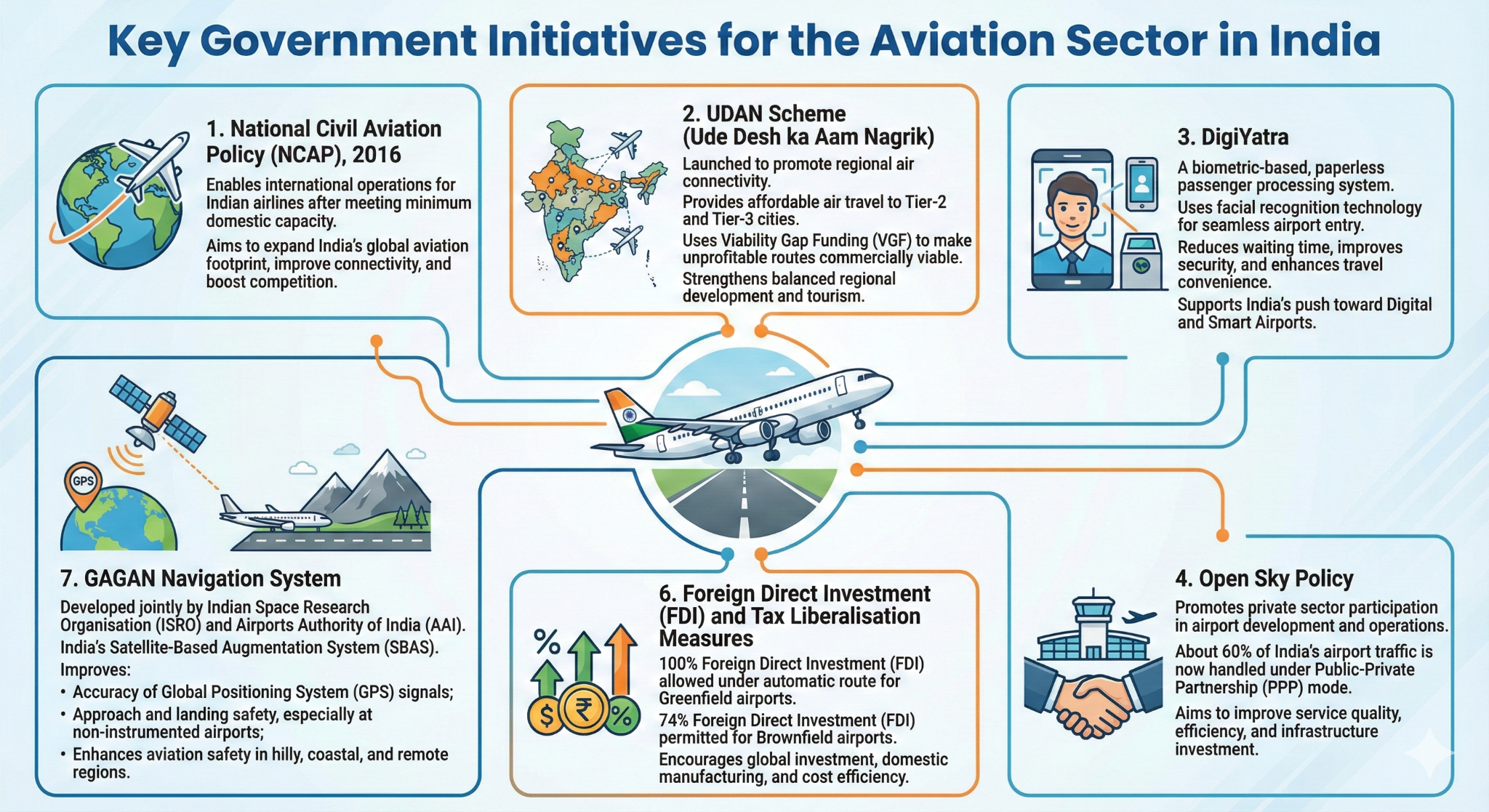
- Airport Infrastructure Expansion: Number of operational airports increased from 74 in 2014 to 163 in 2025. By 2047, India aims to have 350–400 airports.
- Strong focus on Greenfield airports and PPP-based development.
- Indian Civil Aviation Regulation:
- Air Corporations Act, 1953: Nationalised nine airline companies. Government-owned airlines dominated the sector till the mid-1990s.
- Open Sky Policy (1990–94): Allowed private air taxi operators. Ended the monopoly of Indian Airlines (IA) and Air India (AI).
- The Bharatiya Vayuyan Adhiniyam, 2024: Replaces the colonial-era Aircraft Act, 1934 and aligns India’s aviation laws with ICAO standards and the Chicago Convention.
- It promotes Make in India and Atmanirbhar Bharat in aviation manufacturing, introduces simplified licensing and regulatory processes, provides a structured appeals mechanism, and modernises India’s overall aviation governance framework.
What are the Key Challenges in India’s Aviation Sector?
- Pilot and Crew Shortages: Rapid growth in air traffic has created a mismatch between demand and availability of trained pilots, cabin crew, and maintenance staff.
- New safety norms like FDTL have further increased manpower requirements, leading to frequent flight cancellations, delays, and operational disruptions because airlines did not hire and train sufficient pilots in advance to meet the new staffing needs.
- Airport Infrastructure Bottlenecks: Major airports like Delhi, Mumbai, and Bengaluru operate near full capacity, leading to runway congestion, parking shortages, and airspace crowding, especially during peak hours.
- High Operating Costs: Airlines face heavy financial pressure due to high Aviation Turbine Fuel (ATF) prices, aircraft leasing costs in dollars, and rising maintenance expenses.
- Aggressive Capacity and Scheduling Practices: Airlines often announce ambitious flight schedules without adequate backup crews or spare aircraft, increasing the risk of mass cancellations during disruptions.
- Passenger Protection and Grievance Redressal: During large-scale disruptions, passengers face poor communication, weak compensation mechanisms, and limited legal remedies.
- Dependence on Foreign Aircraft and Supply Chains: Heavy reliance on imported aircraft, engines, and spare parts exposes the sector to global supply chain disruptions and currency volatility.
- Exchange Rate Volatility: The depreciation of the Indian rupee against the US dollar raises costs for airlines, as key expenses like aircraft leasing and fuel imports are dollar-denominated.
- Aviation Safety Risks: Recent crashes in 2025 and rising traffic highlight concerns over safety oversight and emergency response.
What Measures can Strengthen India’s Aviation Sector?
- Temporary Regulatory Relief for Stabilisation: DGCA has granted IndiGo a temporary one-time exemption from certain night-operation. This short-term relief should be used strictly for operational stabilisation, not for long-term dependence.
- FDTL norms must not be diluted, as fatigue management is critical to aviation safety.
- Build Operational Buffers: Maintain standby pilots, reserve cabin crew, and spare aircraft to handle disruptions during peak seasons and technical failures.
- Improve Passenger Communication & Compensation: Real-time updates, automatic refunds, and compensation must be strengthened to restore public trust.
- Encourage Sustainable Aviation: Promote Sustainable Aviation Fuel (SAF), energy-efficient airports, and compliance with ICAO's Carbon Offsetting and Reduction Scheme for International Aviation (CORSIA) for carbon reduction.
- Airspace Modernisation: Expedite the proposed Civil Air Traffic Management System with Advanced-Surface Movement Guidance and Control System to optimize airspace usage and reduce delays.
Conclusion
The IndiGo crisis has highlighted serious gaps in manpower planning, infrastructure readiness, and passenger protection in India’s aviation sector. While FDTL norms rightly prioritise safety, airlines must strengthen crew capacity and operational resilience. With airspace modernisation and sustainable practices, the sector can achieve safer and more stable growth.
Frequently Asked Questions (FAQs)
Q. What are FDTL norms?
FDTL (Flight Duty Time Limitation) norms are DGCA safety rules that regulate pilot duty hours, flying time, night landings, and mandatory rest to prevent fatigue.
Q. What are the key new changes under the revised FDTL rules?
Weekly rest increased to 48 hours, night landings capped at 2, no more than 2 continuous night duties, and mandatory quarterly fatigue reporting to DGCA.
Q. What is the role of DGCA in India?
DGCA is India’s apex civil aviation regulator under the Ministry of Civil Aviation, responsible for air safety, licensing, airworthiness, flight regulation, and ICAO coordination.
Q. What is India’s current global position in civil aviation?
India is the 3rd-largest domestic aviation market after the USA and China and supports over 7.7 million jobs.
Summary
- IndiGo faced mass flight cancellations after the rollout of revised FDTL norms, triggering parliamentary scrutiny and exposing manpower gaps.
- The new rules strengthen pilot rest, limit night operations, and mandate fatigue reporting to improve aviation safety.
- India’s aviation sector is rapidly expanding, but it faces challenges like crew shortages, high costs, infrastructure bottlenecks, and safety risks.
- The crisis underscores the need for strict safety enforcement, better crew planning, sustainable aviation, and airspace modernisation.
UPSC Civil Services Examination, Previous Year Questions (PYQs)
Mains
Q. Examine the development of Airports in India through joint ventures under Public–Private Partnership (PPP) model. What are the challenges faced by the authorities in this regard? (2017)