
Eurasian Otter in Kashmir | 17 Feb 2026
A chance sighting of the Eurasian Otter along the Sindh Canal has provided the first direct photographic evidence of the species in the Kashmir Valley, once considered locally extinct in parts of the valley.
Eurasian Otter
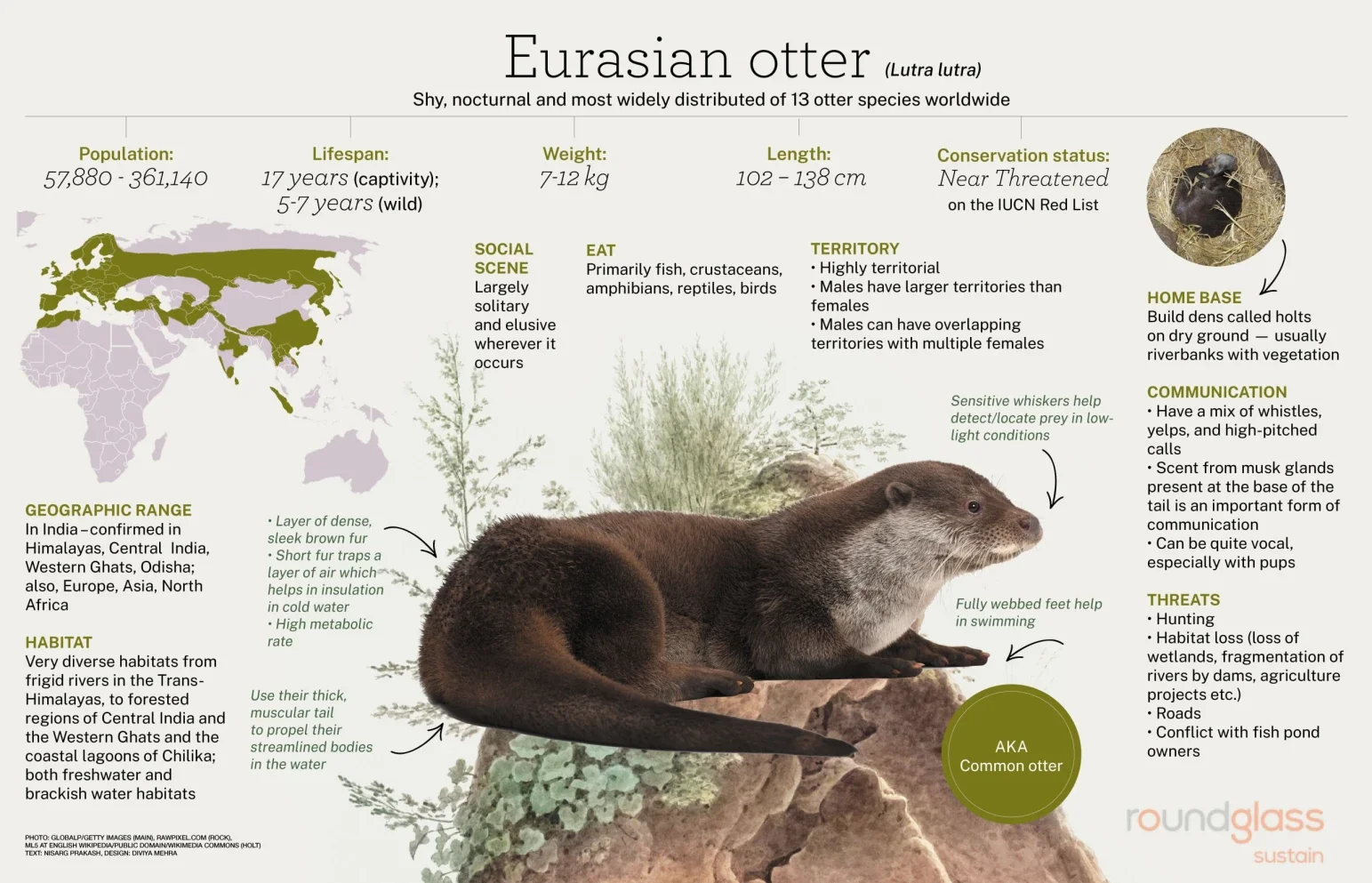
- About: The Eurasian Otter (Lutra lutra), also known as the European or common otter, belongs to the genus Lutra, and family Mustelidae (weasel family).
- Physical Profile: They possess a streamlined body, webbed feet, powerful tail for propulsion, and prominent whiskers (vibrissae) to detect prey underwater. Males are generally larger than females.
- Diet: Primarily carnivorous, with fish comprising approximately 80% of their diet (e.g., eels, salmonids). They also consume amphibians, crustaceans, waterbirds, small mammals, reptiles, insects, and eggs.
- Behaviour: They are generally solitary, territorial, and mostly active at night (nocturnal) or during twilight (crepuscular). They build dens known as holts near water bodies.
- Ecological Significance: As an apex predator of freshwater ecosystems, the otter is a keystone species and a bio-indicator of aquatic health. Its presence signifies clean water, stable prey populations, and functional riparian habitats.
- Conservation Status:
- IUCN Red List: Near Threatened (globally)
- CITES: Appendix I
- Wildlife (Protection) Act, 1972: Schedule II
- Other Otter Species in India: India is home to 3 otter species. Besides the Eurasian Otter (found in the Himalayas, northeast India, and Western Ghats), the other two are the Smooth-coated Otter (found throughout India) and the Small-clawed Otter (found in the Himalayas and southern India).
| Read More: Smooth-coated Otters |