
Durand Line Dispute | 06 Mar 2026
Why in News?
The historically disputed Durand Line has recently witnessed frequent clashes between Afghan Taliban forces and Pakistani troops over border fencing, the presence of Tehrik-i-Taliban Pakistan (TTP), and deportation of Afghan refugees.
- The tensions have escalated into direct military confrontation, including a cross-border retaliatory operation by Pakistan called “Ghazab Lil Haq.”
What is the Durand Line?
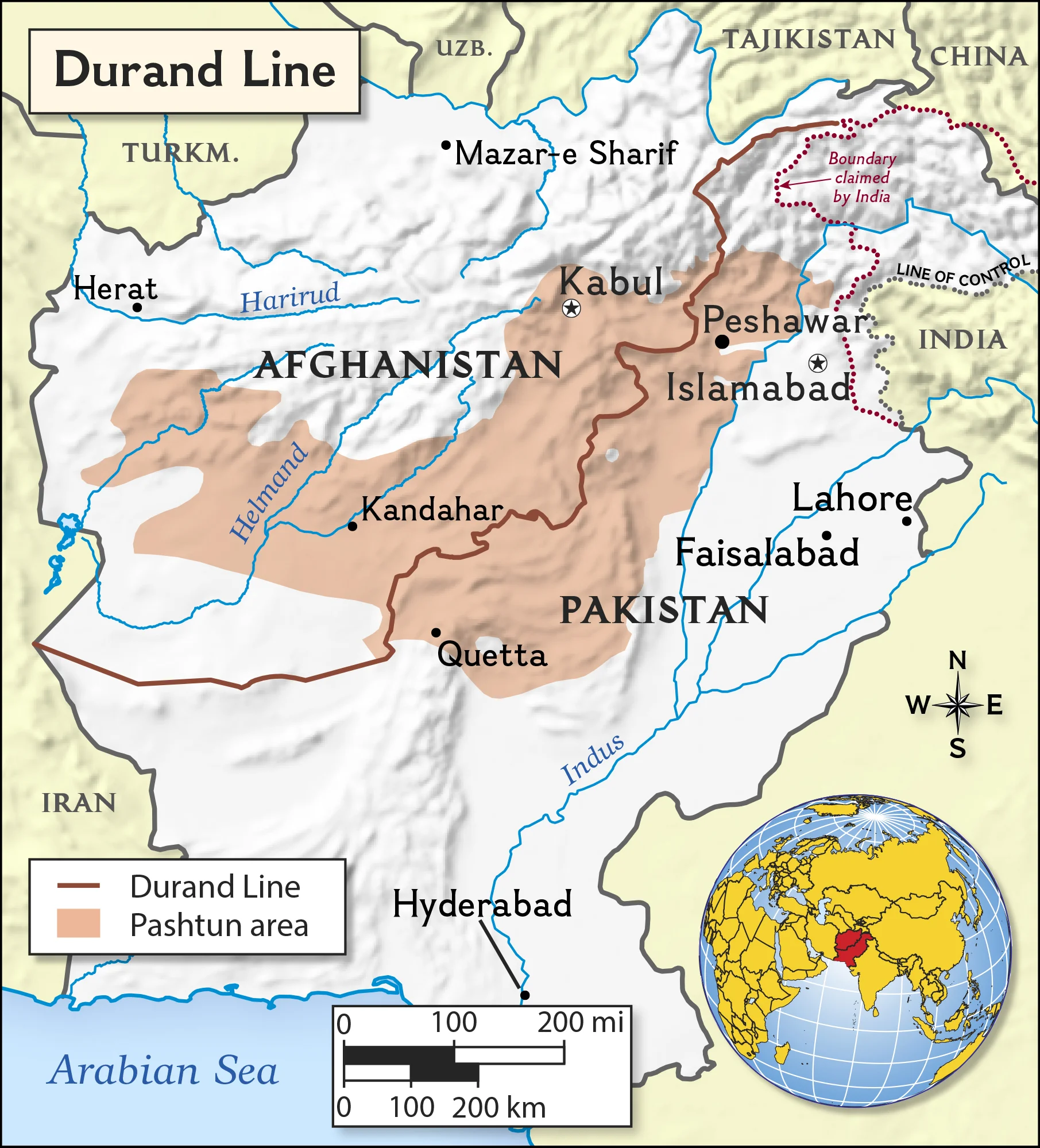
- Background: The Durand Line is a 2,640-kilometer (1,640-mile) porous border separating Pakistan and Afghanistan.
- Stretching from the Karakoram Range near China in the northeast down to the Registan Desert near Iran in the southwest, the boundary passes through vital geographic and strategic features, including the Khyber Pass and the Spīn Ghar (White Mountains).
- Origin: It was established in 1893 through an agreement between Sir Mortimer Durand, a British colonial administrator, and Abdur Rahman Khan, the then Emir of Afghanistan.
- Purpose: It was originally designed to demarcate the spheres of influence between British India and the Afghan Emirate, serving as a buffer zone against the Russian Empire during the "Great Game."
- Anglo-Afghan Wars: Afghanistan became strategically vital during the 1800s as Russia and the British Empire vied for influence in Central Asia.
- The British invaded Afghanistan in 1839, but were pushed back during the First Anglo-Afghan War.
- They invaded again in 1878, won the Second Anglo-Afghan War, and secured the Treaty of Gandamak (1879), which gave them control over Afghanistan’s foreign policy.
- In 1893, Sir Henry Mortimer Durand and Emir Abdur Rahman Khan agreed to create the Durand Line.
- It split the Pashtun tribal areas, placed Balochistan under British India, and established the Wakhan Corridor as a buffer between Russia and Britain.
- The Third Anglo-Afghan War (1919) ended with the Treaty of Rawalpindi, which restored Afghanistan’s control over its foreign affairs and reaffirmed the Durand Line.
- The British invaded Afghanistan in 1839, but were pushed back during the First Anglo-Afghan War.
- Post-1947 Inheritance: After the partition of India in 1947, Pakistan inherited this border.
- However, Afghanistan has historically refused to recognize it as an international boundary.
What are the Core Reasons for the Disputes Around Durand Line?
- Non-Recognition and the Pashtun Issue: The line arbitrarily divides the ethnic Pashtun and Baloch tribes, separating families, lands, and traditional migratory routes.
- Afghanistan has historically harbored irredentist claims, often advocating for a unified "Pashtunistan."
- Unilateral Border Fencing by Pakistan: To curb cross-border terrorism, smuggling, and unregulated movement, Pakistan initiated a massive project to fence the Durand Line in 2017.
- The Afghan Taliban view this fencing as a hostile act that formalizes an illegitimate border and physically divides the Pashtun community. Afghan forces have frequently uprooted fences, leading to deadly skirmishes.
- The TTP Factor (Tehrik-i-Taliban Pakistan): Pakistan accuses the Afghan Taliban of providing safe havens to the TTP, an umbrella militant organization carrying out deadly attacks inside Pakistan.
- The ideological synergy between the Afghan Taliban and the TTP means Kabul has been reluctant to take decisive military action against the group, frustrating Islamabad.
- Trade and Transit Chokepoints: Pakistan frequently closes key border crossings like Torkham and Chaman-Spin Boldak as a pressure tactic.
- Since Afghanistan is a landlocked country heavily reliant on Pakistani ports for international trade, this causes immense economic pain and further sours bilateral relations.
What are the Implications of the Durand Line Dispute for India?
- Collapse of Pakistan’s Strategic Depth Doctrine: Rising Pakistan–Afghanistan tensions and cross-border clashes weaken Pakistan’s long-standing strategy of using the Afghan Taliban as a buffer against India, reinforcing India’s claim that supporting militant proxies backfires.
- Two-Front Challenge for Pakistan: Increased militarization along the Durand Line forces Pakistan to divert military and intelligence resources to its western border, potentially reducing pressure on India’s western front.
- Greater Diplomatic Space for India: Strained Pakistan–Taliban relations open opportunities for India to expand diplomatic outreach, humanitarian aid, and engagement with Afghanistan.
- Rise of Transnational Terrorism: Border instability could strengthen groups like Islamic State Khorasan Province (ISKP) and TTP, increasing risks of regional terrorism and radicalization.
Conclusion
The Durand Line dispute is reshaping South Asian geopolitics. While it may reduce Pakistan’s strategic leverage against India, regional instability and militant expansion remain major risks, requiring India to protect its borders and safeguard connectivity projects in Central Asia.
|
Drishti Mains Question: The Durand Line remains one of the most contested colonial borders in South Asia. Examine the historical roots and contemporary implications of this dispute. |
Frequently Asked Questions (FAQs)
1. What is the Durand Line?
The Durand Line is a 2,640 km border between Pakistan and Afghanistan, established in 1893 by Sir Mortimer Durand and Afghan Emir Abdur Rahman Khan to demarcate British India and Afghanistan.
1. Why does Afghanistan not recognize the Durand Line?
Afghanistan argues that the line arbitrarily divided Pashtun and Baloch tribal communities, leading to long-standing demands for Pashtunistan.
2. What role does Tehrik-i-Taliban Pakistan (TTP) play in the dispute?
TTP militants operate from Afghan territory and carry out attacks in Pakistan, causing Islamabad to accuse the Afghan Taliban of providing safe havens.
3. Why did Pakistan begin fencing the Durand Line?
Pakistan started border fencing in 2017 to curb terrorism, smuggling, and illegal crossings, but the Afghan Taliban oppose it, calling the border illegitimate.
UPSC Civil Services Examination, Previous Year Questions (PYQs)
Prelims
Q. Consider the following countries:(2022)
- Azerbaijan
- Kyrgyzstan
- Tajikistan
- Turkmenistan
- Uzbekistan
Which of the above have borders with Afghanistan?
(a) 1, 2 and 5 only
(b) 1, 2, 3 and 4 only
(c) 3, 4 and 5 only
(d) 1, 2, 3, 4 and 5
Ans: (c)