
Dulhasti Stage-II Project | 29 Dec 2025
Why in News?
The Ministry of Environment, Forest and Climate Change (MoEF&CC)’s Expert Appraisal Committee (EAC) has recommended an environmental clearance for the Dulhasti Stage-II hydropower project.
Summary
- The EAC has recommended clearing the 260 MW Dulhasti Stage-II hydropower project on the Chenab River.
- Strategically, it utilizes existing infrastructure and advances India’s energy security under the suspended Indus Waters Treaty
What is Dulhasti Stage-II Run-of-the-river Hydropower Project?
- Location & Capacity: It is a 260 MW (2x130 MW) underground powerhouse project on the Chenab River in the Kishtwar District of Jammu & Kashmir.
- Design & Function: It is a run-of-the-river (ROR) project. Dulhasti-II will use the existing infrastructure of Stage-I and draw Marusudar River water (a tributary of the Chenab) via the Pakal Dul Hydroelectric Project into the Dulhasti reservoir. The 390 MW Dulhasti-I, a run-of-the-river project, was commissioned in 2007.
- The Pakal Dul Hydroelectric Project is a 1,000 MW ROR hydroelectric project under construction on the Marusudar River. It features a 167-meter-tall concrete-face rockfill dam, the tallest in the Indus River system in India.
- A ROR uses the natural flow and elevation drop of a river to produce electricity without creating a large reservoir for water storage.
- Strategic Significance: The project gained momentum after the suspension of the Indus Water Treaty (IWT), 1960, following the Pahalgam terror attack.
- It will add to the cascade of hydropower projects on the Chenab River, which already includes operational plants (Dulhasti-I (390-MW, Kishtwar), Baglihar (890-MW, Ramban), Salal (Reasi)) and several under-construction projects (Ratle (850MW), Kiru (624 MW), Kwar (540 MW)).
What is the Expert Appraisal Committee (EAC) of MoEF&CC?
- About: The Expert Appraisal Committee (EAC) is a multi-disciplinary, sector-specific committee constituted by the Central Government under the Environment Impact Assessment (EIA) Notification, 2006.
- Primary Role: It is a recommendatory body responsible for the screening, scoping, and detailed appraisal of industrial and infrastructure projects requiring environmental clearance under the EIA law.
- Sectoral Structure: There are nine EACs at the central level, each dedicated to appraising specific project categories, such as River valley and hydro-electric projects (RVHEP), Thermal & coal mining, Nuclear, strategic & defence projects etc.
- Composition & Tenure: Each EAC comprises up to 15 subject matter experts selected based on prescribed qualifications. Committees are reconstituted every three years (with a possible one-year extension).
- Decision-Making: The EAC operates on consensus and collective responsibility. Its final recommendation is submitted to the Ministry of Environment, Forest and Climate Change (MoEFCC), which takes the final decision on granting or denying environmental clearance.
Indus Waters Treaty
- About: The Indus Waters Treaty (IWT) is a bilateral water-sharing pact between India and Pakistan, brokered by the World Bank and signed in 1960.
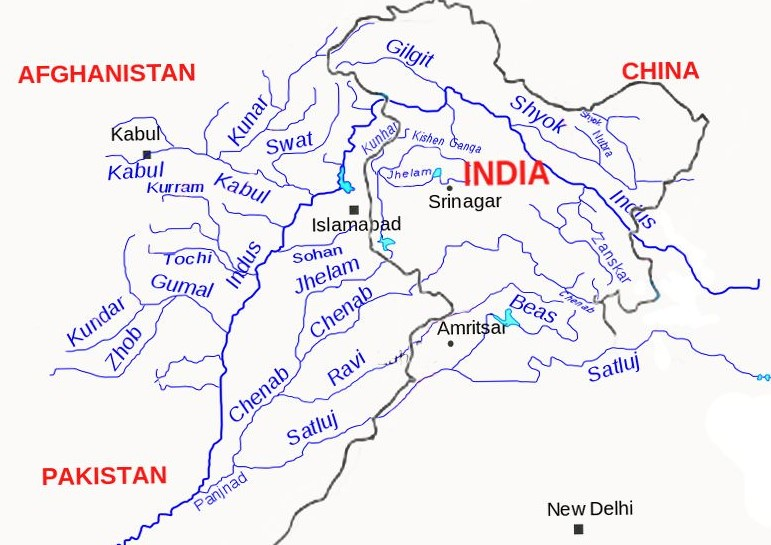
- It governs the distribution and utilization of the waters of the Indus River and its five major tributaries—the Sutlej, Beas, Ravi, Jhelum, and Chenab.
- Water Allocation: The treaty assigns India full control over the three eastern rivers (Ravi, Beas, and Sutlej). Pakistan is allocated the three western rivers (Indus, Jhelum,and Chenab).
- India is permitted limited use of the western rivers for specified domestic, non-consumptive, agricultural, and hydroelectric purposes, subject to defined conditions.
- Overall, Pakistan receives about 80% of the water from the Indus River system, while India receives around 20%.
- Permanent Indus Commission (PIC): The treaty establishes a Permanent Indus Commission (PIC), comprising commissioners from both nations. The PIC is required to meet at least once annually to oversee the treaty’s implementation and address routine issues.
- Dispute Resolution Process (Article IX):
- First Level: Disputes or questions regarding interpretation or implementation are to be resolved through discussions within the PIC.
- Second Level: If unresolved by the PIC, either Commissioner may request the World Bank to appoint a Neutral Expert.
- Third Level: If the issue is deemed a "dispute" or falls outside the Neutral Expert's mandate, either party may seek the establishment of a Court of Arbitration by the World Bank.
Chenab
- About: Chenab is a transboundary river in the Indus system, spanning India and Pakistan.
- It originates in the upper Himalayas of Himachal Pradesh (Baralacha Pass in Lahaul) as the Chandrabhaga, formed by the confluence of the Chandra and Bhaga rivers.
- Key Tributaries: Major tributaries are the Marusudar (largest), Miyar Nalla, Bhut Nalla, Kalnai, Ans, Tawi, and Neeru rivers.
- Course & Flow: The river flows northwest through Jammu & Kashmir’s districts of Kishtwar, Doda, Ramban, and Reasi, carving deep gorges, before entering Pakistan’s Punjab plains, where it joins the Sutlej to form the Panjnad, which then merges with the Indus.
Frequently Asked Questions (FAQs)
1. What is the Expert Appraisal Committee (EAC)?
The EAC is a sector-specific recommendatory body that appraises projects for environmental clearance under the EIA Notification, 2006, based on expert consensus.
2. What type of project is Dulhasti Stage-II?
It is a 260 MW run-of-the-river hydropower project on the Chenab River in Jammu and Kashmir.
3. How does the Indus Waters Treaty (1960) allocate river waters between India and Pakistan?
The IWT allocates the three Eastern Rivers (Ravi, Beas, Sutlej) to India and the three Western Rivers (Indus, Jhelum, Chenab) to Pakistan.
UPSC Civil Services Examination, Previous Year Question (PYQ)
Q. With reference to the Indus river system, of the following four rivers, three of them pour into one of them which joins the Indus directly. Among the following, which one is such a river that joins the Indus direct? (2021)
(a) Chenab
(b) Jhelum
(c) Ravi
(d) Sutlej
Ans: (d)
Q. Consider the following pairs (2019)
|
Glacier |
River |
|
1. Bandarpunch |
Yamuna |
|
2. Bara Shigri |
Chenab |
|
3. Milam |
Mandakini |
|
4. Siachen |
Nubra |
|
5. Zemu |
Manas |
Which of the pairs given above are correctly matched?
(a) 1, 2 and 4
(b) 1, 3 and 4
(c) 2 and 5
(d) 3 and 5
Ans: (a)