
Dugong | 24 Jan 2026
The Expert Appraisal Committee (EAC) of the Union Ministry of Environment, Forest and Climate Change (MoEFCC) has recommended a major design overhaul of the proposed International Dugong Conservation Centre in Manora, Thanjavur (Tamil Nadu).
- The proposed centre is located within the Coastal Regulation Zone (CRZ)-III No Development Zone and overlapping CRZ-I areas containing mangroves and seagrass meadows.
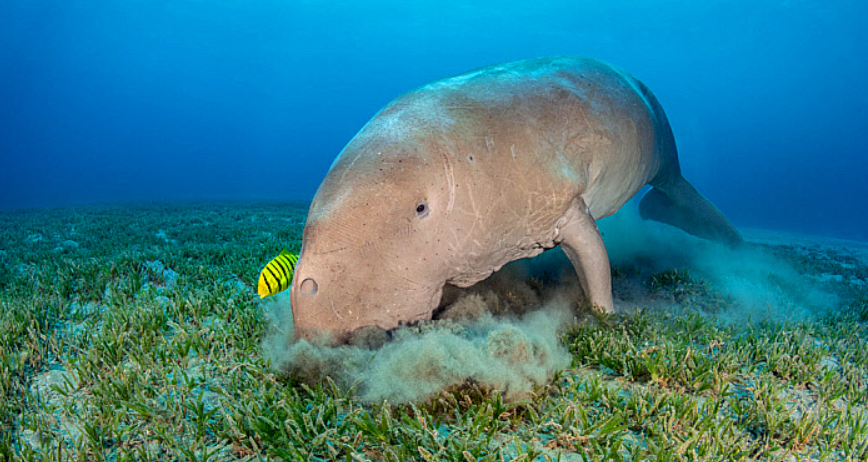
Dugong
- About: The dugong is a large marine mammal featuring a dolphin-like tail, and can grow up to 10 feet in length and weigh around 420 kg. They are also called sea cows and farmers of the sea.
- Habitat & Diet: They are strictly herbivorous, feeding primarily on seagrass meadows, living in shallow, warm coastal waters (<10m depth) like bays and lagoons.
- Indian Distribution: Found in the Gulf of Kutch, Gulf of Mannar–Palk Bay, and Andaman and Nicobar Islands.
- Behaviour & Reproduction: They are long-lived (up to 70 years), typically solitary or in small pairs. They have a slow reproductive cycle, reaching maturity at 9–10 years and giving birth only every 3–5 years.
- Conservation Status: Listed as Vulnerable on the IUCN Red List, protected under Appendix I of CITES (banning international trade), and under Schedule I of the Wildlife (Protection) Act, 1972.
Seagrass
- Seagrass is an underwater flowering plant and vital wetland ecosystem that stabilizes the seafloor, supports fisheries, sequesters carbon, and shelters marine life.
- India’s largest meadows, found in the Gulf of Mannar and Palk Bay (Tamil Nadu), host its highest diversity with over 13 species, while populations in Lakshadweep, Kachchh, Andhra Pradesh, and Odisha are limited and increasingly threatened.
| Read More: Threat to Dugong Population in India |