
DHRUVA Framework | 10 Dec 2025
Why in News?
The Department of Posts has prepared a draft of proposed amendments to the Post Office Act, 2023 to provide the necessary legislative backing for the Digital Hub for Reference and Unique Virtual Address (DHRUVA) framework.
- The amendments aim to support DHRUVA’s ecosystem reforms and enable its nationwide rollout.
What is the DHRUVA Framework?
- DHRUVA: It is proposed as a Digital Public Infrastructure (DPI), similar to Aadhaar and Unified Payments Interface (UPI).
- It will allow logistics companies, e-commerce firms, and gig platforms to receive a user’s digital address “label” instead of a full physical address.
- Once the user authorises this label, the platform can access both the descriptive address and the geo-coded DIGIPIN (Digital Postal Index Number).
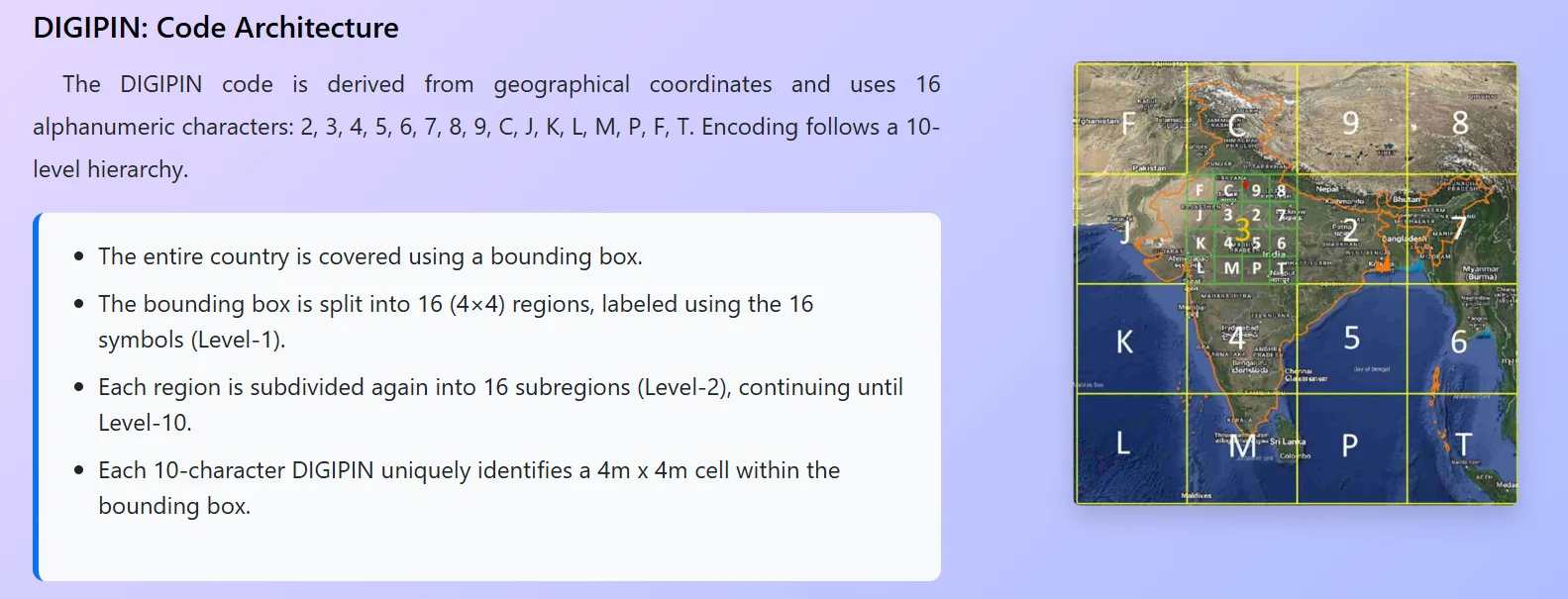
- DIGPIN is an open-source, in-house location pin system developed by India Post, assigning a unique code to every 12 sq. metre block in the country.
- DIGIPIN uses a 10-digit alphanumeric code derived from latitude–longitude coordinates. It divides India into a grid using 16 unique characters (2 to 9, C, J, K, L, M, P, F, T), enabling a hierarchical and precise location encoding system.
- It is especially useful in rural areas where clear descriptive addresses may be unavailable, providing delivery personnel with precise geo-location as a fallback alongside the traditional PIN code.
- DHRUVA’s Ecosystem: DHRUVA proposes the creation of specialised institutions:
- Address Service Providers (ASPs): Generate the digital address labels.
- Address Validation Agencies (AVAs): Verify and authenticate addresses.
- Address Information Agents (AIAs): Allow users to manage consent and address-sharing settings.
- A Central Governance Entity: Similar to National Payments Corporation of India, to regulate standards and operations.
- Significance of DHRUVA:
- Enhances User Control and Privacy: Introduces consent-based address sharing, allowing users to decide who can access their address and for what duration.
- This reduces repeated disclosure of personal address information while ensuring secure and controlled data sharing.
- Boosts Efficiency for Digital and Delivery Platforms: A single, verified digital address token streamlines operations for platforms like Amazon, Uber, and India Post.
- It reduces delivery failures, returns, and misrouting, improving overall efficiency and reducing operational costs.
- Seamless Address Updates: When users relocate, DHRUVA allows address updates to be reflected across multiple platforms automatically.
- This ensures continuity in deliveries, communication, and service access without repeated manual updates.
- Enhances User Control and Privacy: Introduces consent-based address sharing, allowing users to decide who can access their address and for what duration.
Frequently Asked Questions (FAQs)
Q. What is DHRUVA?
DHRUVA (Digital Hub for Reference and Unique Virtual Address) is a proposed Digital Public Infrastructure that issues tokenised digital address labels linked to a user’s descriptive address and geo-coded DIGIPIN for standardised, consent-based address sharing.
Q. What is DIGIPIN and how does it work?
DIGIPIN is a 10-digit alphanumeric, open-source geocode developed by India Post that assigns a unique code to every 12 sq. metre block using a 16-character grid derived from latitude–longitude coordinates.
Q. How does DHRUVA protect user privacy?
DHRUVA proposes consent-based address sharing and tokenisation, enabling users to control who accesses their descriptive address and DIGIPIN and for what duration, thereby reducing repeated disclosure of personal address information.
Summary
- The Department of Posts has proposed DHRUVA, a Digital Public Infrastructure to standardise addresses through digital “labels” backed by amendments to the Post Office Act, 2023.
- DHRUVA links a user-authorised digital label with the descriptive address and the geo-coded DIGIPIN, a 10-digit alphanumeric code mapped to every 12 sq. metre block.
- The ecosystem will include Address Service Providers, Validation Agencies, Information Agents and a central governance body similar to NPCI.
- The framework enhances privacy, improves last-mile delivery, and enables seamless address updates across platforms while reducing operational inefficiencies.
UPSC Civil Services Examination, Previous Year Questions (PYQs)
Prelims
Q. Consider the following statements: (2018)
- Aadhaar card can be used as a proof of citizenship or domicile.
- Once issued, Aadhaar number cannot be deactivated or omitted by the Issuing Authority.
Which of the statements given above is/are correct?
(a) 1 only
(b) 2 only
(c) Both 1 and 2
(d) Neither 1 nor 2
Ans: (d)