
Corruption Perception Index 2025 | 16 Feb 2026
For Prelims: Corruption Perception Index (CPI), Corruption, Political Financing, NGO, Rule of Law, Parliament, Regressive Tax, Parliamentary Scrutiny, Money Laundering.
For Mains: Key findings of the Corruption Perception Index (CPI) 2025, causes and consequences of corruption. Recommendations suggested in the CPI 2025 to curb corruption.
Why in News?
The Transparency International released the Corruption Perception Index (CPI) 2025 that evaluated 182 countries based on perceived public sector corruption, using a scale from zero (highly corrupt) to 100 (very clean).
- The report provides a comprehensive assessment of global corruption trends, their underlying drivers, societal impacts, and actionable recommendations.
Summary
- Global average CPI dropped to 42, with 122 countries scoring below 50, indicating widespread corruption.
- Democracies score higher (71 average) than authoritarian regimes (32), proving institutional strength controls corruption.
- Recommendations focus on independent judiciaries, political transparency, civic space protection, and international cooperation against illicit financial flows.
What are the Key Findings of the Corruption Perception Index (CPI) 2025?
- Global Average Decline: For the first time in more than a decade, the global CPI average has dropped to just 42 out of 100. The vast majority of countries (122 out of 182) score below 50, indicating serious corruption problems worldwide.
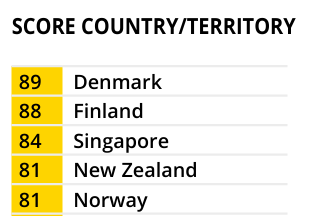
- Shrinking High Performers: The number of countries scoring above 80 has shrunk from 12 a decade ago to just 5 this year (Denmark, Finland, Singapore, New Zealand, Norway).
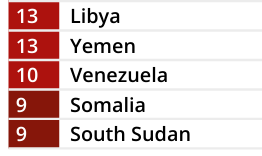
- Top and Bottom Performers: Denmark (Score - 89) ranks highest for the 8th consecutive time, while Somalia and South Sudan (9) are at the bottom. Venezuela (10) and other conflict-affected or repressive regimes populate the lowest tiers.
- India’s Position: In 2025, India ranked 91st on the Corruption Perceptions Index (CPI) with a score of 39/100, improving slightly from its 96th rank in 2024.
- India (score 39, rank 91) outperforms most South Asian neighbors but lags behind Bhutan (71, 18), and China (43, 76).
- India is tied with the Maldives (39, 91). Others rank lower: Sri Lanka (35, 107), Nepal (34, 109), Pakistan (28, 136), Bangladesh (24, 150), with Afghanistan and Myanmar (16, 169).
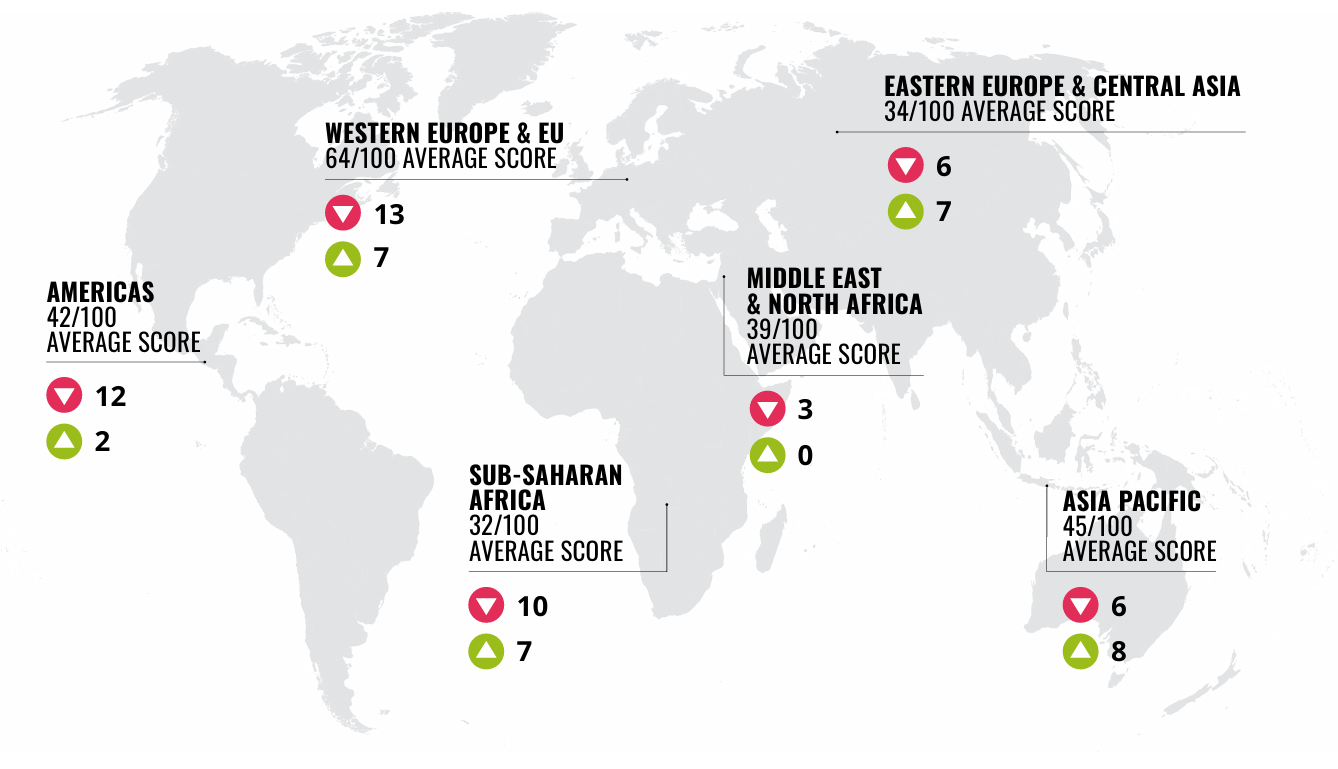
- Regional Averages: Full democracies average 71, flawed democracies average 47, and authoritarian regimes average just 32, demonstrating the strong correlation between democratic institutions and corruption control.
What are the Causes of Corruption Identified in the Report?
- Weak Justice and Rule of Law: Politicisation of judicial appointments, prosecutorial interference, under-resourcing, and lack of independence create impunity. When justice systems are captured, laws protect the powerful rather than the public.
- Undue Influence on Political Decision-Making: Opaque political financing, unregulated lobbying, conflicts of interest, and the influence of wealthy donors or cronies allow private interests to seize public authority. This leads to “grand corruption” and state capture, where institutions serve elite interests.
- Shrinking Civic Space and Media Freedom: Restrictive NGO laws, smear campaigns, surveillance, censorship, and violence against journalists (829 journalists killed globally since 2012, many while investigating corruption) silence watchdogs. Reduced transparency and accountability enable corruption to flourish.
- Failures in Public Financial Management: Lack of oversight in budgeting, procurement, and debt management, combined with patronage networks, diverts public funds and creates opportunities for bribery and favouritism.
What are the Consequences of Corruption?
- Erosion of Justice and Human Rights: Impunity undermines the rule of law, denies remedies to victims (especially marginalised communities), and increases barriers to accessing justice, creating a vicious cycle of further corruption.
- Democratic Decline and State Capture: Corruption weakens elections, parliaments, and oversight institutions, leading to policy capture, reduced public trust, and political polarisation. It enables authoritarian tendencies and makes democratic reversal difficult.
- Suppression of Civic Space and Media: Attacks on journalists and civil society reduce accountability, foster self-censorship, and allow corruption to remain hidden. This disproportionately affects investigative reporting on high-level graft.
- Deterioration of Public Services and Rising Inequality: Diverted funds result in poor-quality healthcare, education, infrastructure, and essential services. Unofficial payments act as a regressive tax on the poor, exclude vulnerable groups, and exacerbate poverty, fiscal crises, and social unrest (e.g., Gen-Z-led protests that toppled governments in Nepal and Madagascar in 2025).
- Broader Societal and Economic Impacts: Corruption contributes to economic instability, deters investment, worsens climate vulnerability (e.g., stolen adaptation funds), and fuels public discontent. In extreme cases, it leads to state fragility and conflict
Transparency International
- About: Transparency International (TI) is a premier global civil society organization dedicated to combating corruption by promoting transparency, accountability, and integrity across government, business, and civil society worldwide.
- It was founded in 1993 and headquartered in Berlin, Germany.
- Core Mission: The organization envisions a world free from corruption, which it defines as "the abuse of entrusted power for private gain." Its work spans government, business, civil society, and daily life.
- Flagship Publication: The organization is best known for its annual Corruption Perceptions Index (CPI). It also produces the Global Corruption Barometer.
What Recommendations are Suggested in the CPI 2025 to Curb Corruption?
- Independent, and Transparent Justice Institutions: Shield judicial appointments from political interference, adequately resource justice systems, and enable victims of corruption (including communities) to seek remedies through civil society representation.
- Tackle Undue Influence on Political Decision-Making: Regulate political financing with full transparency and caps on donations, disclose lobbying activities, and manage conflicts of interest to prevent policy capture and protect the public interest.
- Easy Access to Justice: Provide direct or representative legal pathways for individuals and communities affected by corruption, with tailored support for marginalised groups.
- Foster Civic Space and Anti-Corruption Reporting: Protect freedoms of expression, association, and information; safeguard journalists, whistleblowers, and NGOs; and remove barriers to domestic and international funding for civil society.
- Transparency and Oversight in Financial Management: Strengthen parliamentary scrutiny, independent audits, and regulatory oversight of public spending, borrowing, and procurement. Ensure inclusive participation in oversight mechanisms.
- Prevent, Detect, and Punish Corruption: Implement robust national and international enforcement, seize stolen assets, close cross-border money laundering channels, and foster multilateral cooperation to address transnational corruption.
Conclusion
The CPI 2025 reveals a troubling global corruption trend, with the average score dropping to 42 for the first time in a decade. Democratic backsliding, restricted civic space, and weak institutions drive this decline. Urgent implementation of transparent governance, independent judiciaries, and protected civil society is essential to reverse this trajectory.
|
Drishti Mains Question: What are the socio-economic consequences of corruption on public service delivery and inequality? |
Frequently Asked Questions (FAQs)
1. What is the Corruption Perceptions Index (CPI)?
The CPI is an annual index published by Transparency International that ranks countries by perceived levels of public sector corruption, using a scale of 0 (highly corrupt) to 100 (very clean).
2. What was India's rank and score in CPI 2025?
India ranked 91st with a score of 39 out of 100, showing slight improvement from its 96th rank in 2024.
3. Which countries topped and bottomed the CPI 2025?
Denmark (89) topped the index for the eighth consecutive year, while Somalia and South Sudan (9) were the lowest-ranked countries.
UPSC Civil Services Examination, Previous Year Questions (PYQs)
Prelims
Q1. With reference to the ‘Prohibition of Benami Property Transactions Act, 1988 (PBPT Act)’, consider the following statements: (2017)
- A property transaction is not treated as a benami transaction if the owner of the property is not aware of the transaction.
- Properties held benami are liable for confiscation by the Government.
- The Act provides for three authorities for investigations but does not provide for any appellate mechanism.
Which of the statements given above is/are correct?
(a) 1 only
(b) 2 only
(c) 1 and 3 only
(d) 2 and 3 only
Ans: (b)
Mains
Q. Discuss how emerging technologies and globalisation contribute to money laundering. Elaborate measures to tackle the problem of money laundering both at national and international levels. (2021)
Q. “Institutional quality is a crucial driver of economic performance”. In this context suggest reforms in the Civil Service for strengthening democracy. (2020)