
Commonwealth Conference of Speakers and Presiding Officers | 17 Jan 2026
Why in News?
The Prime Minister inaugurated the 28th Commonwealth Conference of Speakers and Presiding Officers (CSPOC) in the historic Central Hall (formerly Chamber of Princes) of Old Parliament.
- India hosts CSPOC after 16 years, previously in 1971, 1986, and 2010, reflecting its growing prominence in parliamentary diplomacy.
- CSPOC holds its main conference biennially (every two years), with a Standing Committee meeting in the intervening year. Its core objectives are to uphold impartiality in presiding officers, advance knowledge of parliamentary democracy, and strengthen parliamentary institutions.
What is the Commonwealth?
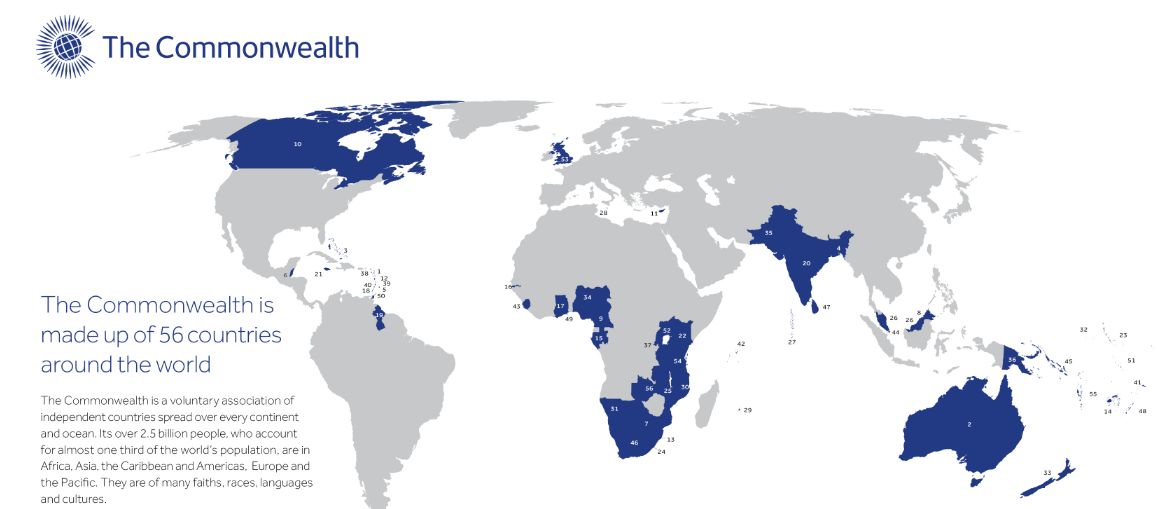
- About: It is a voluntary association of 56 independent and equal countries, primarily consisting of former territories of the British Empire.
- As of January 2026, 15 Commonwealth countries recognize King Charles III (who succeeded Queen Elizabeth II in 2022) as their head of state. E.g., Canada, New Zealand.
- Barbados removed Queen Elizabeth II as its head of state in 2021 and became a republic.
- Genesis: It evolved from the equality principles of the 1926 Imperial Conference (London) to the 1949 London Declaration, which established the modern Commonwealth by admitting republics and non-British monarchies. Gabon and Togo joined in 2022.
- India's Role: India is the largest member by population, the 4th largest financial contributor, and has hosted major events like the 1983 Commonwealth Summit and the 2010 Commonwealth Games in New Delhi. India will host the Commonwealth Games 2030.
- Values and Governance: It is guided by the Commonwealth Charter, promoting development, democracy, and peace, with the Commonwealth Secretariat in London supporting member states in achieving these goals.
Chamber of Princes
- Location: Located within the old Parliament House (Samvidhan Sadan). It is also known as Narendra Mandal and was later remodelled into the Library Hall.
- Establishment & Function: It was established in 1920 under the Government of India Act, 1919, as a British-created consultative body. It functioned from 1921 to 1947, allowing India's princely states to raise issues with the Crown through sittings presided over by the Viceroy.
- Post-Independence Role: It housed the Supreme Court of India from its inauguration on 28th January, 1950, until August 1958. Prior to that, the Federal Court of India had sat there from 1937 to 1950.
Frequently Asked Questions (FAQs)
1. What is the Commonwealth Conference of Speakers and Presiding Officers (CSPOC)?
The CSPOC is a biennial conference of parliamentary leaders to uphold impartiality in presiding officers and strengthen parliamentary democracy.
2. What was the historical significance of the 'Chamber of Princes'?
Established by the Government of India Act, 1919, it functioned from 1921 to 1947 as a consultative body for princely states with the British Crown. Post-independence, it housed the Federal Court (1937–1950) and the Supreme Court of India (1950–1958).
3. Describe the genesis of the modern Commonwealth of Nations.
The modern Commonwealth evolved from the 1926 Imperial Conference to the 1949 London Declaration, which admitted republics and non-British monarchies, transforming it into a voluntary association of independent states.
UPSC Civil Services Examination Previous Year Question (PYQ)
Q. Consider the following statements: (2010)
- The Commonwealth has no charter, treaty or constitution.
- All the territories/countries once under the British empire (jurisdiction/rule/mandate) automatically joined the Commonwealth as its members.
Which of the statements given above is/are correct?
(a) 1 only
(b) 2 only
(c) Both 1 and 2
(d) Neither 1 nor 2
Ans: (a)