
China’s Cenling County and India’s Objection | 13 Apr 2026
India has firmly rejected China’s attempts to assign “fictitious names” to places within its territory, especially in Arunachal Pradesh, asserting that such actions are baseless and unacceptable.
- The Ministry of External Affairs reiterated that these regions will always remain an integral part of India, while also stating that such actions undermine efforts to stabilise and normalise bilateral relations.
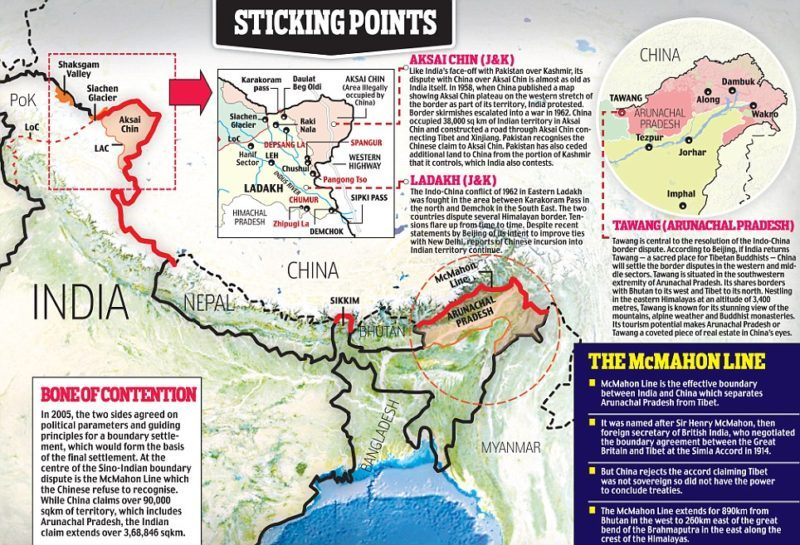
- Background: China has recently established a new county named “Cenling” in Xinjiang. It lies near the tri-junction region adjoining Afghanistan, Pakistan-occupied Kashmir, and India’s Arunachal Pradesh, close to the Karakoram range.
- It will be administered under the Kashgar prefecture, a strategic region on the ancient Silk Road and a key gateway for the China-Pakistan Economic Corridor (CPEC), which passes through PoK and is opposed by India.
- Pattern: This development reflects a continuing pattern, as China has created multiple such administrative units in recent years, including Hean and Hekang, against which India has formally protested.
- China’s Claim: China’s claims are rooted in its rejection of the boundary defined under the Simla Convention and the associated McMahon Line.
- It further justifies its position by citing historical and cultural linkages between Tawang monasteries and Lhasa.
- Objective: Renaming places and creating administrative units are seen as strategic tools used by China to reinforce territorial claims and exert pressure on India.
- Strategic Significance: This approach reflects a broader geopolitical pattern, similar to China’s conduct in the South China Sea, where symbolic actions are combined with economic and military strength to assert sovereignty.
| Read more: India Rejects China’s Claim Over Arunachal Pradesh |