
Capital Goods Sector | 11 Feb 2026
Prelims: Capital Goods, Public Capital Expenditure, Index of Industrial Production, PLI Scheme, Customs Duty, Lithium-Ion Batteries
Mains: Role of capital goods in industrial growth, Infrastructure-led development, Public investment and private investment crowding-in, Industrial policy and Energy transition
Why in News?
The Union Budget 2026–27 announced a major push to the capital goods sector through higher public capital expenditure, targeted manufacturing schemes, and tax and customs duty incentives.
Summary
- The Union Budget 2026–27 positions the capital goods sector as a core driver of infrastructure creation and manufacturing growth.
- Public capital expenditure is increased to ₹12.2 lakh crore, reinforcing investment-led economic expansion.
- New manufacturing schemes and fiscal incentives aim to build domestic capacity, reduce import dependence, and support long-term industrial competitiveness.
What Are the Key Announcements in the Union Budget 2026–27 for Strengthening the Capital Goods Sector?
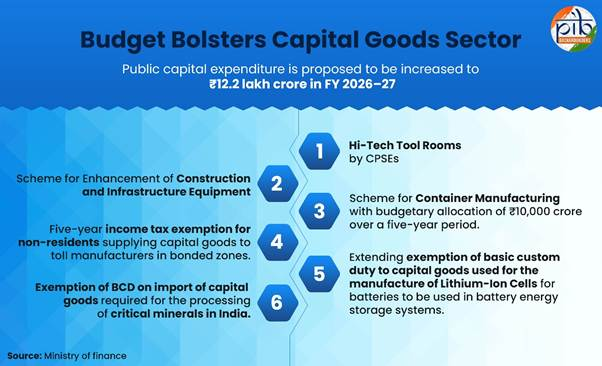
- Public Capital Expenditure: The Union Budget 2026–27 increases public capital expenditure to ₹12.2 lakh crore to accelerate infrastructure-led growth.
- Government capital outlay has risen 4.2 times from FY18 to FY26 (Budget Estimates), reflecting sustained policy focus on public investment.
- Higher public capex is expected to crowd in private investment and expand productive capacity across sectors.
- Manufacturing Capacity Enhancement: The budget proposes the establishment of Hi-Tech Tool Rooms by Central Public Sector Enterprises to support high-precision manufacturing.
- These facilities will provide digitally enabled design, testing, and manufacturing services at lower costs.
- A Scheme for Enhancement of Construction and Infrastructure Equipment is introduced to promote domestic manufacturing of advanced construction machinery.
- Container Manufacturing Scheme: The budget announces a ₹10,000 crore Container Manufacturing Scheme to be implemented over five years.
- The scheme aims to develop a globally competitive container manufacturing ecosystem in India.
- It is expected to strengthen logistics infrastructure and support export growth.
- Support to Toll Manufacturing and Electronics Manufacturing: The budget provides a five-year income tax exemption to non-resident entities supplying capital goods and equipment to toll manufacturers operating in bonded zones.
- Additional tax exemptions are extended to foreign suppliers supporting electronics manufacturing in bonded zones.
- These measures aim to reduce capital investment costs and promote electronics manufacturing in India up to the tax year 2030–31.
- Energy Transition and Critical Minerals: The budget extends customs duty exemptions on capital goods used for manufacturing lithium-ion cells for battery energy storage systems.
- It also exempts customs duty on capital goods required for processing critical minerals in India.
- These measures are intended to strengthen domestic value chains and support energy security and energy transition goals.
Capital Goods
- Capital goods include plant, machinery, and equipment used for production or service delivery, including for modernisation, technological upgradation, and capacity expansion.
- They are utilised across manufacturing, infrastructure, agriculture, mining, allied activities, and the services sector.
Significance of Capital Goods Sector
- High Economic Multiplier Effect: Public capital expenditure generates strong spillover effects across the economy, with studies estimating a multiplier of 2.5–3.5 times.
- Foundation of Manufacturing: Capital goods provide the machinery backbone for sectors such as automobiles, electronics, textiles, and heavy industry.
- Catalyst for Technological Upgradation: The sector enables diffusion of advanced technologies such as automation, robotics, AI, and IoT into the wider industrial ecosystem.
- Strategic Role: Capital goods are essential for renewable energy systems, EV batteries, and critical mineral processing.
- Employment and Skill Development Engine: Capital goods manufacturing is skill-intensive, generating employment across engineering, fabrication, and technical trades.
Initiatives for Capital Goods Sector
- Make in India: Promotes domestic manufacturing of capital goods to reduce import dependence and strengthen industrial self-reliance.
- National Capital Goods Policy, 2016: Provides a comprehensive roadmap to increase production, exports, and technological depth of the capital goods sector.
- Capital Goods Scheme: Phase I focused on addressing skill gaps, technology development, and industry–academia collaboration through shared facilities.
- Phase II expands the scope of Phase I by scaling up indigenous technology development, skilling, testing, and industry participation.
- Production Linked Incentive Schemes: PLI schemes boost demand for advanced capital goods by incentivising large-scale manufacturing in key sectors such as automobiles, batteries, and electronics.
What are the Challenges Faced by the Capital Goods Sector?
- Inverted Duty Structure: Higher import duties on raw materials than on finished capital goods raise domestic production costs, discouraging local value addition and making imports more competitive than indigenous manufacturing.
- Technology Gap and Low R&D Intensity: Limited domestic technological depth and low R&D expenditure constrain high-precision manufacturing, leading to dependence on imported advanced components and restricting movement up the value chain.
- High Logistics and Infrastructure Costs: Elevated logistics costs and inefficiencies in transport and ports increase delivery timelines and operational expenses, reducing global competitiveness—particularly for heavy and over-dimensional capital goods.
- Fragmented Industry Structure: Dominance of MSMEs limits economies of scale, access to affordable finance, and ability to invest in advanced testing, certification, and technology upgradation required for global markets.
- Dependence on Government Capex: Sectoral growth remains closely linked to public capital expenditure cycles, making it vulnerable to fiscal tightening.
What are the Measures Required to Strengthen the Capital Goods Sector?
- Expansion of Hi-Tech Tool Rooms and Shared Infrastructure: The government should strengthen and expand digitally enabled Hi-Tech Tool Rooms and Common Engineering Facility Centres to provide MSMEs access to high-precision “mother machinery.” This will enhance manufacturing quality, precision, and global competitiveness.
- Promotion of Indigenous Manufacturing of Advanced Machinery: Targeted schemes are needed to encourage domestic production of technologically advanced infrastructure and construction equipment such as tunnel-boring machines and heavy industrial systems, thereby reducing import dependence.
- Reduction in Cost of Capital: Fiscal incentives, tax exemptions, and easier access to credit should be provided to reduce the upfront capital burden on manufacturers and facilitate acquisition of advanced global technology.
- Strengthening R&D and Industry–Academia Collaboration: Greater investment in Centres of Excellence and innovation hubs is essential to develop import-substitute technologies, promote skill development, and enhance technological self-reliance.
- Development of Robust Logistics: Improving logistics infrastructure and promoting domestic container manufacturing will reduce transportation costs, enhance supply chain resilience, and improve overall cost competitiveness of the sector.
Conclusion
The Union Budget 2026–27 reinforces the capital goods sector as a pillar of India’s investment-led growth strategy. Sustained public capital expenditure, manufacturing incentives, and support for energy transition position the sector to drive long-term industrial and infrastructure development.
|
Drishti Mains Question “The capital goods sector is central to infrastructure creation and investment-led growth in India.” Comment. |
UPSC Civil Services Examination, Previous Year Question (PYQ)
Mains:
Q. Distinguish between Capital Budget and Revenue Budget. Explain the components of both these Budgets. (2021)
Q. The public expenditure management is a challenge to the Government of India in the context of budget-making during the post-liberalization period.(2019)