
BBNJ Agreement Enters Into Force | 20 Jan 2026
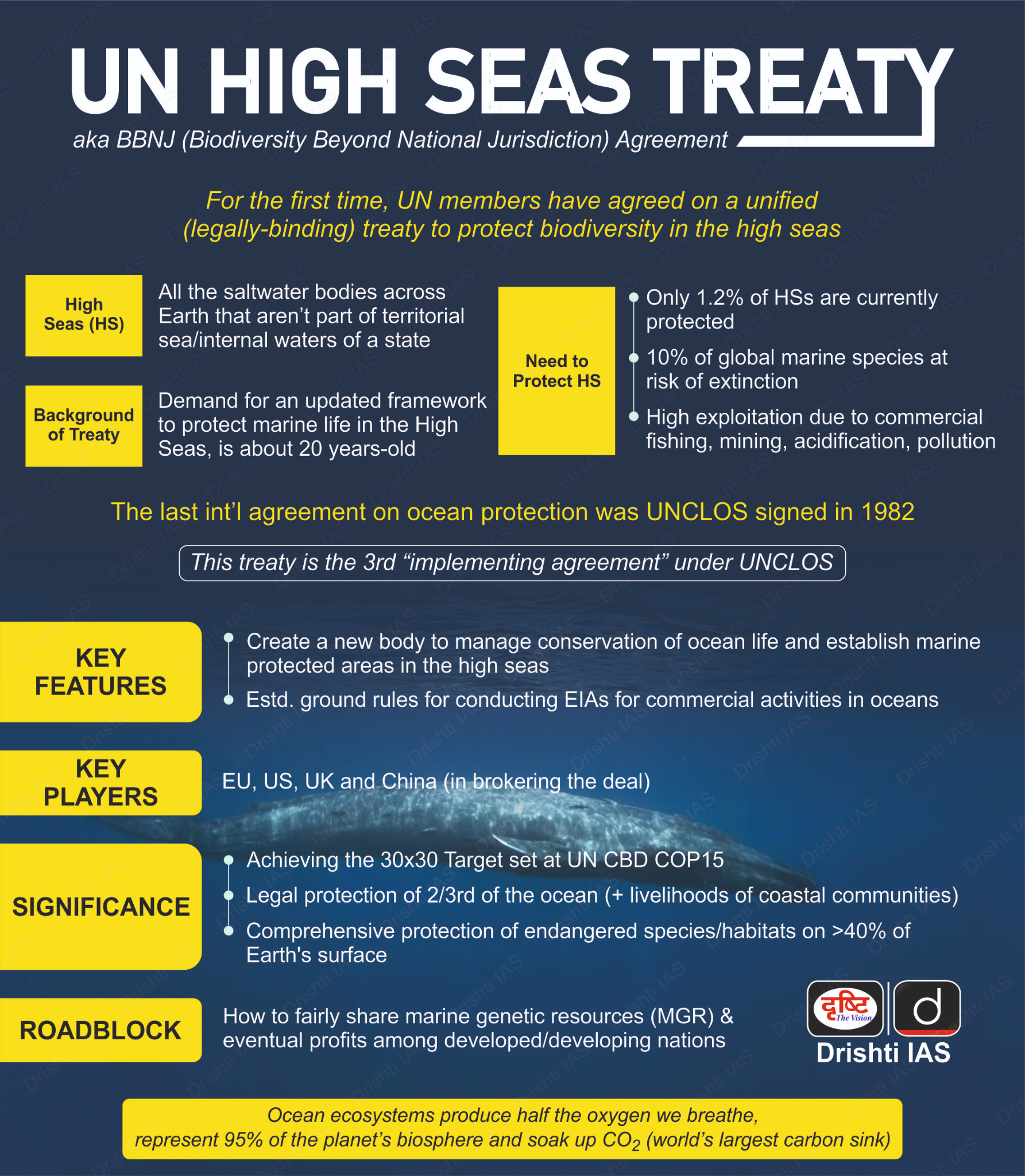
The Biodiversity Beyond National Jurisdiction (BBNJ) Agreement, the world’s first legally binding treaty to protect marine biodiversity in international waters, came into force on 17th January 2026 and is the first ocean treaty to ensure inclusive ocean governance, with provisions for Indigenous Peoples and local communities and gender balance.
- BBNJ Agreement: Agreement on Marine Biological Diversity of Areas Beyond National Jurisdiction (BBNJ Agreement), adopted under United Nations Convention on the Law of the Sea (UNCLOS), 1982.
- It applies to the high seas and the international seabed, i.e., ocean areas lying beyond national Exclusive Economic Zones (EEZs) and outside the control of any single country.
- The Agreement also establishes a funding mechanism and creates key institutional structures, including a Conference of the Parties (COP), subsidiary bodies, a Clearing-House Mechanism, and a secretariat.
- Adoption and Legal Status: The treaty was adopted in 2023 at the UN Headquarters in New York and entered into force 120 days after ratification by at least 60 countries, a threshold that has been crossed, with more than 80 countries having ratified it so far.
- Major economies such as China, Germany, Japan, France, and Brazil have ratified the treaty. However, like the US, India signed the agreement (in 2024), but its domestic ratification process remains pending.
- Four Pillars Of The BBNJ Agreement:
- Marine Genetic Resources (MGRs), including fair and equitable sharing of benefits.
- Area-Based Management Tools (ABMTs), such as Marine Protected Areas (MPAs).
- Environmental Impact Assessments (EIAs) for activities in the high seas
- Capacity-Building and Transfer of Marine Technology to developing countries.
- Significance: The BBNJ Agreement fills a long-standing governance gap by introducing legally binding rules for over two-thirds of the ocean’s surface, covering more than 90% of Earth’s living space by volume, and strengthening global ocean conservation under UNCLOS, often described as the constitution of the oceans.
- The agreement supports SDG 14 (Life Below Water) and contributes to addressing the triple planetary crisis of climate change, biodiversity loss, and pollution, by regulating human activities in ecologically sensitive international waters.
- The BBNJ Agreement is the third implementation agreement under UNCLOS, alongside the 1994 Part XI Implementation Agreement on international seabed mining and the 1995 UN Fish Stocks Agreement on straddling and highly migratory fish stocks.
| Read more: High Seas Treaty |