
Anti-Dumping Probe into Ethyl Chloroformate | 23 Mar 2026
Why in News?
The Directorate General of Trade Remedies (DGTR), under the Ministry of Commerce and Industry, has launched an anti-dumping investigation into the alleged dumping of ethyl chloroformate from China to protect the domestic chemical industry.
- In a related development, the DGTR has also opened a separate anti-dumping investigation into imports of hexamine, another chemical intermediate, from China, Russia, and the United Arab Emirates.
What is Ethyl Chloroformate?
- About: Ethyl chloroformate is a highly reactive organic compound. It is the ethyl ester of chloroformic acid and is primarily used as a versatile reagent in organic synthesis, particularly in the pharmaceutical and agrochemical industries.
- When it reacts with water (hydrolysis), it decomposes into ethanol, carbon dioxide, and hydrochloric acid.
- Key Applications:
- Synthesis of Pharmaceuticals: It is a critical intermediate in the production of various drugs, including modified penicillins and ore flotation agents.
- Industrial Use: It serves as a stabilizer for PVC and is used in the synthesis of agricultural chemicals like herbicides and insecticides.
- Activation of Carboxylic Acids: It reacts with carboxylic acids to form mixed anhydrides, which are highly reactive intermediates used to create esters or amides.
- Hazards:
- Toxicity: It is highly toxic by inhalation and harmful if swallowed. Short-term exposure can cause pulmonary edema (fluid in the lungs).
- Corrosivity: It is a strong lachrymator (causes severe eye watering) and causes acid-type burns to the skin, eyes, and mucous membranes.
- Flammability: It is a highly flammable liquid and can form explosive mixtures with air.
Hexamine is a white crystalline, highly soluble heterocyclic organic compound. It is produced from formaldehyde and ammonia and is widely used in making resins, plastics, pharmaceuticals, and rubber additives.
- It also serves as a fuel tablet (clean-burning) and has applications in medicine and organic chemistry, though it can be toxic and irritating.
What is Anti-Dumping Duty?
- About: Anti-Dumping Duty (ADD) is a protectionist tariff imposed by a government on foreign imports that it believes are priced below fair market value (a practice known as "dumping").
- There are also countervailing duties, which are imposed to neutralize the impact of subsidies provided by exporting countries, together ensuring a level playing field in international trade.
- Legal Basis: It is governed by the WTO’s Anti-Dumping Agreement. In India, it is administered by the Directorate General of Trade Remedies (DGTR) under the Ministry of Commerce, though the final decision regarding the imposition of duty recommended by the DGTR is taken by the Ministry of Finance.
- Under the WTO Agreement, a de minimis (minimum level) dumping margin limit of 2% of export price has been prescribed and no anti-dumping duty can be imposed if the dumping margin is below this threshold limit.
- This de minimis limit is the same for exports from developing as well as from developed countries.
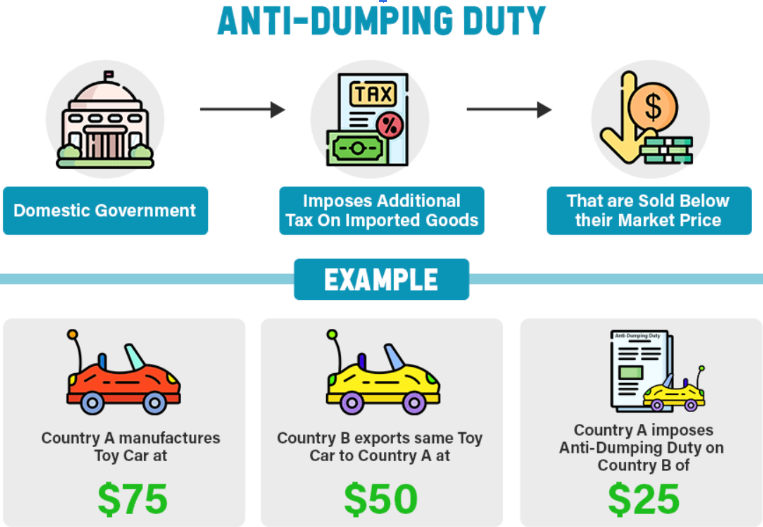
What is the Difference Between Anti-Dumping Duty and Countervailing Duty?
|
Feature |
Anti-Dumping Duty (ADD) |
Countervailing Duty (CVD) |
|
Target |
Unfair pricing by private companies. |
Unfair subsidies provided by foreign governments. |
|
Objective |
To offset the price differential and prevent "predatory pricing" that hurts local industry. |
To neutralize the unfair advantage gained through government financial assistance. |
|
WTO Agreement |
Governed by the Anti-Dumping Agreement. |
Governed by the Agreement on Subsidies and Countervailing Measures (SCM). |
|
Duty Calculation |
Equal to the margin of dumping (difference between normal value and export price, adjusted for comparability). The duty is capped at this margin. |
Equal to the amount of the subsidy attributable to the exported product (subsidy margin). The duty is capped at this amount. |
|
Investigation Requirements |
Requires demonstration of: (1) dumping, (2) material injury (or threat thereof) to the domestic industry, and (3) causal link between the two. |
Requires demonstration of: (1) existence of a specific subsidy, (2) material injury (or threat thereof), and (3) causal link. |
Frequently Asked Questions (FAQs)
1. What is the "de minimis" threshold in anti-dumping investigations?
It is a WTO-mandated 2% limit; if the dumping margin is below this percentage of the export price, no Anti-Dumping Duty can be legally imposed.
2. How does the primary cause of ADD differ from CVD?
ADD targets firm-level predatory pricing (selling below domestic cost), whereas CVD targets government-level subsidies that provide an unfair competitive advantage.
3. Which nodal agencies are involved in notifying trade remedial duties in India?
The DGTR (Ministry of Commerce) conducts the investigation and recommends the duty, but the Ministry of Finance is the final authority that imposes it.
4. Why is Ethyl Chloroformate significant for the Indian economy?
It serves as a vital organic intermediate for the pharmaceutical and agrochemical industries, making its pricing critical for drug and pesticide manufacturing costs.
UPSC Civil Services Examination, Previous Year Questions (PYQs)
Q. The terms ‘Agreement on Agriculture’, ‘Agreement on the Application of Sanitary and Phytosanitary Measures’ and ‘Peace Clause’ appear in the news frequently in the context of the affairs of the (2015)
(a) Food and Agriculture Organization
(b) United Nations Framework Conference on Climate Change
(c) World Trade Organization
(d) United Nations Environment Programme
Ans: C
Q. In the context of which of the following do you sometimes find the terms ‘amber box, blue box and green box’ in the news? (2016)
(a) WTO affairs
(b) SAARC affairs
(c) UNFCCC affairs
(d) India-EU negotiations on FTA
Ans: A