
ANEEL Fuel for Thorium-based Reactors | 04 Dec 2025
Why in News?
US‑based Clean Core Thorium Energy (CCTE) aims to bring a new thorium‑based nuclear fuel called Advanced Nuclear Energy for Enriched Life (ANEEL) to India’s reactors as a next-generation fuel suitable for India’s Pressurized Heavy Water Reactors (PHWRs).
What is Advanced Nuclear Energy for Enriched Life (ANEEL)?
- About: It is a unique blend of thorium and a small amount of enriched uranium (High Assay Low Enriched Uranium). It is specifically designed to power India's fleet of PHWRs and currently in the advanced stages of testing in the US.
- The fuel is named to honor Dr. Anil Kakodkar, one of India’s foremost nuclear scientists.
- Target Reactor: Designed as a drop-in fuel for PHWRs (like India’s indigenous reactors), it can operate within existing systems with only minimal adjustments.
- India currently has 22 operating reactors, 18 are PHWRs and 4 are Light Water Reactors (LWRs). Additionally, India is constructing 10 new PHWRs, each rated at 700 MW.
- Significance of ANEEL: The Levelized Cost of Electricity (LCOE) from India's natural uranium reactors is about Rs 6/kWh, and ANEEL fuel could cut this by 20–30%, boosting nuclear power competitiveness.
- It offers higher efficiency, better fuel performance, over 85% less nuclear waste, and uses thorium, which is abundantly available.
- Conditions Favouring ANEEL:
- Government Push: The 2024 budget outlined plans to partner with the private sector to develop Bharat Small Reactors (BSRs) and new nuclear technologies.
- Rising Demand: Nuclear capacity is projected to grow from 8.2 GW to 22 GW by 2032, creating huge demand for advanced fuel like ANEEL.
- Industrial Decarbonization: BSRs are envisioned to provide clean power for industries like steel, cement, and fertilizers.
- Powering New-Age Infrastructure: The boom in data centers and AI requires vast, reliable clean power, which small nuclear reactors can supply.
- Renewed Indo-US nuclear cooperation: A major obstacle in Indo-US nuclear cooperation was India’s Civil Liability for Nuclear Damage Act (2010), which held equipment suppliers responsible for accidents.
- CCTE says this is not a problem because it only supplies fuel technology, not reactors, and the fuel will be managed by India’s Department of Atomic Energy.
What is a Thorium-based Nuclear Reactor?
- About: It is a type of nuclear reactor that uses thorium (Th-232) as its primary fertile fuel material, as opposed to the conventional use of uranium (U-235) or plutonium (Pu-239).
- Thorium itself is not fissile (cannot sustain a chain reaction on its own), so it must be combined with a fissile "driver" material (like U-235, U-233, or plutonium) to initiate and sustain the nuclear reaction.
- Advantages:
- Abundance: Thorium is 3–4 times more abundant than uranium and widely available in India, Australia, and the USA.
- Energy Density: CERN notes that one ton of thorium can yield energy equivalent to 200 tons of enriched uranium while generating 100 times less nuclear waste.
- Inherent Safety Features: Thorium designs like Molten Salt Reactors (MSRs) operate at atmospheric pressure and use passive safety systems—e.g., a frozen salt plug melts during overheating, draining fuel into a cooling tank and stopping the reaction.
- Proliferation Resistance: The thorium cycle produces less long-lived weapon-grade transuranic waste; U-233 is contaminated with U-232, whose strong gamma radiation makes it detectable and hard to handle.
- India's Special Interest: India holds around 25% of the world’s thorium reserves and has a 3-stage nuclear program where thorium is a key component, aimed at achieving long-term energy independence.
India's 3-Stage Nuclear Power Program
- About: It is a strategy to develop nuclear energy by efficiently using India’s limited uranium and abundant thorium.
- Formulated by Dr. Homi Bhabha in the 1950s, it aims to meet India’s long-term energy needs and ensure self-reliance.
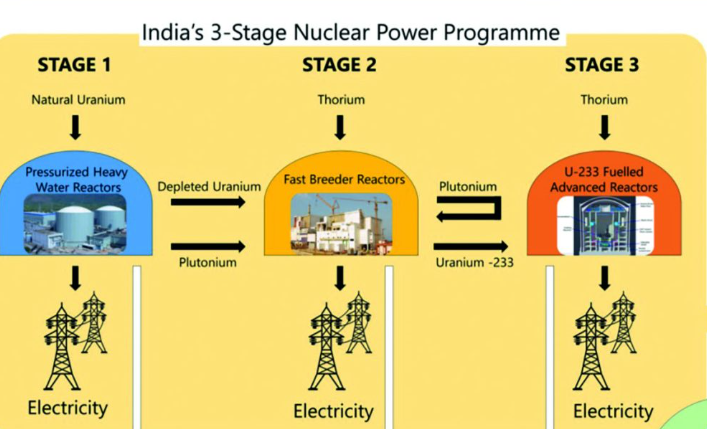
- 3-Stages: The strategy uses different reactors to transition to thorium-based power.
- Stage I: PHWRs use natural uranium (U-238) with heavy water; spent fuel is reprocessed to obtain plutonium.
- Stage II: Fast Breeder Reactors (FBRs) use plutonium from Stage I and breed U-233 from thorium.
- Stage III: Thorium-based reactors use U-233 and thorium, aiming to make U-233 India’s primary nuclear fuel.
Frequently Asked Questions (FAQs)
Q. What is ANEEL fuel?
ANEEL fuel is a thorium-enriched uranium fuel designed for India’s PHWRs, enhancing efficiency, safety, and reducing nuclear waste by over 85%.
Q. How does ANEEL fuel reduce electricity costs?
By increasing fuel efficiency and reducing waste, ANEEL can cut the Levelized Cost of Electricity (LCOE) from ₹6/kWh to ₹4.2–4.8/kWh.
Q. What is India’s 3-stage nuclear program?
A strategic roadmap using PHWRs, Fast Breeder Reactors, and thorium-based reactors to transition from uranium to thorium and ensure long-term energy security.
Summary
- The ANEEL fuel, a blend of thorium and enriched uranium, can reduce power costs by 20–30% and cut waste by over 85% in India's existing PHWRs.
- It serves as a crucial bridging technology for India's three-stage nuclear program, enabling early thorium use to progress towards the ultimate goal of sustainable thorium-based reactors.
- This Indo-US collaboration gains traction from renewed diplomatic efforts and India's policy push for private sector involvement in Bharat Small Reactors (BSRs) for industrial decarbonization.
- Leveraging India's vast thorium reserves, ANEEL aligns with the national strategy for energy security and clean, baseload power to meet rising demands from industries and new-age infrastructure like data centers.
UPSC Civil Services Examination, Previous Year Questions (PYQs)
Q. In India, why are some nuclear reactors kept under “IAEA safeguards” while others are not? (2020)
(a) Some use uranium and others use thorium
(b) Some use imported uranium and others use domestic supplies
(c) Some are operated by foreign enterprises and others are operated by domestic enterprises
(d) Some are State-owned and others are privately owned
Ans: (b)
Q. In the Indian context, what is the implication of ratifying the ‘Additional Protocol’ with the ‘International Atomic Energy Agency (IAEA)’?(2018)
(a) The civilian nuclear reactors come under IAEA safeguards.
(b) The military nuclear installations come under the inspection of IAEA.
(c) The country will have the privilege to buy uranium from the Nuclear Suppliers Group (NSG).
(d) The country automatically becomes a member of the NSG.
Ans: (a)