
Air Pollution in India | 07 Mar 2026
Why in News?
An analysis by the Centre for Research on Energy and Clean Air (CREA), a Finland-based independent research group, found that 204 out of 238 Indian cities failed to meet national air quality standards during winter 2025–26.
- The analysis used data from the Central Pollution Control Board (CPCB) collected through Continuous Ambient Air Quality Monitoring Stations (CAAQMS), and the findings highlight the severity of winter air pollution across India.
What are the Key Findings of the CREA Analysis?
- Widespread National Non-Compliance: During the winter period, 204 out of 238 cities recorded average PM2.5 levels exceeding the Indian National Ambient Air Quality Standard (NAAQS) of 40 µg/m³.
- Not a single city out of the 238 analyzed managed to meet the World Health Organization’s (WHO) safe PM2.5 standard of 5 µg/m³.
- Most Polluted Cities: Ghaziabad emerged as the most polluted city in the country with an average PM2.5 concentration of 172 µg/m³. It was closely followed by Noida (166 µg/m³) and Delhi (163 µg/m³).
- The majority of India's economic hubs struggled with toxic air. Delhi (163 µg/m³), Kolkata (78 µg/m³), Mumbai (48 µg/m³), and Chennai (44 µg/m³) all recorded winter PM2.5 concentrations above the national standard.
- Cleanest Cities: Chamarajanagar in Karnataka was recorded as the cleanest city in India during the winter season, boasting an average PM2.5 concentration of just 19 µg/m³.
- Bengaluru was the only megacity to keep its air quality slightly below the NAAQS limit, recording an average PM2.5 concentration of 39 µg/m³.
- Southern and Central/Northeastern India performed the best. The ten cleanest cities included eight from Karnataka, one from Madhya Pradesh, and one from Meghalaya.
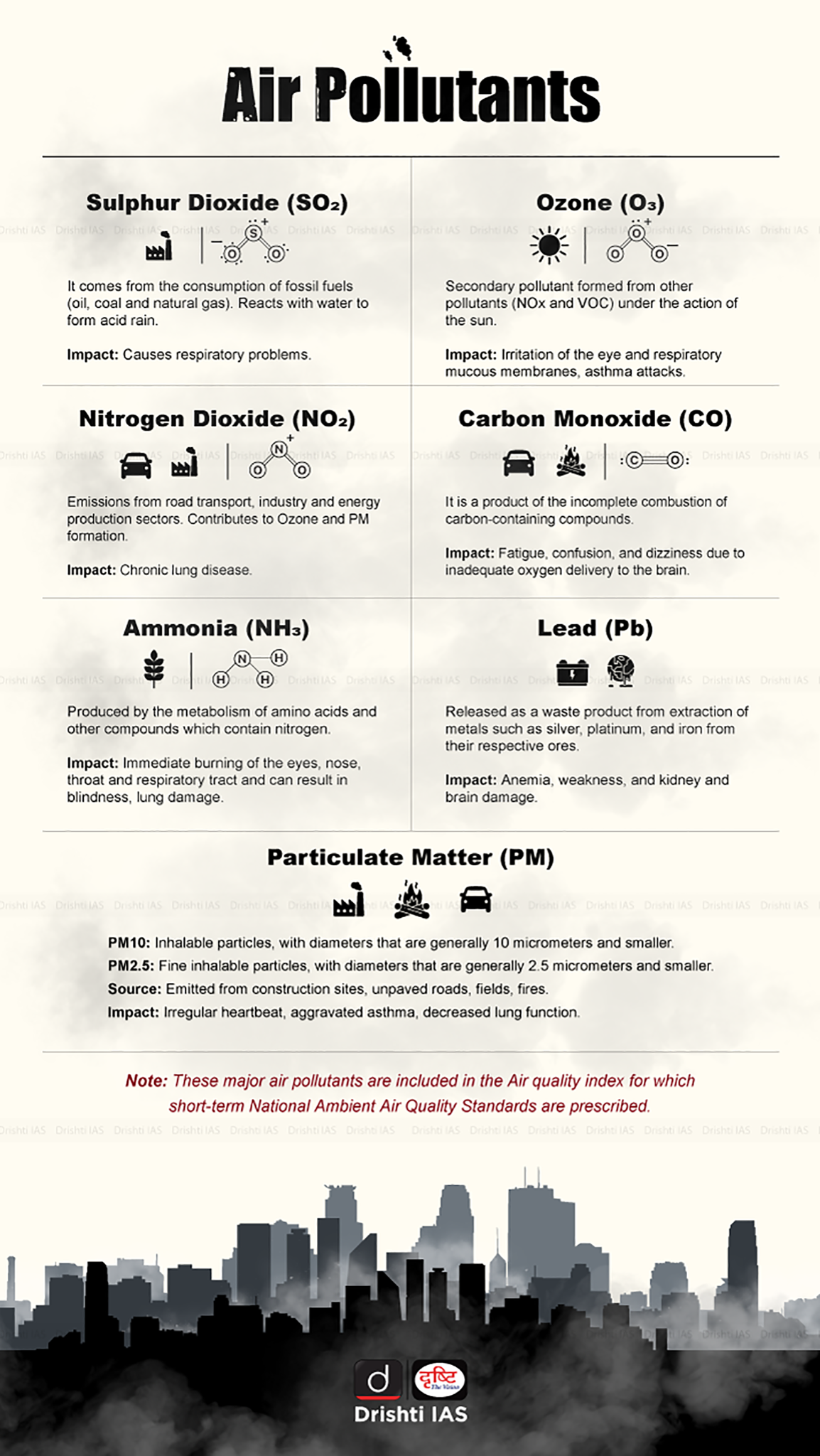
Key Terms Related to Air Pollution
Core Pollutants
- Particulate Matter (PM10 & PM2.5): Microscopic solid or liquid matter suspended in the atmosphere.
- PM10 particles have a diameter of 10 micrometers or less. PM2.5 are incredibly fine particles (2.5 micrometers or less) that can penetrate the lung barrier and enter the bloodstream.
- Ground-Level (Tropospheric) Ozone (O3): Unlike stratospheric ozone (which protects us from UV rays), ground-level ozone is a harmful secondary pollutant.
- It is not emitted directly but is created by chemical reactions between oxides of nitrogen (NOx) and volatile organic compounds (VOCs) in the presence of sunlight.
- Volatile Organic Compounds (VOCs): Organic chemicals that easily become vapors or gases at room temperature.
- They are emitted from paints, solvents, vehicle exhaust, and industrial processes, and play a major role in smog formation.
- Secondary Pollutants: Pollutants not directly emitted from a source but formed in the lower atmosphere by chemical reactions among primary pollutants (e.g., ground-level ozone, photochemical smog).
Atmospheric Phenomena
- Photochemical Smog: A brownish-gray haze caused by the action of solar ultraviolet radiation on an atmosphere polluted with hydrocarbons and oxides of nitrogen.
- It is a common problem in heavily motorized cities with warm, sunny climates.
- Temperature Inversion (Thermal Inversion): The temperature inversion occurs when air temperature increases with altitude instead of decreasing, creating a warm layer above cooler air that traps pollutants near the ground.
- In winter, Delhi’s cold conditions cause pollutants to accumulate in the lower atmosphere, forming dense smog and worsening surface-level air pollution.
- Acid Rain: Precipitation containing harmful amounts of nitric and sulfuric acids, formed primarily by nitrogen oxides and sulfur dioxide released into the atmosphere from burning fossil fuels.
Monitoring & Measurement
- Air Quality Index (AQI): A color-coded tool for effective communication of air quality status to people.
- In India, the National AQI calculates an overall index based on the concentrations of 8 pollutants (PM10, PM2.5, NO2, SO2, CO, O3, NH3, and Pb).
- NAAQS (National Ambient Air Quality Standards): Standards prescribed by the CPCB for ambient air quality.
- In India, NAAQS covers 12 pollutants (the 8 in AQI plus Benzene, Benzo(a)Pyrene, Arsenic, and Nickel).
- SAFAR (System of Air Quality and Weather Forecasting and Research): An initiative by the Ministry of Earth Sciences (MoES) to provide location-specific information on air quality in near real-time and its forecast 1-3 days in advance.
- CAAQMS (Continuous Ambient Air Quality Monitoring Stations): Highly advanced, automated stations that continuously measure air pollutants and transmit data in real-time to central servers (used to calculate the daily AQI).
Governance & Action Frameworks
- GRAP (Graded Response Action Plan): An emergency set of anti-pollution measures implemented in the Delhi-NCR region.
- The measures under GRAP are "graded" and kick in incrementally as the AQI deteriorates (from "Poor" to "Severe+").
- Bharat Stage (BS) Emission Standards: BS Emission norms instituted by the Government of India to regulate the output of air pollutants from internal combustion engines and motor vehicles.
- India is currently following BS-VI norms.
- NCAP (National Clean Air Programme): A national-level strategy launched by the Ministry of Environment, Forest and Climate Change (MoEFCC) to tackle air pollution comprehensively across the country, targeting a 20-30% reduction in particulate matter concentrations by 2024 (later revised to a 40% reduction by 2026).
Frequently Asked Questions (FAQs)
1. What is PM2.5 and why is it dangerous?
PM2.5 refers to particulate matter with a diameter of2.5 micrometers or less, which can penetrate deep into the lungs and bloodstream, causing respiratory and cardiovascular diseases.
2. What is the Air Quality Index (AQI)?
TheAir Quality Index (AQI) is a color-coded tool used in India to communicate air quality levels, calculated based on the concentration of eight major pollutants.
3. What is Temperature Inversion and how does it affect air pollution?
Temperature inversion occurs whenwarmer air sits above cooler air near the ground, trapping pollutants and causing severe smog, especially during winter in northern India.
4. What is the objective of the National Clean Air Programme?
NCAP aims toreduce particulate matter pollution by up to 40% by 2026 through city-specific action plans, monitoring expansion, and coordinated pollution control measures.
5. What is the Graded Response Action Plan?
GRAP is anemergency pollution control framework for Delhi-NCR, where restrictions are implemented progressively as AQI levels worsen.
UPSC Civil Services Examination, Previous Year Question (PYQ)
Prelims
Q. Artificial way of causing rainfall to reduce air pollution makes use of (2025)
a) silver iodide and potassium iodide
b) silver nitrate and potassium iodide
c) silver iodide and potassium nitrate
d) silver nitrate and potassium chloride
Ans: (a)
Q. How is the National Green Tribunal (NGT) different from the Central Pollution Control Board (CPCB)? (2018)
- The NGT has been established by an Act whereas the CPCB has been created by an executive order of the Government.
- The NGT provides environmental justice and helps reduce the burden of litigation in the higher courts whereas the CPCB promotes cleanliness of streams and wells, and aims to improve the quality of air in the country.
Which of the statements given above is/are correct?
(a) 1 only
(b) 2 only
(c) Both 1 and 2
(d) Neither 1 nor 2
Ans: (b)
Mains
Q. Describe the key points of the revised Global Air Quality Guidelines (AQGs) recently released by the World Health Organisation (WHO). How are these different from its last update in 2005? What changes in India’s National Clean Air Programme are required to achieve revised standards?(2021)