
National Counter-Terrorism Policy and Strategy: PRAHAAR
For Prelims: Multi Agency Centre, Intelligence Bureau, Central Armed Police Forces, National Investigation Agency, Universal Declaration of Human Rights, Mutual Legal Assistance Treaties
For Mains: India’s counter-terrorism architecture and the role of PRAHAAR, Intelligence-led policing and inter-agency coordination in internal security, Balancing national security with human rights and civil liberties.
Why in News?
The Ministry of Home Affairs (MHA) unveiled India’s first-ever comprehensive National Counter-Terrorism Policy and Strategy, titled 'PRAHAAR'. This marks a paradigm shift from a reactive security stance to a proactive, intelligence-driven doctrine.
Summary
- India’s first-ever comprehensive National Counter-Terrorism Policy and Strategy, titled 'PRAHAAR' shifts to a proactive, intelligence-led, whole-of-government and whole-of-society approach, combining prevention, swift response, de-radicalisation, legal frameworks, and international cooperation to address evolving terror threats.
- Its effectiveness will depend on overcoming federal coordination challenges, capacity gaps, and civil liberties concerns while strengthening technology use, inter-agency coordination, and global partnerships to ensure security with adherence to the rule of law.
What is PRAHAAR?
- PRAHAAR: The strategy is an acronym representing the core pillars of India's proactive defense mechanism:
- Prevention of terror attacks to protect Indian citizens and interests;
- Responses, which are swift and proportionate to the threat posed;
- Aggregating internal capacities for achieving synergy in a whole-of-government approach;
- Human rights and ‘Rule of Law’ based processes for mitigation of threats;
- Attenuating the conditions enabling terrorism, including radicalization;
- Aligning and shaping the international efforts to counter terrorism;
- Recovery and resilience through a whole-of-society approach.
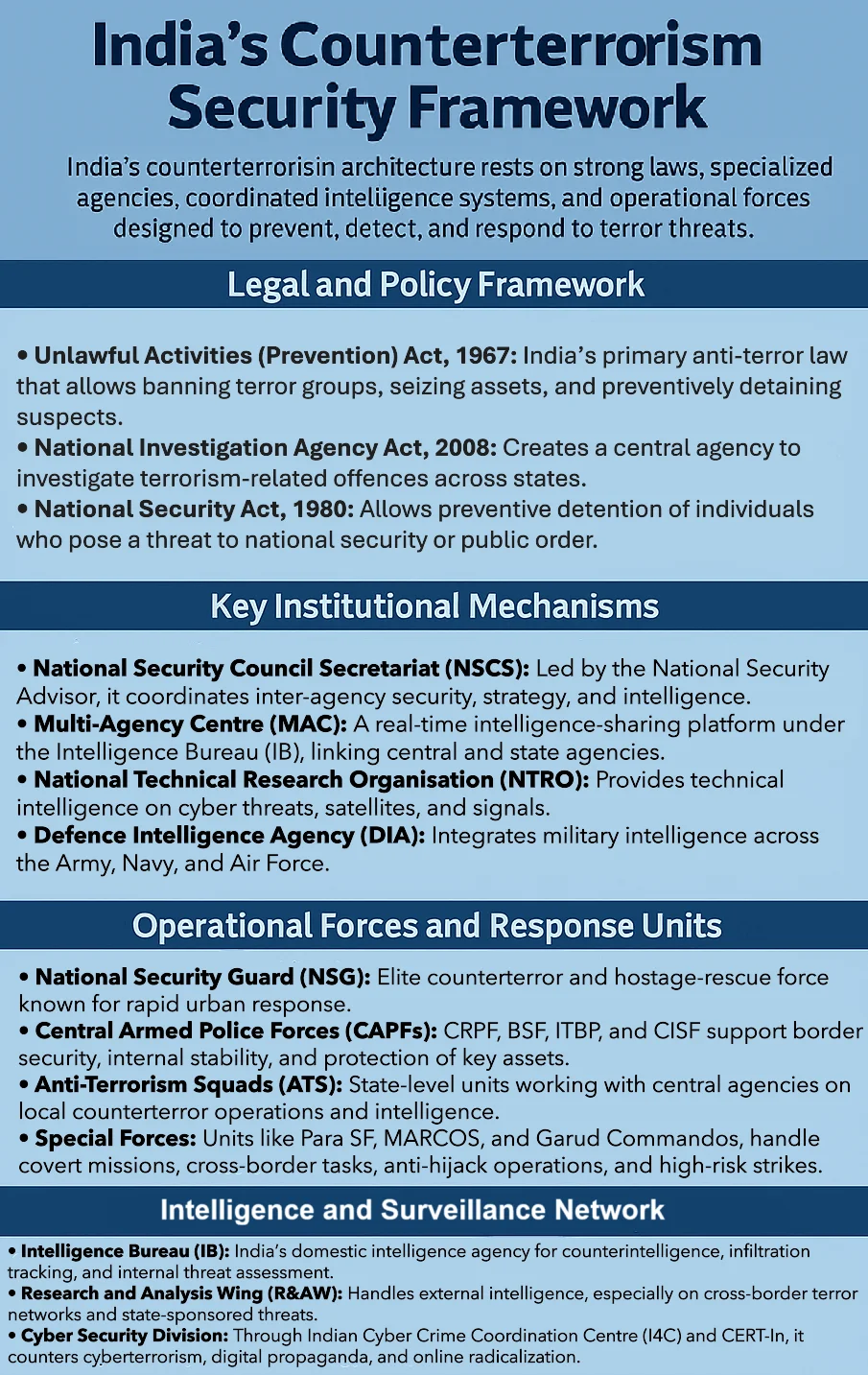
- Prevention of Terror Attacks: India follows a proactive, intelligence-led counter-terrorism approach anchored by the Multi Agency Centre (MAC) and Joint Task Force on Intelligence (JTFI) under the Intelligence Bureau for real-time intelligence sharing among central and state agencies.
- Law enforcement actively counters terrorist misuse of the internet for recruitment, propaganda, and communication, while dismantling over-ground worker (OGW) support networks.
- Coordinated operations target the emerging nexus between illegal arms syndicates and terrorist groups and disrupt terror funding through legal frameworks.
- Border guarding forces and immigration authorities deploy advanced technologies to address threats across land, air, and maritime domains, alongside strengthened protection of critical infrastructure such as power, railways, aviation, ports, defence, space, and atomic energy sectors.
- Response: The local police serve as the primary first responders, bolstered by specialized State Counter-Terror (CT) Forces and Central Armed Police Forces (CAPFs).
- The National Security Guard (NSG) acts as the nodal national agency under the MHA, providing elite intervention for major attacks and leading capacity-building initiatives for state units.
- Coordination is streamlined through an MHA-issued Standard Operating Procedure (SOP) and the Multi-Agency Centre (MAC), which facilitates real-time intelligence dissemination and analysis.
- Post-incident, the National Investigation Agency (NIA) works alongside State Police to ensure high prosecution rates, aiming to establish a robust legal deterrent against future terror threats.
- Aggregating Capacities: Focuses on standardization and modernization across India's security landscape.
- It mandates the continuous acquisition of advanced weaponry and technology while upgrading training faculties to incorporate global best practices.
- Key agencies like the Bureau of Police Research & Development (BPR&D) and CAPFs lead large-scale training, while the NSG provides specialized urban combat expertise to state units.
- By identifying resource gaps and advocating for a uniform anti-terrorism structure across all States, the policy ensures that multi-agency responses are synergistic and interoperable.
- Human Rights and Rule of Law Based Processes: Underscores India’s commitment to a justice-based counter-terrorism framework.
- It balances national security with fundamental rights by adhering to the Rule of Law, the Protection of Human Rights Act (1993), and international treaties like the Universal Declaration of Human Rights (1948) and the International Covenant on Civil and Political Rights.
- The legal backbone consists of the Unlawful Activities (Prevention) Act (UAPA), 1967, supported by the new criminal codes (Bharatiya Nyaya Sanhita, 2023, Bharatiya Nagarik Suraksha Sanhita, 2023, Bharatiya Sakshya Adhiniyam, 2023) alongside specialized laws like the PMLA (2002) and the Arms Act (1959).
- To prevent misuse, the policy highlights a robust multi-level judicial redressal system from District Courts to the Supreme Court ensuring due process, affordable legal representation, and ample opportunities for appeal.
- Attenuating Conducive Conditions: It focuses on a "Soft-Power" approach to supplement hard security.
- It addresses the root causes of radicalization through a multi-stakeholder de-radicalization framework involving community leaders, religious heads, and NGOs to counter extremist narratives.
- The policy adopts a graded response to radicalised youth, prioritising rehabilitation for minor cases and legal action against hardcore elements.
- It also focuses on socio-economic empowerment to prevent recruitment and includes measures to curb prison radicalisation by separating ideologues from vulnerable inmates.
- Aligning and Shaping the International Efforts: Targets the trans-national nature of terror through a multi-layered diplomatic and legal strategy.
- It focuses on denying safe havens by utilizing Mutual Legal Assistance Treaties (MLATs), Extradition Treaties, and Joint Working Groups (JWGs) to facilitate evidence sharing and the deportation of fugitives.
- Beyond agency-to-agency intelligence exchange, India leverages international forums to share global best practices and collaborates with partners to designate terrorists at the United Nations, ensuring a holistic and globally-aligned national response.
- Recovery and Resilience: Advocates for a "Whole-of-Society" approach to minimize the impact of terror attacks.
- Central to this is a strong public-private partnership that facilitates rapid restoration and long-term community strength.
- By combining state-led restoration with reinforced police security measures, the policy aims to restore normalcy swiftly and build long-term psychological and physical resilience against terror-induced disruption.
Cross-Border and Emerging Terror Threats
- State-Sponsored Terrorism: Persistent cross-border support to jihadi outfits and affiliated groups planning and executing attacks in India.
- Global Terror Linkages: Groups such as Al-Qaeda and ISIS attempt to incite violence through sleeper cells and online radicalisation.
- Use of Advanced Technologies: Drones and modern tools are used by handlers abroad to facilitate attacks, especially in Punjab and Jammu & Kashmir.
- Criminal-Terror Nexus: Terror groups increasingly collaborate with organised crime networks for logistics, recruitment, and funding.
- Digital Ecosystem Misuse: Social media, encrypted messaging apps, dark web, and cryptocurrencies enable propaganda, coordination, and anonymous financing.
- CBRNED Threats: Risks of terrorists accessing Chemical, Biological, Radiological, Nuclear, Explosive, and Digital (CBRNED) materials remain a major concern.
- Drone and Robotics Risks: Potential misuse by state and non-state actors for surveillance and lethal operations.
- Cyber Threats: Criminal hackers and hostile nation-states continue to target India through cyber-attacks on critical systems.
What are the Implementation Challenges of PRAHAAR Strategy?
- Federal Friction in Execution: "Public Order" and "Police" are subjects under the State List of the Indian Constitution.
- Centralizing the anti-terror structure can lead to jurisdictional overlaps and center-state operational delays.
- Technological and Capacity Asymmetries: Local police (the first responders) often lack the funding, cyber-training, and advanced infrastructure needed to tackle modern threats like drones and the dark web.
- Upgrading these state units requires massive financial outlays that many states cannot independently afford.
- Subjectivity in De-radicalization: The policy proposes a "graded police response" based on the level of an individual's radicalization.
- Because measuring radicalization is inherently psychological and subjective, lacking clear legal benchmarks could lead to inconsistent application, arbitrary profiling, or localized grievances.
- Concerns Regarding Stringent Security Laws: Heavy reliance on stringent security laws often brings up concerns regarding low conviction rates and prolonged pre-trial detentions.
- Inter-Departmental Silos: Despite advocating for a "Whole-of-Government" approach, the Indian security apparatus has historically struggled with institutional turf wars.
- Ensuring seamless, real-time intelligence sharing and operational synergy among local police, central armed police forces, and national intelligence networks without bureaucratic delays remains a practical hurdle.
What Measures can Strengthen the PRAHAAR Strategy?
- Inter-Agency Coordination: Strengthen intelligence-sharing mechanisms and regularly update counter-terror laws to address emerging threats.
- Capacity Building: Enhance State and UT Counter-Terrorism Units and Anti-Terrorism Squads (ATS) with uniform structures, modern resources, advanced training, and standardised investigation methods.
- Embed legal experts throughout terror investigations to improve prosecution quality and conviction rates.
- Global Cooperation: Expand national, regional, and international collaboration to combat transnational terrorism and advance a comprehensive global framework aligned with PRAHAAR.
- Technological Countermeasures: Invest in technology and partner with the private sector to counter terrorist misuse of Information and Communication Technology (ICT) and address evolving digital threats.
- Amend IT Rules to hold social media platforms accountable for promoting extremist content and mandate independent radicalisation audits.
- Integrate Crypto-Based Financing tracking tools into the Central Bank Digital Currency framework and enforce strict KYC norms on decentralized finance platforms to curb terror funding.
- Use big data fusion and machine learning to detect suspicious financial and behavioural patterns before attacks materialise.
- Specialised Terror Prosecution: Create a dedicated cadre of federal prosecutors trained in cyber forensics and anti-terror laws to improve conviction rates.
- Digital Evidence Sharing: Establish fast-track international agreements for real-time access to encrypted data during critical investigations.
Conclusion
PRAHAAR reflects a zero-tolerance, proactive whole-of-society approach that combines technological disruption, legal action, and community-based de-radicalisation to strengthen national security. Its success will depend on balancing firm enforcement with the protection of fundamental rights.
|
Drishti Mains Question Q. Evaluate the significance of the 'PRAHAAR' policy in the context of India’s evolving internal security challenges. |
Frequently Asked Questions (FAQs)
1. What is PRAHAAR?
PRAHAAR is India’s first comprehensive National Counter-Terrorism Policy launched by the Ministry of Home Affairs to adopt a proactive, intelligence-led, zero-tolerance approach to terrorism.
2. What are the key pillars of PRAHAAR?
Its pillars include prevention, response, capacity aggregation, human rights compliance, de-radicalisation, international cooperation, and recovery through a whole-of-society approach.
3. Which legal frameworks support PRAHAAR?
Key laws include the Unlawful Activities (Prevention) Act (1967), Prevention of Money Laundering Act (2002), Arms Act (1959), and the new criminal codes of 2023.
4. What are the major challenges in implementing PRAHAAR?
Challenges include federal coordination issues, capacity gaps in state police, subjectivity in de-radicalisation, civil liberties concerns, and inter-agency coordination hurdles.
5. How does PRAHAAR address modern terror threats?
It targets cyber radicalisation, crypto-based financing, drone threats, CBRN risks, and cross-border terror networks through technology, intelligence sharing, and international cooperation.
UPSC Civil Services Examination, Previous Year Questions (PYQs)
Mains
Q. What are India’s internal security challenges? Give out the role of Central Intelligence and Investigative Agencies tasked to counter such threats. (2023)
Q. Analyse the multidimensional challenges posed by external state and non-state actors, to the internal security of India. Also discuss measures required to be taken to combat the threats. (2021)
Q. The banning of ‘Jamaat-e – islaami’ in Jammu and Kashmir brought into focus the role of over-ground workers (OGWs) in assisting terrorist organizations. Examine the role played by OGWs in assisting terrorist organizations in insurgency affected areas. Discuss measures to neutralize the influence of OGWs. (2019)
Independence of the Election Commission of India
For Prelims: Chief Election Commissioner (CEC), Chief Election Commissioner and other Election Commissioners (Appointment, Conditions of Service and Term of Office) Act, 2023, Anoop Baranwal Case, 2023, Election Commission, LoP, CJI, Goswami Committee, Law Commission.
For Mains: Independence and neutrality of constitutional bodies in India, Article 324 and constitutional safeguards for free and fair elections, Electoral reforms in India.
Why in News?
The independence of the Election Commission of India (ECI) is under scrutiny following concerns over voter roll revisions, including the Special Intensive Revision (SIR) in Bihar and the reported deletion of around 65 lakh voters.
- An Opposition alliance has moved a resolution to remove the Chief Election Commissioner (CEC), bringing renewed focus on the neutrality of the ECI and the protection of adult franchise under Article 326.
Summary
- The Election Commission of India’s independence is protected by constitutional safeguards, but concerns over appointments, voter roll revisions, financial autonomy, and enforcement powers have raised questions about its neutrality and effectiveness.
- Strengthening reforms such as a balanced selection process, equal security of tenure, technological transparency, and greater institutional autonomy are essential to ensure free and fair elections and maintain public trust.
What are the Concerns Regarding the Independence of the ECI?
- Appointment Process Debate: Historically, the Constitution did not prescribe a specific legislative process for the appointment of the CEC and ECs, leaving it to the Executive (President acting on the advice of the Council of Ministers).
- In the Anoop Baranwal v. Union of India case (2023), the Supreme Court (SC) ruled that a collegium comprising the Prime Minister, the Leader of the Opposition (LoP) in the Lok Sabha, and the Chief Justice of India (CJI) should make appointments to insulate the body from executive bias, until Parliament passed a law.
- The Parliament subsequently passed the Chief Election Commissioner and Other Election Commissioners Act, 2023 replacing the CJI in the selection committee with a Union Cabinet Minister nominated by the Prime Minister.
- Critics argue this gives the Executive a 2:1 majority in the selection process, potentially compromising institutional neutrality.
- Flaws in the Removal Mechanism: While the CEC enjoys the same protection against removal as a Supreme Court judge (impeachment by Parliament), the two Election Commissioners (ECs) can be removed by the President simply on the recommendation of the CEC.
- This disparity creates a hierarchy and potential vulnerability for the ECs, who might feel pressured to align with the CEC or the Executive.
- Financial Autonomy: Unlike the Comptroller and Auditor General (CAG) or the Supreme Court, the budget of the ECI is not "charged" upon the Consolidated Fund of India.
- Instead, it is a "voted" expenditure, meaning it requires parliamentary approval, which theoretically subjects the ECI's financial independence to the government of the day.
- Enforcement of the MCC: The Model Code of Conduct (MCC) lacks statutory backing, leading to concerns that the ECI is "toothless" or selective when taking action against high-profile political figures for hate speech or campaign violations.
- Post-Retirement Appointments: The Constitution does not debar the retiring CEC or ECs from any further appointment by the government.
- This creates a potential "conflict of interest," as the prospect of post-retirement sinecures (like governorships or commissions) could influence their impartiality while in office.
- Electoral Roll Integrity and "Vote Theft": The Special Intensive Revision (SIR) of electoral rolls has become a flashpoint for allegations of "vote theft": In States like Bihar and West Bengal, allegations have surfaced regarding the potential deletion of millions of voters.
- Opposition parties allege these deletions disproportionately target minority communities and their supporters.
- The ECI’s use of SIR to "weed out foreigners" has been criticized as a "selective disenfranchisement based on religion".
- Concerns have been raised that wide discretion given to Booth Level Officers during house-to-house verification, combined with limited oversight, may lead to arbitrary voter exclusions and undermine electoral fairness.
- Technology and Transparency Debate: The Election Commission has directed state poll officials to destroy CCTV, webcasting, and video footage of elections after 45 days if no court challenge is filed, a move that has raised concerns about transparency.
- There is growing demand to extend the preservation period to at least 180 days to enable credible post-election audits and strengthen public trust.
- At the same time, the rise of AI-generated content and deepfakes, particularly during recent state elections, has tested the ECI’s ability to curb disinformation in a neutral manner, without creating perceptions of bias or favoring any political narrative.
Constitutional Mandate and Safeguards Ensuring the Independence of the ECI
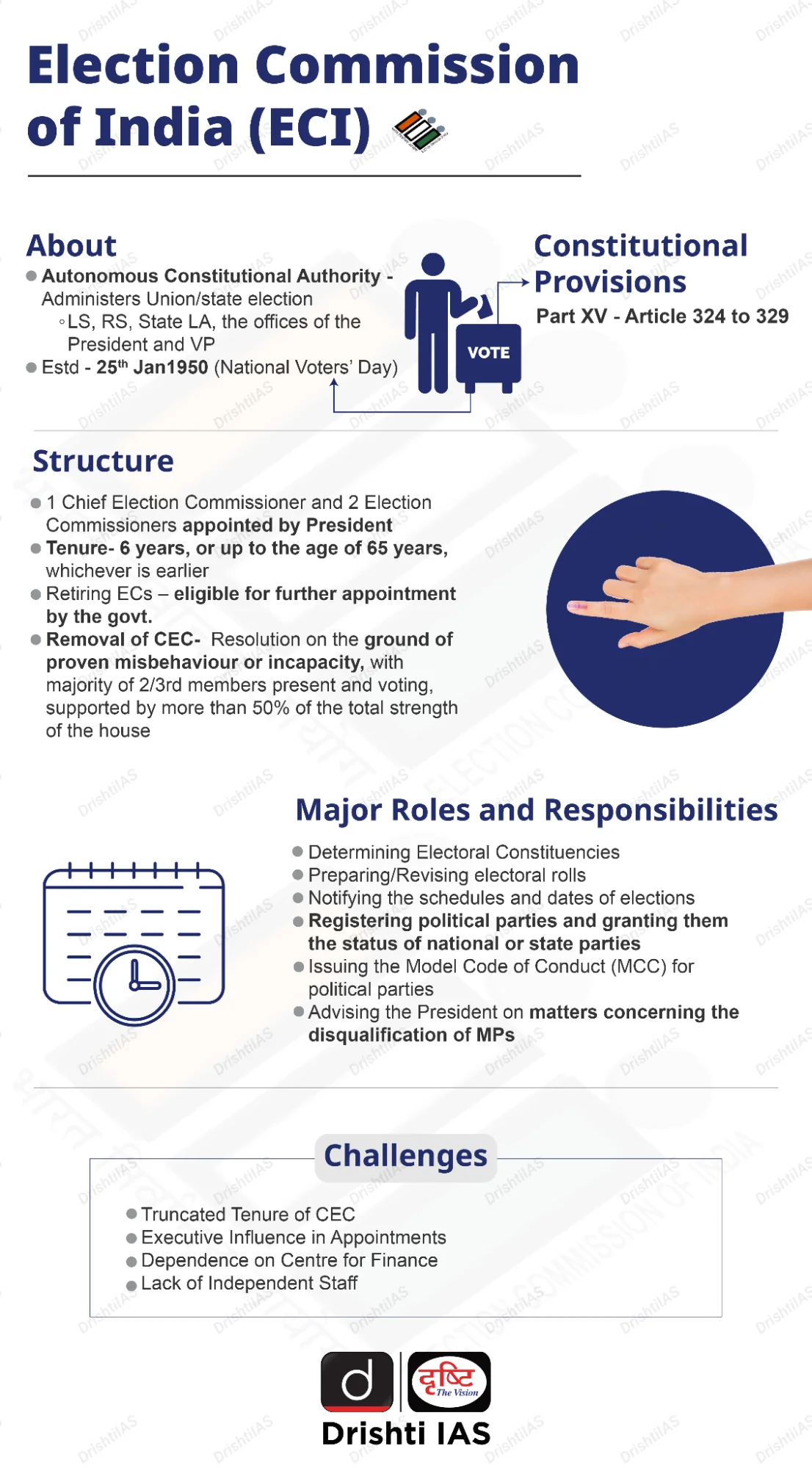
- Vesting of Electoral Authority: Article 324(1) vests the superintendence, direction, and control of electoral roll preparation and conduct of elections to Parliament, State Legislatures, and the offices of President and Vice-President in the Election Commission.
- This centralised authority ensures autonomy in managing the entire electoral process.
- Composition and Appointment: Under Article 324(2), the Election Commission consists of the CEC and other ECs as determined by the President.
- Their appointment by the President, subject to parliamentary law, gives the body constitutional legitimacy while allowing statutory regulation.
- Role of the CEC as Chairman: Article 324(3) provides that when additional ECs are appointed, the CEC acts as Chairman of the Commission.
- This ensures administrative leadership while maintaining a collegial decision-making structure.
- Appointment of Regional Commissioners: Article 324(4) allows the President to appoint Regional Commissioners, in consultation with the ECI, to assist during elections.
- This strengthens the Commission’s operational capacity without undermining its autonomy.
- Security of Tenure and Removal Safeguards: Article 324(5) provides critical safeguards:
- The CEC can be removed only in the same manner and on the same grounds as a Supreme Court judge.
- Service conditions cannot be altered to the CEC’s disadvantage after appointment.
- These provisions protect the Commission from arbitrary executive action.
- Administrative Support: Article 324(6) mandates that the President or Governor must provide necessary staff to the ECI upon request, ensuring it has the resources required to function effectively.
What are the Key Judgments Regarding ECI Independence?
- Indira Nehru Gandhi vs Raj Narain (1975): The SC held that free and fair elections form part of the Basic Structure of the Constitution, ensuring that electoral integrity cannot be compromised and reinforcing the ECI’s central role in protecting democracy.
- Mohinder Singh Gill vs Chief Election Commissioner (1978): The SC ruled that Article 324 grants the ECI plenary powers to act in areas where the law is silent to ensure free and fair elections, thereby strengthening its functional autonomy.
- A.C. Jose vs Sivan Pillai (1984): The SC clarified that the ECI cannot override existing laws, limiting its Article 324 powers to gaps in legislation and ensuring that independence operates within the rule of law.
- T.N. Seshan vs Union of India (1995): The SC upheld the validity of a multi-member Election Commission and stated that the CEC is “first among equals,” not superior to other commissioners, promoting collective decision-making and preventing concentration of power.
- Vineet Narain vs Union of India (1997): The SC held that the CEC cannot recommend the removal of Election Commissioners suo motu, safeguarding their tenure and protecting institutional independence.
- Anoop Baranwal vs Union of India (2023): The SC directed that appointments of the CEC and Election Commissioners be made by a committee including the Prime Minister, Leader of Opposition, and Chief Justice of India, reducing executive dominance in appointments.
Key Committee / Commission Recommendations for ECI Independence
- Dinesh Goswami Committee (1990): Recommended a statutory selection committee and making the Model Code of Conduct (MCC) legally enforceable to prevent its selective application.
- Indrajit Gupta Committee (1998): Advocated for State Funding of Elections to reduce the "money power" that the ECI often struggles to monitor effectively.
- Second Administrative Reforms Commission (ARC) (2005): Suggested a collegium headed by the Prime Minister, with the Speaker of the Lok Sabha, the LoP, the Law Minister, and the Deputy Chairman of the Rajya Sabha as members.
- Law Commission (255th Report) (2015): Proposed that all three Commissioners (CEC and ECs) should have equal constitutional protection against removal, ending the hierarchy that makes ECs vulnerable, ensuring equal constitutional security of tenure.
- Proposed establishment of a permanent, independent Secretariat for the ECI to strengthen administrative autonomy.
What Measures can Strengthen the Independence of the Election Commission of India?
- Parity in Security of Tenure: The Constitution must be amended to provide the same protection against removal to the ECs as is currently guaranteed to the CEC.
- They should only be removable through a rigorous parliamentary impeachment process, insulating them from executive pressure.
- Reforming the Appointment Process: The CEC and Other ECs Act of 2023 should be reviewed to restore a balanced, neutral selection collegium.
- Reintroducing the Chief Justice of India or mandating a unanimous consensus within the committee would mitigate the current executive dominance.
- Granting Contempt Powers: Amending the Contempt of Courts Act of 1971 to empower the ECI to punish those who make baseless, malicious accusations against it would help preserve its institutional credibility and authority.
- Financial and Administrative Autonomy: To guarantee absolute financial independence, the budget of the Election Commission of India should be directly "charged" upon the Consolidated Fund of India.
- Mandatory Cooling-Off Period: To eliminate the lure of future political patronage, a mandatory cooling-off period or a complete constitutional bar on post-retirement government appointments (such as state Governorships) must be instituted for retiring Chief Election Commissioners and Election Commissioners.
- Transparent Electoral Roll Revisions: To prevent arbitrary voter deletions, SIR exercises should include transparent data audits, regular publication of supplementary lists, and strong grievance redressal mechanisms.
- Upholding transparency and addressing stakeholder concerns are essential to maintain trust in elections, the bedrock of democracy.
- Technological Safeguards: Mandating statistically significant cross-verification of Electronic Voting Machines with Voter-Verifiable Paper Audit Trails, especially in cases of data discrepancies, is vital to restoring and maintaining absolute public trust in the electoral machinery.
Conclusion
The independence of the Election Commission of India is vital for preserving free and fair elections and sustaining public trust in democracy. While constitutional safeguards exist, emerging challenges in appointments, electoral roll management demand urgent reforms. Strengthening institutional autonomy and transparency will be key to safeguarding India’s democratic integrity.
|
Drishti Mains Question: Q. “The independence of the Election Commission is central to India’s democratic framework.” Examine the constitutional safeguards and emerging challenges to its autonomy |
Frequently Asked Questions (FAQs)
1. What constitutional provision ensures the independence of the ECI?
Article 324 vests superintendence, direction, and control of elections in the ECI and provides safeguards such as security of tenure and removal procedures.
2. Why is the removal process of the CEC considered a safeguard?
The CEC can be removed only through a process similar to that of a Supreme Court judge, preventing arbitrary executive action.
3. What is the controversy surrounding the 2023 appointment law?
The law replaced the Chief Justice of India with a Union Minister in the selection committee, raising concerns about executive dominance.
4. Why is the Model Code of Conduct seen as weak?
It lacks statutory backing, limiting the ECI’s ability to enforce penalties for violations like hate speech and campaign misconduct.
5. How can technology strengthen electoral transparency?
Measures such as preserving CCTV footage, digital logs, and cross-verifying EVMs with VVPAT can enhance auditability and public trust.
.
UPSC Civil Services Examination, Previous Year Questions (PYQs)
Prelims
Q.Consider the following statements: (2017)
- The Election Commission of India is a five-member body.
- Union Ministry of Home Affairs decides the election schedule for the conduct of both general elections and bye-elections.
- Election Commission resolves the disputes relating to splits/mergers of recognised political parties.
Which of the statements given above is/are correct?
(a) 1 and 2 only
(b) 2 only
(c) 2 and 3 only
(d) 3 only
Ans: (d)
Mains
Q.Discuss the role of the Election Commission of India in the light of the evolution of the Model Code of Conduct. (2022)
India's HPV Vaccination Drive
Why in News?
India is all set to launch the Human Papillomavirus (HPV) vaccination nationwide, aimed at eliminating cervical cancer, one of the most common yet preventable cancers affecting women in India.
What are the Key Facts Regarding the HPV Vaccination Drive?
- Target Group & Coverage: It will target girls aged 14 years and will be voluntary and free of cost, conducted at designated government health facilities like Ayushman Arogya Mandirs and District Hospitals.
- The vaccine reduces cervical cancer risk by over 85% when administered in teenage years.
- Vaccine Details: It will initially use MSD's Gardasil (US-based), a quadrivalent vaccine that protects against HPV types 16 and 18 (which cause cervical cancer) and types 6 and 11.
- Scientific Efficacy & Safety: The vaccine is non-live (does not cause HPV infection) and has a strong safety record with over 500 million doses administered globally since 2006.
- Studies show HPV vaccines are 93–100% effective in preventing cervical cancer caused by various HPV types.
- Procurement & Implementation: Under India’s partnership with GAVI, the Vaccine Alliance, Gardasil vaccines, approved by the Central Drugs Standard Control Organisation (CDSCO) and widely used internationally, have been made available for the national programme.
- India's apex immunisation body, the National Technical Advisory Group on Immunisation (NTAGI), had recommended the vaccine's introduction. The Union Budget 2024 speech encouraged vaccination for girls aged 9-14 years for cervical cancer prevention.
- Campaign Strategy: Unlike routine immunisation under the Universal Immunisation Programme (UIP), the HPV drive will be conducted as a special campaign on designated immunisation days and tracked through the U-WIN digital platform to ensure rapid coverage.
What is Human Papillomavirus (HPV)?
- About: HPV is a group of more than 200 related, non-enveloped, double-stranded DNA viruses belonging to the Papillomaviridae family that primarily infect epithelial cells on the skin and mucous membranes.
- Most infections are asymptomatic and resolve spontaneously, with approximately 90% clearing within one to two years through the body's immune response.
- Classification of HPV Types: HPV types are classified into two main categories:
- Low-risk types (e.g., HPV 6 and 11): These primarily cause benign conditions such as genital warts or common skin warts.
- High-risk types (e.g., HPV 16 and 18): These are oncogenic and responsible for the majority of HPV-related cancers.
- Disease Burden: Cervical cancer is the 2nd most common cancer among women in India, with nearly 80,000 new cases and over 42,000 deaths reported annually. Persistent HPV infection causes nearly 85% of all cervical cancers, with types 16 and 18 accounting for over 80% of cases in India.
- Transmission: Transmission occurs mainly through intimate skin-to-skin contact, most commonly during sexual activity (vaginal, anal, or oral). It is the most common sexually transmitted infection worldwide.
- Prevention Strategy: Vaccination is the best way to prevent HPV infection and related cancers. The primary target is all girls aged 9–14 years, before they become sexually active. The vaccine may be given as 1 or 2 doses. Additional prevention methods include condom use, voluntary male circumcision, and smoking cessation.
- WHO Elimination Targets (WHA 73.2): The Global strategy to accelerate the elimination of cervical cancer sets three key targets by 2030:
- 90% of girls fully vaccinated with HPV vaccine by age 15.
- 70% of women screened with a high-performance test by age 35 and again by 45.
- 90% of women identified with cervical disease receive treatment and care.
- WHO Response Framework: Preventing HPV-related cancers is a key goal of the WHO's global health strategy for 2022–2030, which addresses HIV, hepatitis, and sexually transmitted infections. Additionally, a 2021 WHO resolution on oral health includes measures to combat mouth and throat cancers.
1. What is the primary objective of India’s HPV vaccination programme?
To eliminate cervical cancer by providing free, voluntary vaccination to girls aged 9–14 years, primarily targeting HPV types 16 and 18.
2. Which vaccine is being used in the national HPV drive?
India is using Gardasil, a quadrivalent vaccine protecting against HPV 6, 11, 16, and 18.
3. What are WHO’s cervical cancer elimination targets?
The World Health Organization aims for 90% vaccination, 70% screening, and 90% treatment coverage by 2030.
UPSC Civil Services Examination, Previous Year Question (PYQ)
Q. ‘Mission Indradhanush’ launched by the Government of India pertains to (2016)
(a) immunization of children and pregnant women
(b) construction of smart cities across the country
(c) India’s own search for the Earth-like planets in outer space
(d) New Educational Policy
Ans: (a)
Renaming Kerala to “Keralam”
Why in News?
The Union Cabinet has approved the proposal to change the name of the State of Kerala to “Keralam.” A Bill titled Kerala (Alteration of Name) Bill, 2026 will be processed under Article 3 of the Constitution. The move follows a 2024 resolution by the Kerala Legislative Assembly requesting the change.
What is the Constitutional Procedure for Renaming a State?
- Parliamentary Authority: Under Article 3 of the Constitution of India, the Parliament holds the exclusive power to form new states or alter the area, boundaries, or name of any existing State by law.
- State Resolution: The process practically begins when a State Assembly passes a resolution for the name change and sends it to the Ministry of Home Affairs (MHA).
- Clearance and No Objection Certificates: The Ministry of Home Affairs examines the request and seeks No Objection Certificates from various stakeholders such as the Ministry of Railways, the Intelligence Bureau, the Department of Posts, Survey of India, and the Registrar General of India to ensure the name change does not conflict with existing administrative, geographical, or security records.
- The Department of Legal Affairs and Legislative Department, Ministry of Law and Justice, have concurred with the proposal for the alteration of the name of the State of ‘Kerala’ as ‘Keralam’.
- Prior Recommendation: Once the Ministry of Home Affairs clears the proposal, the Bill can then only be introduced in Parliament with the prior recommendation of the President.
- State Legislature's Views: If the Bill affects the name or boundaries of a State, the President must refer the draft Bill to the respective State Legislature.
- Time-Bound Process: The State Legislature is asked to express its views within a specific period designated by the President.
- Parliament is not strictly bound by the views of the State Legislature; it may accept or reject them.
- Simple Majority: The Bill requires only a simple majority in the Parliament to be passed, and it is not considered a constitutional amendment under Article 368.
- Presidential Assent: After passage, the Bill is sent to the President for assent. Upon assent, the name change becomes law, and the First Schedule is amended.
- The First Schedule of the Indian Constitution lists the names and territorial boundaries of all States and Union Territories, forming the legal basis of India’s political map.
- The Kerala Assembly specifically requested that the name be changed to "Keralam" not just in the First Schedule, but across all official languages recognized in the Eighth Schedule of the Constitution, ensuring total linguistic consistency.
- Historical Precedents: Notable changes include Uttaranchal to Uttarakhand (2007) and Orissa to Odisha (2011).
The Origins of 'Keralam'
- Epigraphic and Etymological Roots: The earliest epigraphic evidence of the region is found in the Rock Edict II of Emperor Ashoka (257 BCE), which refers to the region as "Keralaputra" (often interpreted as a reference to the Chera dynasty).
- Linguistic Evolution: According to the renowned German scholar Herman Gundert (who compiled the first Malayalam-English dictionary), the word "Keralam" evolved from "Cheram" or "Cheralam."
- The root word "cher" means "to join," and "alam" translates to "land or region."
- Thus, "Cheralam" or "Keralam" denoted the integrated land between Gokarnam and Kanyakumari.
- The Aikya Kerala Movement: The political demand for a unified state integrating the Malayalam-speaking regions of Malabar, Kochi, and Travancore gained significant momentum during the 1920s alongside the national freedom struggle.
- State Reorganization (1956): Post-independence, the State Reorganisation Commission (SRC), headed by Syed Fazl Ali, recommended the creation of a unified state based on linguistic lines.
- On 1st November 1956 (celebrated annually as Kerala Piravi Day), the modern state was formed by integrating the Malabar district and Kasargod taluk while excluding certain southern taluks of Travancore.
- However, in the Constitution, the anglicized or altered version "Kerala" was recorded instead of the native Malayalam "Keralam."
Frequently Asked Questions (FAQs)
1. Which constitutional provision allows the renaming of a state in India?
Article 3 empowers Parliament to alter the name, area, or boundaries of a state by law.
2. What role does the President play in the renaming process?
The Bill can be introduced only with the prior recommendation of the President, who also refers it to the State Legislature for views.
3. Are the views of the State Legislature binding on Parliament?
No, Parliament may accept or reject the State’s views while passing the law.
4. Why is the First Schedule important in a state name change?
The First Schedule lists state names and territories; renaming requires its amendment.
5. What was the Aikya Kerala Movement?
A 1920s movement demanding a unified Malayalam-speaking state, leading to Kerala’s formation in 1956.
UPSC Civil Services Examination, Previous Year Questions (PYQs)
Prelims
Q: Which one of the following is the correct chronological order of the formation of the following states as full states of the Indian Union? (2007)
(a) Sikkim — Arunachal Pradesh — Nagaland — Haryana
(b) Nagaland — Haryana — Sikkim — Arunachal Pradesh
(c) Sikkim — Haryana — Nagaland — Arunachal Pradesh
(d) Nagaland — Arunachal Pradesh — Sikkim — Haryana
Ans: (b)
IEA Full Membership for India
The International Energy Agency (IEA) welcomed progress on India’s request for full membership, marking a significant step in integrating the world’s 3rd-largest energy consumer into global energy governance.
- India, an IEA associate member since 2017, faces a complex path to full membership as the IEA framework restricts it to Organisation for Economic Cooperation and Development (OECD) countries, an organization India has no inclination to join.
International Energy Agency
- About IEA: The IEA is an intergovernmental body established in 1974 by 17 OECD countries in response to the global oil crisis caused by the Arab oil embargo (1973–1974) during the Yom Kippur War (1973). Its original mandate was to ensure stable oil supplies and manage energy emergencies.
- Members must hold strategic oil reserves equivalent to at least 90 days of net imports, which can be released during supply disruptions.
- Evolving Role of IEA: The IEA's role has diversified significantly. It now concerns itself with a variety of energy sources, including renewables, and focuses heavily on climate change, decarbonisation, energy transitions, and critical minerals programmes.
- Membership Expansion: Full membership was historically open only to OECD nations. IEA currently has 32 full members, with Colombia set to become the 33rd after joining the OECD in 2020.
- In 2015, the IEA introduced the associate member category for non-OECD countries, and it currently has 13 associate members. The associate members participate in the policy discussions and activities, but do not have decision-making rights.
- India's Strategic Importance: The IEA accounts for 80% of global energy demand when including its associate members (India, China, Brazil, etc). The IEA itself notes that India is poised to see the largest energy demand growth of any country in the world over the next three decades.
- Key Publications: Publishes flagship reports like the World Energy Outlook, World Energy Investment Report, and the Global Energy Review.
| Read More: World Energy Investment Report 2025 |
India–GCC Free Trade Agreement
India and the Gulf Cooperation Council (GCC) signed a Joint Statement to advance negotiations on the India–GCC Free Trade Agreement, following the Terms of Reference agreed earlier. The move aims to deepen economic cooperation and marks a significant milestone in India–GCC relations.
- India - GCC Trade: The GCC is India's largest trading partner bloc, accounting for 15.42% of India’s global trade.
- Bilateral trade reached USD 178.56 billion in FY 2024-25 (Exports: USD 56.87 billion; Imports: USD 121.68 billion), registering a steady annual average growth rate of 15.3% over the past five years.
- Key Indian Exports: India primarily exports engineering goods, rice, textiles, machinery, and gems and jewellery to the GCC.
- Key Indian Imports: Imports from the GCC are dominated by crude oil, Liquefied Natural Gas (LNG), petrochemicals, and precious metals like gold.
- Economic Significance: The GCC represents a massive market of 61.5 million people with a USD 2.3 trillion GDP (9th globally), and serves as a major source of Foreign Direct Investment (FDI) for India (cumulative investments exceeding USD 31.14 billion as of September 2025).
- Diaspora and Soft Power: The region hosts nearly 10 million Indian diaspora members, acting as a vital "living bridge" that reinforces people-to-people connections and supports the substantial presence of Indian companies in the Gulf.
Gulf Cooperation Council (GCC)
- It is a regional political and economic alliance established in 1981, comprising Bahrain, Kuwait, Oman, Qatar, Saudi Arabia, and the United Arab Emirates.
- Formed in response to regional tensions such as the Iranian Revolution (1979) and the Iran–Iraq War (1980–1988), the GCC aims to promote economic, security, cultural, and social cooperation among its members.
- GCC headquartered in Riyadh, Saudi Arabia, its organisational structure includes the Supreme Council, the highest authority composed of member state heads with a rotating presidency.
.webp)
| Read more: India GCC Economic and Strategic Links |
16th Edition of Exercise Vajra Prahar
The 16th edition of the India-US joint special forces exercise ‘Vajra Prahar’ began at the Special Forces Training School in Bakloh, Himachal Pradesh.
Vajra Prahar
- First conducted in India in 2010, the exercise is held alternately in India and the US. The previous edition was held in Idaho, US.
- It involves personnel from the Indian Army’s Special Forces and the US Army’s Green Berets.
- The primary aim is to promote robust military cooperation by enhancing interoperability, jointness, and the mutual exchange of tactical expertise.
- It will enable the sharing of best practices and experience in areas such as joint mission planning capabilities and operational tactics.
India- US Defence Cooperation
- Strategic Evolution: The relationship is anchored by the "New Framework for India-US Defence Cooperation" (renewed in 2015) and India's designation as a Major Defence Partnership (MDP) in 2016. India was also elevated to Tier-1 of the US Strategic Trade Authorization (STA) in 2018, easing export controls for high technology.
- The bilateral ties were further solidified with the new 'Framework for the US-India Major Defence Partnership' signed in October 2025 to guide the next decade of cooperation.
- The India-US Defense Acceleration Ecosystem (INDUS X) launched in 2023 to fast-track defense innovation, private investment, and technology co-production.
- Foundational Agreements: Military interoperability is cemented by crucial agreements: Logistics Exchange Memorandum of Agreement (LEMOA - 2016), Communications Compatibility and Security Agreement (COMCASA - 2018), Industrial Security Agreement (ISA - 2019), and the Basic Exchange and Cooperation Agreement (BECA - 2020).
- Defense Procurement: The Indian armed forces operate major US-origin platforms including the Apache, Chinook, MH60R helicopters, and P8I maritime aircraft.
- Joint Military Exercises: Key bilateral drills include Yudh Abhyas (Army), Cope India (Air Force), and Tiger Triumph (Tri-services).
| Read more: Strengthening Indo-US Strategic Partnership |
Dharma Guardian Exercise
The 7th edition of the annual Joint Military Exercise 'Dharma Guardian' between the Indian Army and the Japan Ground Self-Defense Force (JGSDF) commenced in Chaubattia, Uttarakhand.
- Aim: The primary objective is to strengthen military collaboration and enhance combined capabilities to undertake joint operations in a semi-urban environment.
- Participating Units: The Indian Army contingent is drawn from the Ladakh Scouts, while the JGSDF is represented by troops from the 32nd Infantry Regiment.
- Key Tactical Activities: The schedule includes establishing a Temporary Operating Base, developing an Intelligence, Surveillance and Reconnaissance (ISR) grid, setting up Mobile Vehicle Check Posts, conducting Cordon and Search Operations, and executing Heliborne Operations and House Intervention Drills.
- Strategic Significance: Held alternately in India and Japan, the exercise is a key pillar of defence cooperation, anchored in the employment of modern technology, enhancing interoperability and contemporary operational aspects.
- Other India-Japan Military Exercises: JIMEX (Japan-India Maritime Exercise), Veer Guardian (air exercise), Shinyuu Maitri (air exercise), Sahyog Kaijin (coast guard), Malabar (India, Japan, Australia, and the United States).
| Read More: Revisiting India-Japan Relations |