
Biological Weapons Convention and Bioterrorism
For Prelims: Biological Weapons Convention, Weapons of Mass Destruction, INTERPOL, SCOMET List.
For Mains: Strengths and weaknesses of the Biological Weapons Convention (BWC), India’s national biosecurity architecture, regulation of biotechnology.
Why in News?
At the 50-year commemoration of the Biological Weapons Convention (BWC) in New Delhi, India’s External Affairs Minister highlighted that the world is still not prepared to deal with bioterrorism, stressing rising risks from non-state actors and calling for stronger global biosecurity frameworks.
What is the Biological Weapons Convention (BWC)?
- About: The BWC, formally titled “The Convention on the Prohibition of the Development, Production and Stockpiling of Bacteriological (Biological) and Toxin Weapons and on their Destruction,” effectively prohibits the development, production, acquisition, transfer, stockpiling and use of biological and toxin weapons.
- The General Purpose Criterion under Article I of the BWC bans any biological agents, toxins, or related materials that lack legitimate peaceful, protective, or prophylactic use, instead of listing specific agents or technologies.
- BWC opened for signature in 1972 and entered into force in 1975 (India ratified in 1974).
- The Convention is reviewed every five years to align it with evolving scientific, technological, and security challenges.
- The BWC supplements the 1925 Geneva Protocol, which had prohibited only the use of biological weapons.
- Key Features: The BWC defines biological and toxin weapons as microorganisms (such as viruses, bacteria, and fungi) or toxins produced by living organisms that are deliberately released to cause disease or death in humans, animals, or plants.
- It is the first multilateral disarmament treaty banning an entire category of Weapons of Mass Destruction (WMD).
- It prohibits development, production, acquisition, stockpiling, transfer, and use of biological and toxin weapons.
- India and BWC: To ensure BWC full implementation, India has established a strong domestic regulatory framework, including the Manufacture, Use, Import, Export and Storage of Hazardous Micro-organisms, Genetically Engineered Organisms or Cells Rules, 1989, the Weapons of Mass Destruction and their Delivery Systems (Prohibition of Unlawful Activities) Act, 2005, and export controls under the Special Chemicals, Organisms, Materials, Equipment and Technologies (SCOMET) list.
- Gaps in BWC: Lacks a formal compliance and verification mechanism to ensure member countries follow treaty obligations.
- The BWC’s Implementation Support Unit, was set up to handle administrative and coordination tasks, has no verification powers, leaving the Convention without an enforcement mechanism unlike the Organisation for the Prohibition of Chemical Weapons (OPCW) under the Chemical Weapons Convention.
- No structured system to track emerging scientific and technological developments.
- These gaps weaken global confidence in the treaty and reduce collective preparedness against bioweapons.
What is Bioterrorism?
- About: According to the INTERPOL, Bioterrorism is the deliberate release of harmful biological agents or toxins to cause disease and fear, aiming to pressure or influence governments or civilian populations for political or social objectives.
Concerns Associated with Bioterrorism
- High Casualty Potential: Biological agents can spread rapidly, cause mass infections, and overwhelm public health systems.
- Covid-19 exposed major gaps in global outbreak response, showing how unprepared nations were even for natural pathogens.
- Difficult Detection & Attribution: Many biological attacks resemble natural outbreaks, making it hard to detect early or identify the perpetrator.
- Dual-Use Research Risks: Advances in biotechnology, synthetic biology, and genetic engineering can be misused to create more potent or resistant pathogens.
- Low-Cost, High-Impact Threat: Biological weapons are cheaper to produce compared to nuclear or chemical weapons, making them attractive to non-state actors.
- Psychological & Economic Disruption: Fear, misinformation, and public panic can destabilise societies, disrupt supply chains, and damage economies.
What Measures Can Strengthen Biosecurity?
- National Implementation Framework: India has proposed a comprehensive framework covering high-risk biological agents, oversight of dual-use research, mandatory domestic reporting, and incident-management mechanisms.
- Bio-Forensics & Attribution: Build scientific capacity to trace the source of outbreaks, support investigations, and deter deliberate misuse.
- Focus on the Global South: India stresses that Global South countries should be central to future biosecurity planning because they are most vulnerable and must have equitable access to vaccines, medicines, and technology.
- Dual-Use Dilemma Oversight: Research on vaccines, diagnostics, or biofuels can be misused, so stricter ethical review, monitoring, and regulatory checks are essential.
- Article VII Assistance Mechanism: India (along with France) recommended creating a global database to facilitate timely assistance to any State Party exposed to biological threats or treaty violations.
- International Cooperation: India stresses that biological threats cannot be addressed in isolation and require stronger international cooperation, especially in capacity building, surveillance, and technology sharing.
- Agreements like the Cartagena Protocol on Biosafety, 2000 support this by promoting the safe handling and movement of living modified organisms to protect biodiversity and human health.
- Confidence Building Measures (CBMs): Improve transparency through regular data sharing, facility declarations, and national legislation updates to strengthen trust under the BWC.
Conclusion
Bioterrorism risks are rising, and gaps in the BWC show the world is not fully prepared. India’s push for stronger compliance, oversight, and Global South inclusion is vital for building a safer global biosecurity system.
|
Drishti Mains Question: Critically examine the main gaps in the Biological Weapons Convention (BWC) and suggest reforms to make it responsive to 21st-century biotechnology risks. |
Frequently Asked Questions (FAQs)
Q. What is the Biological Weapons Convention (BWC)?
The BWC (entered into force 1975) prohibits development, production, stockpiling, transfer and use of biological and toxin weapons and has 189 States Parties; it is the first multilateral treaty banning an entire WMD category.
Q. Why is the BWC considered to have critical gaps?
The BWC lacks a formal verification/compliance mechanism, has no permanent technical body, and lacks a structured system to track rapid scientific/technological advances, weakening collective preparedness.
Q. What key measures has India proposed to strengthen biosecurity?
India has proposed a National Implementation Framework (oversight of high-risk agents, dual-use research governance, domestic reporting, incident management) and co-proposed an Article VII assistance database with France.
Q. What legal instruments does India use to implement BWC obligations domestically?
India employs the Manufacture, Use, Import, Export and Storage Rules (1989), the Weapons of Mass Destruction (WMD) Act, 2005, and export controls via the SCOMET list (Category-2 covers micro-organisms and toxins).
Summary
- At the 50-year commemoration of the Biological Weapons Convention (BWC), India warned that the world is still unprepared for bioterrorism, especially with rising risks from non-state actors.
- The BWC, despite banning biological and toxin weapons, has major gaps: no verification system, no permanent technical body, and no mechanism to track new scientific advances.
- India urged placing the Global South at the centre of future biosecurity reforms, stressing the need for equitable access to vaccines, technology, and stronger international cooperation under Article VII.
UPSC Civil Services Examination, Previous Year Question (PYQ)
Prelims
Q. Consider the following pairs: (2020)
International agreement/set-up Subject
- Alma-Ata Declaration : Healthcare of the people
- Hague Convention : Biological and chemical weapons
- Talanoa Dialogue : Global climate change
- Under2 Coalition : Child rights
Which of the pairs given above is/are correctly matched?
(a) 1 and 2 only
(b) 4 only
(c) 1 and 3 only
(d) 2, 3 and 4 only
Ans: (c)
Mains
Q. The scourge of terrorism is a grave challenge to national security. What solutions do you suggest to curb this growing menace? What are the major sources of terrorist funding? (2017)
India’s Judicial Pendency Crisis
For Prelims: Judiciary, Lower Courts, Supreme Court, High Court, Law Commission, Lok Adalats, e-Courts Mission Mode Project, Special Leave Petitions, Commercial Courts Act, 2015.
For Mains: Status of Judicial Pendency in India and their Reasons, Systemic Reforms are Necessary to Reduce Judicial Pendency in India.
Why in News?
Union Minister of Law and Justice informed that the judiciary faces a major manpower shortage, and the gap between high vacancies and a rising case load (roughly 4.80 crore cases pending in lower courts) underscores the need for systemic reforms.
What is the Status of Pendency Across Indian Judiciary?
- Pendency in Higher Courts: The Supreme Court has seen a sharp rise in pendency—up by about 30% in four years, from 70,239 cases in 2021 to 90,694 cases in 2025.
- Rising Pendency in Lower Courts: Nearly 4.80 crore cases are pending in the Lower Courts. The case of Maharashtra, where lower court vacancies have stayed at 250 since 2021, shows that pendency has likely kept rising because recruitment has not moved forward.
- State‑wise Disparities: Uttar Pradesh is the epicenter of India’s judicial backlog, with Lower Courts holding 1.13 crore pending cases, accounting for over 23% of the country’s total.
- The Allahabad High Court also records the highest pendency among High Courts, with 11.66 lakh cases awaiting disposal.
How do Systemic Issues Contribute to the Pendency Crisis in the Indian Judiciary?
- Inadequate Judge to Population Ratio: India has a very low judge-to-population ratio, only 21 judges per million, compared to 150 per million in the US, and far below the Law Commission’s 1987 recommendation of 50 per million.
- Former CJI DY Chandrachud also stressed that India “needs more judges” and that the judiciary is in talks with the government to increase judicial strength at all levels.
- High Vacancy Rate: As the data shows, 4,855 vacancies in lower courts and 297 in High Courts mean existing judges are severely overburdened. A single judge in a lower court may have thousands of pending cases.
- Infrastructural Deficiencies: Many courts lack adequate courtrooms, clerical staff, stenographers, and modern technological support (computers, video-conferencing), slowing down daily proceedings.
- Inefficient Case Management: Weak pre-trial scheduling, poor prioritization of old cases, and not grouping similar matters result in disorganized hearings.
- Frequent and easily granted adjournments—due to lawyers’ absence, deliberate delays, or procedural lapses—causing cases to stretch across multiple hearings for years.
- Slow & Complex Appointment Process: The recruitment of judges is lengthy and slowed by bureaucratic and political delays, with the Collegium-Executive tussle prolonging High Court and Supreme Court vacancies.
- Meanwhile, insufficient specialized courts (e.g., for cybercrimes) force general courts to handle complex cases, worsening pendency.
- Low Adoption of Alternative Dispute Resolution (ADR): Mechanisms like mediation, arbitration, and Lok Adalats are underutilized. While Lok Adalats dispose of millions of cases, they often handle pre-litigation or smaller disputes, not the core backlog.
How does the Judicial Vacancy and Pendency Crisis Undermine India’s Justice Delivery?
- Compromises Constitutional Guarantees: It directly infringes upon Article 21's right to speedy trial, transforming "justice delayed" into "justice denied" and violating the due process of law.
- Lower Quality of Justice Delivery: The heavy workload on existing judges, often hearing hundreds of cases per day, risks compromising deliberation, thoroughness, and fairness of judgments.
- Erodes Public Trust & Social Contract: Inordinate delays lead to litigation fatigue, diminish deterrent value of judgments, and breed public disillusionment with the judiciary, weakening the social contract between the state and citizens.
- Stifles Economic Growth: Protracted adjudication of commercial disputes creates regulatory uncertainty, increases transaction costs, and acts as a deterrent to investment, adversely impacting India's ease of doing business rankings and economic potential.
- Exacerbates Social Inequity: The crisis has a disproportionate impact on marginalized sections and under-trial prisoners, perpetuating pre-trial detention that often exceeds potential sentences, thus reinforcing existing socio-economic disparities.
- Threatens the Rule of Law: By rendering legal remedies ineffective, it encourages vigilantism and extra-constitutional means of dispute resolution.
- This erosion of institutional efficacy fundamentally undermines the Rule of Law, a Basic Structure of the Constitution.
Initiatives to Reduce Judicial Pendency in India
What Systemic Reforms are Necessary to Reduce Judicial Pendency in India?
- Expedite Filling Vacancies: A national judicial recruitment framework is essential to mandate urgent, time-bound hiring in high-need states like Uttar Pradesh, Gujarat, and Madhya Pradesh.
- A long-term goal is to raise the national judge-to-population ratio to 50 per million, as recommended by the 120th Law Commission Report (1987).
- Optimize Existing Judge Time & Court Processes: Grant adjournments only in exceptional cases, with penalties for frivolous delays.
- Expand dedicated courts for commercial disputes, cheque bounce cases, traffic offences, and family law to enhance expertise and speed.
- Leverage Technology (Digital Courts): Fully implement the e-Courts Mission Mode Project with video-conferencing, e-filing, and case management systems.
- Use AI-powered triage tools to categorize cases, suggest mediation, predict hearing time.
- Promote ADR: Make pre-litigation mediation compulsory for most civil and commercial disputes, as in the Commercial Courts Act, 2015. Strengthen Lok Adalats and arbitration by enhancing enforceability and promoting institutional arbitration.
- Optimizing Supreme and High Court Functions: The Supreme Court should drastically restrict Special Leave Petitions to focus on constitutional matters, reducing its backlog.
- High Courts must enforce strict case management and performance benchmarks in lower courts.
Conclusion
India’s judiciary faces a critical manpower and infrastructural shortage, leading to unprecedented case pendency. Systemic reforms—including mission-mode recruitment, technology adoption, optimized case management, and expanded ADR mechanisms—are urgently needed. Enhancing judicial strength and efficiency at all levels is essential to ensure timely justice and reduce the backlog crisis.
|
Drishti Mains Question: Critically examine the key factors responsible for the high pendency of cases in the Indian judiciary. Suggest systemic reforms to ensure timely justice. |
Frequently Asked Questions (FAQs)
Q. What is the current pendency in India’s lower courts?
Nearly 4.80 crore cases are pending in lower courts, with Uttar Pradesh alone accounting for 1.13 crore cases.
Q. What is India’s judge-to-population ratio?
India has 21 judges per million people, far below the Law Commission’s 1987 recommendation of 50 per million.
Q. What is the e-Courts Project?
The e-Courts Project is a flagship mission-mode initiative to digitize Indian courts through ICT for efficient case management, e-filing, and online access to justice.
Summary
- India faces a severe judicial pendency crisis with nearly 4.8 crore cases in lower courts and a sharp 30% rise in Supreme Court backlog over four years.
- Uttar Pradesh is the worst-affected region, accounting for over 23% of the national backlog, highlighting severe state-level systemic failures.
- Key causes include a low judge-population ratio, high vacancies, infrastructural deficits, inefficient case management, and low adoption of Alternative Dispute Resolution.
- Essential reforms involve mission-mode recruitment, full implementation of the e-Courts Project, mandatory pre-litigation mediation, and rationalizing the Supreme Court's docket to focus on constitutional matters.
UPSC Civil Services Examination Previous Year Question (PYQ)
Prelims
Q. With reference to the Indian judiciary, consider the following statements:
- Any retired judge of the Supreme Court of India can be called back to sit and act as a Supreme Court judge by the Chief Justice of India with the prior permission of the President of India.
- A High Court in India has the power to review its own judgement as the Supreme Court does.
Which of the statements given above is/are correct? (2021)
(a) 1 only
(b) 2 only
(c) Both 1 and 2
(d) Neither I nor 2
Ans: (c)
Q. Consider the following statements: (2019)
- The 44th Amendment to the Constitution of India introduced an Article placing the election of the Prime Minister beyond judicial review.
- The Supreme Court of India struck down the 99th Amendment to the Constitution of India as being violative of the independence of judiciary.
Which of the statements given above is/are correct?
(a) 1 only
(b) 2 only
(c) Both 1 and 2
(d) Neither 1 nor 2
Ans: (b)
Mains
Q. Discuss the desirability of greater representation to women in the higher judiciary to ensure diversity, equity and inclusiveness. (2021)
Q. Critically examine the Supreme Court’s judgement on ‘National Judicial Appointments Commission Act, 2014’ with reference to appointment of judges of higher judiciary in India. (2017)
Thalassemia Burden in India
Why in News?
Five children with thalassemia in Jharkhand tested positive for Human Immunodeficiency Virus (HIV) after receiving HIV-contaminated blood transfusions.
What is Thalassemia?
- Definition & Cause: Thalassemia is an inherited genetic disorder where the body produces insufficient hemoglobin, the protein in red blood cells that carries oxygen, resulting in anemia and poorly functioning red blood cells.
- Types of Thalassemia:
- Based on the Part of Hemoglobin Affected:
- Alpha Thalassemia: Caused by reduced or absent production of the alpha chain of hemoglobin.
- Beta Thalassemia: Caused by reduced or absent production of the beta chain of hemoglobin.
- Based on Severity: Trait/Minor (Mild or no symptoms; person is a carrier), Intermedia (may sometimes require transfusions), Major (requires regular blood transfusions, e.g., Cooley’s Anemia).
- Special Named Types: Constant Spring (type of alpha thalassemia), Cooley’s Anemia (beta thalassemia major) and Hemoglobin Bart Hydrops Fetalis (most severe alpha thalassemia).
- Based on the Part of Hemoglobin Affected:
- Symptoms & Effects: Symptoms stem from anemia and include fatigue, weakness, shortness of breath, and pale skin.
- Severe cases can lead to complications like bone marrow expansion, skeletal deformities, enlarged spleen, and a compromised immune system.
- Risk Factors: The primary risk factor is family history, as it is genetically inherited. It is more prevalent in individuals with ancestry from the Mediterranean, Asia, Africa, and the Middle East.
- Thalassemia Burden in India: India is often called the thalassemia capital of the world, with around 150,000 patients and about 12,000 new cases each year. Thalassemia is classified as a disability under the RPwD Act, 2016, reflecting its serious and chronic impact.
- The beta thalassemia carrier rate is 3–4%, meaning 35–45 million people carry the gene that includes 8% tribal communities.
- Thalassemia Control Initiative:
- Comprehensive Guidelines on Prevention and Control of Hemoglobinopathies (2016): Provides a detailed policy framework for managing Thalassemia Major and Non-Transfusion Dependent Thalassemia (NTDT), covering treatment protocols, monitoring, and psychological support.
- National Health Mission (NHM): Provides states with funding for strengthening healthcare infrastructure, including Blood Banks, Day Care Centres, medicines, lab services, and staff training.
- Thalassemia Bal Sewa Yojana (TBSY): A Coal India Limited (CIL) Corporate Social Responsibility (CSR) initiative offering financial assistance of up to Rs 10 lakh for Bone Marrow Transplants (BMT) to eligible patients at 17 empanelled hospitals.
- Phase II of this scheme (since 2021) also covers Aplastic Anemia.
- e-RaktKosh: It provides information on blood availability and blood banks, helping patients—like those with thalassemia—who need regular transfusions.

| Click Here to Read: Human Immunodeficiency Virus |
Frequently Asked Questions (FAQs)
Q. What is Thalassemia?
Thalassemia is a genetic blood disorder causing insufficient hemoglobin, leading to anemia and poorly functioning red blood cells.
Q. Which are the main types of Thalassemia?
Alpha Thalassemia (low alpha chains) and Beta Thalassemia (low beta chains), with severity classified as trait, intermedia, or major.
Q. Why is India considered a high-burden country for Thalassemia?
India has ~150,000 patients, 12,000 new cases annually, and 3–4% beta thalassemia carrier rate, with prevalence in tribal and certain regional populations.
Summary
- The recent HIV transmission to five thalassemia patients in Jharkhand via blood transfusion highlights a severe failure in India's blood safety protocols.
- India bears a massive thalassemia burden as the "world capital," with over 150,000 patients, 12,000 new cases annually, and a 3-4% carrier rate.
- Government initiatives include the 2016 Hemoglobinopathies Guidelines, NHM funding for infrastructure, and the ₹10 lakh TBSY scheme for transplants.
- The incident underscores a critical gap between policy and implementation, demanding urgent action on monitoring and safe transfusion practices.
UPSC Civil Services Examination Previous Year Question (PYQ)
Q. Which of the following diseases can be transmitted from one person to another through tattooing? (2013)
- Chikungunya
- Hepatitis B
- HIV-AIDS
Select the correct answer using the codes given below:
(a) 1 only
(b) 2 and 3 only
(c) 1 and 3 only
(d) 1, 2 and 3
Ans: (b)
Q. Which one of the following statements is not correct? (2019)
(a) Hepatitis B virus is transmitted much like HIV.
(b) Hepatitis B unlike Hepatitis C, does not have a vaccine.
(c) Globally, the number of people infected with Hepatitis B and C viruses arc several times more than those infected with HIV.
(d) Some of those infected with Hepatitis B and C viruses do not show the symptoms for many years.
Ans: (b)
Q. With regard to the transmission of the Human Immunodeficiency Virus, which one of the following statements is not correct? (2010)
(a) The chances of transmission from female to male are twice as likely as from male to female
(b) The chances of transmission are more if a person suffers from other sexually transmitted infections
(c) An infected mother can transmit the infection to her baby during pregnancy, at childbirth and by breast feeding
(d) The risk of contracting infection from transfusion of infected blood is much higher than an exposure to contaminated needle
Ans: (a)
Q. Consider the following statements: (2010)
- Hepatitis B is several times more infectious than HIV/AIDS
- Hepatitis B can cause liver cancer
Which of the statements given above is/are correct?
(a) 1 only
(b) 2 only
(c) Both 1 and 2
(d) Neither 1 nor 2
Ans: (c)
Early Closure of the Antarctic Ozone Hole
Why in News?
The Antarctic ozone hole closed unusually early in 2025, offering one of the strongest signs yet that the ozone layer is on a steady path to long-term recovery.
What is the Antarctic Ozone Hole?
- About: The Antarctic ozone hole refers to the seasonal thinning of the stratospheric ozone layer over Antarctica during the austral spring (September–November).
- Scientists use the term “ozone hole” for regions where ozone levels fall below 220 Dobson Units (DU), not because ozone disappears entirely, but because concentrations drop far below normal.
- This phenomenon was first detected in the early 1980s, when ground-based and satellite measurements showed dramatic drops in ozone levels over the South Pole.
- Reasons for Ozone Holes Over Antarctica:
- Polar Vortex: During the Antarctic winter, a strong and stable polar vortex forms, trapping air and creating extremely cold temperatures in the stratosphere.
- This isolated air mass prevents mixing with warmer air, allowing conditions ideal for ozone-destroying reactions.
- Polar Stratospheric Clouds (PSCs): The extreme cold enables the formation of PSCs.
- These clouds host chemical reactions that activate chlorine and bromine, mainly released from CFCs (chlorofluorocarbons).
- About 80% of stratospheric chlorine and bromine over Antarctica comes from anthropogenic sources.
- Sunlight in Spring: When sunlight returns in spring, these reactive chemicals rapidly destroy ozone molecules, this leads to a large region of severely reduced ozone, known as the “ozone hole.”
- Polar Vortex: During the Antarctic winter, a strong and stable polar vortex forms, trapping air and creating extremely cold temperatures in the stratosphere.
- Ozone Hole Closure: Ozone hole closure refers to the point each year when ozone levels over Antarctica rise above 220 DU again, marking the end of the seasonal thinning.
- As the Antarctic stratosphere warms after spring, polar clouds fade, ozone production resumes, and winds bring in ozone-rich air, restoring the layer and closing the hole.
- The early 2025 closure signals recovery driven by the Montreal Protocol (which phased out CFCs and other ozone-depleting substances), lower chlorine and bromine levels, and favourable stratospheric conditions.
- Significance of Early 2025 Closure: It signals recovery driven by the Montreal Protocol (which phased out CFCs and other ozone-depleting substances) is effective, and cuts harmful UV exposure.
- Boosts confidence that the ozone layer may return to pre-1980 levels globally around 2040, the Arctic by 2045, and the Antarctic by 2066. ozone recovery cools the stratosphere, potentially strengthening Southern Hemisphere jet streams
Ozone
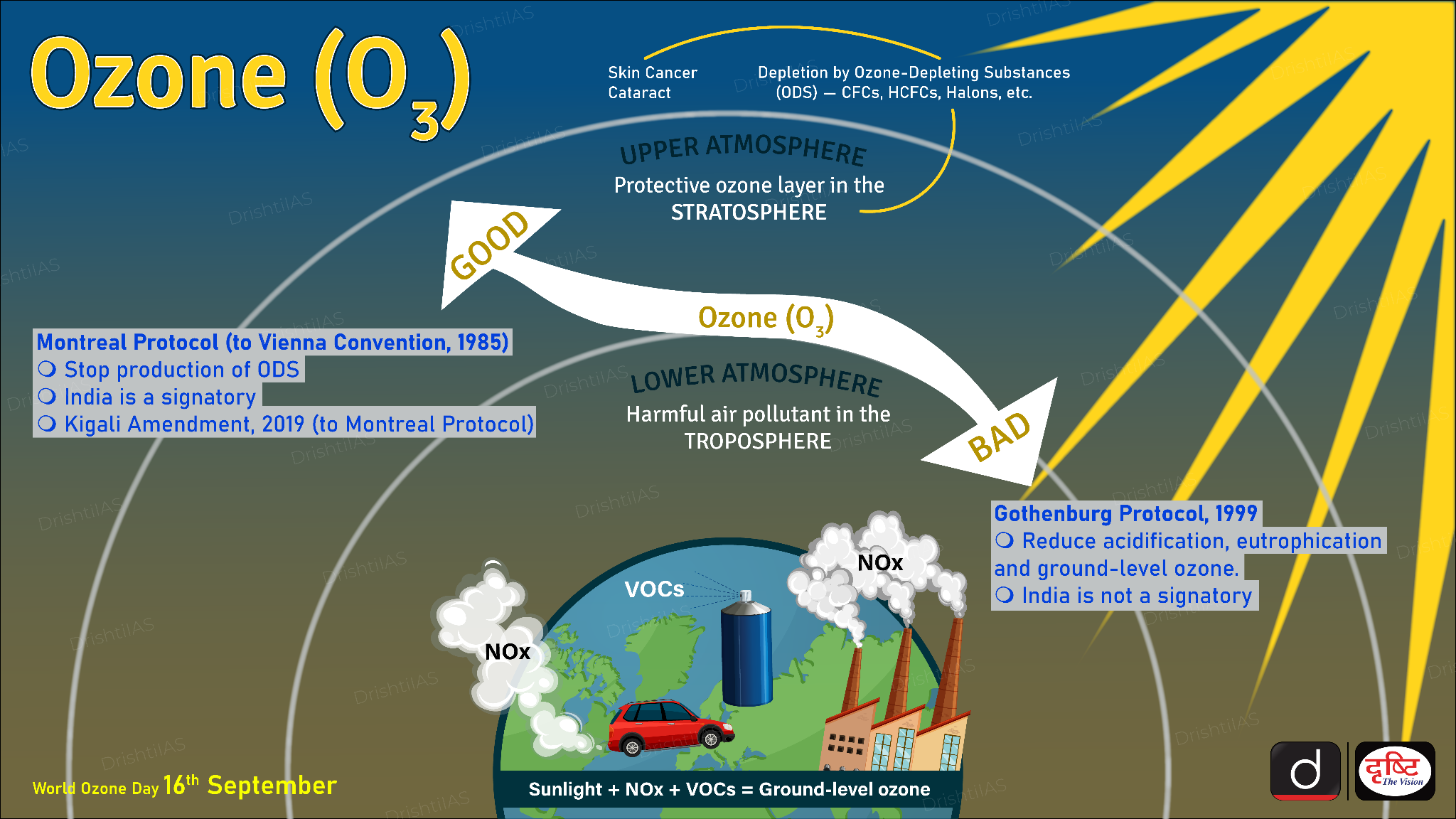
- About: Ozone (O₃) is a reactive gas made of three oxygen atoms; it can be natural or man-made.
- It exists in two layers:
- Stratospheric ozone (good ozone): Forms naturally 15–30 km above Earth by the interaction of UV radiation with oxygen. Acts as Earth’s sunscreen by absorbing harmful UV rays.
- Tropospheric ozone (bad ozone): Forms near the ground due to reactions involving Volatile Organic Compounds, and nitrogen oxides, contributing to smog.
- Ozone is measured in Dobson Units (DU); the global average is about 300 DU, with lower values at poles and higher near the equator.
- It exists in two layers:
- Benefits: The ozone layer protects humans and ecosystems by blocking UV radiation that can cause skin cancer, cataracts, immune suppression, and crop and marine damage.
- Depletion: Ozone depletion is driven by chlorine- and bromine-based chemicals such as CFCs, HCFCs, halons, commonly used in refrigeration, air-conditioning, aerosols, foams, and fire extinguishers.
- These chemicals reach the stratosphere where UV light breaks them down, releasing reactive chlorine and bromine that destroy ozone molecules.
- Global Action: The Montreal Protocol (1987) regulates the global phase-out of ozone-depleting substances; it is the first treaty in UN history with universal ratification (2009).
- HFCs, though ozone-safe, are potent greenhouse gases and are being phased down under the Kigali Amendment (2016).
- Phasing out Ozone-Depleting Substances also helps climate mitigation, preventing an estimated 0.5°C to 1°C of warming by 2050.
Frequently Asked Questions (FAQs)
Q. What is meant by the “ozone hole”?
The “ozone hole” denotes regions over Antarctica where column ozone falls below 220 Dobson Units (DU), indicating significant seasonal thinning of stratospheric ozone.
Q. Why did the Antarctic ozone hole close early in 2025?
Early closure in 2025 resulted from a combination of lower stratospheric chlorine and bromine, effective implementation of the Montreal Protocol, and favourable stratospheric temperatures and circulation.
Q. How does the Montreal Protocol contribute to ozone recovery?
The Montreal Protocol (1987) phased out production and consumption of ozone-depleting substances (CFCs, halons, HCFCs), reducing stratospheric chlorine/bromine and enabling gradual ozone layer recovery.
Summary
- The Antarctic ozone hole closed unusually early in 2025, indicating strong ongoing recovery of the ozone layer.
- Ozone depletion occurs when CFC-derived chlorine and bromine react on polar stratospheric clouds and reduce ozone below 220 DU.
- The early closure is driven by the success of the Montreal Protocol, falling ozone-depleting substances, and favourable stratospheric conditions.
- This strengthens expectations that the ozone layer could return to pre-1980 levels by around 2040.
UPSC Civil Services Examination Previous Year Question (PYQ)
Q. Which one of the following is associated with the issue of control and phasing out of the use of ozone depleting substances? (2015)
(a) Bretton Woods Conference
(b) Montreal Protocol
(c) Kyoto Protocol
(d) Nagoya Protocol
Ans: (b)
Q. Consider the following statements: (2012)
Chlorofluorocarbons, known as ozone-depleting substances, are used
- in the production of plastic foams
- in the production of tubeless tyres
- in cleaning certain electronic components
- as pressurizing agents in aerosol cans
Which of the statements given above is/are correct?
(a) 1, 2 and 3 only
(b) 4 only
(c) 1, 3 and 4 only
(d) 1, 2, 3 and 4
Ans: (c)
Q. Consider the following: (2019)
- Carbon monoxide
- Methane
- Ozone
- Sulphur dioxide
Which of the above are released into atmosphere due to the burning of crop/biomass residue?
(a) 1 and 2 only
(b) 2, 3 and 4 only
(c) 1 and 4 only
(d) 1, 2, 3 and 4
Ans: (d)
International Cheetah Day
The Prime Minister of India marked International Cheetah Day (4th December) by noting India’s progress under Project Cheetah.
- International Cheetah Day: Designated by American zoologist Dr. Laurie Marker, founder of the Cheetah Conservation Fund, in memory of a cheetah named Khayam that she raised, the Day highlights global efforts to prevent the species’ extinction and strengthen conservation.
- Project Cheetah: India launched Project Cheetah in 2022 to reintroduce cheetahs after more than 70 years of extinction.
- Operated under Project Tiger, it is the world’s first intercontinental translocation of a large wild carnivore and follows the Cheetah Action Plan.
- The project aims to establish breeding populations in suitable habitats, use cheetahs as a flagship species to restore open forests and savannas, promote eco-development and ecotourism through community awareness.
- It is implemented by the National Tiger Conservation Authority in partnership with the Madhya Pradesh Forest Department and the Wildlife Institute of India, with oversight from the Cheetah Project Steering Committee set up in 2023.
- Achievements: Under the project, 8 cheetahs from Namibia and 12 from South Africa were relocated to Kuno National Park.
- As of December 2025, India is home to 32 cheetahs, including 21 born in the country.

| Read more: Project Cheetah and Gandhi Sagar Wildlife Sanctuary |
World Soil Day
World Soil Day (on 5th December) established by the Food and Agriculture Organization (FAO) of the United Nations, highlights the importance of soil as a life-sustaining resource, with the 2025 theme Healthy Soils for Healthy Cities.
- Importance of Healthy Urban Soils: Vital for tackling heat islands, pollution, flooding, and food insecurity, as they act as natural filters, carbon sinks, and water sponges that enhance climate resilience and support biodiversity.
- Extent of Degradation: Despite their importance, urban soils are heavily degraded due to contamination, compaction, and sealing by concrete. The FAO notes that nearly a third of the world’s soils are degraded.
- World Soil Day: The idea of an international day for soil was first proposed by the International Union of Soil Sciences in 2002. FAO promoted its formal recognition, leading to the FAO Conference endorsing World Soil Day in 2013.
- The UN General Assembly then officially designated 5th December 2014 as the first World Soil Day.
- The 2025 World Soil Day calls for restoring soil through composting, green infrastructure, responsible soil management, and promoting urban agriculture to build healthier, more resilient cities.
- India’s Soil Conservation Initiatives: Soil Health Card Scheme for nutrient-based soil management.
- Pradhan Mantri Krishi Sinchayee Yojana and Watershed Programs to reduce erosion and improve moisture retention.
- MGNREGA land works supporting soil restoration and water conservation.
- Smart Cities Mission promoting green infrastructure, open spaces, sustainable landscaping, and soil-friendly urban design.
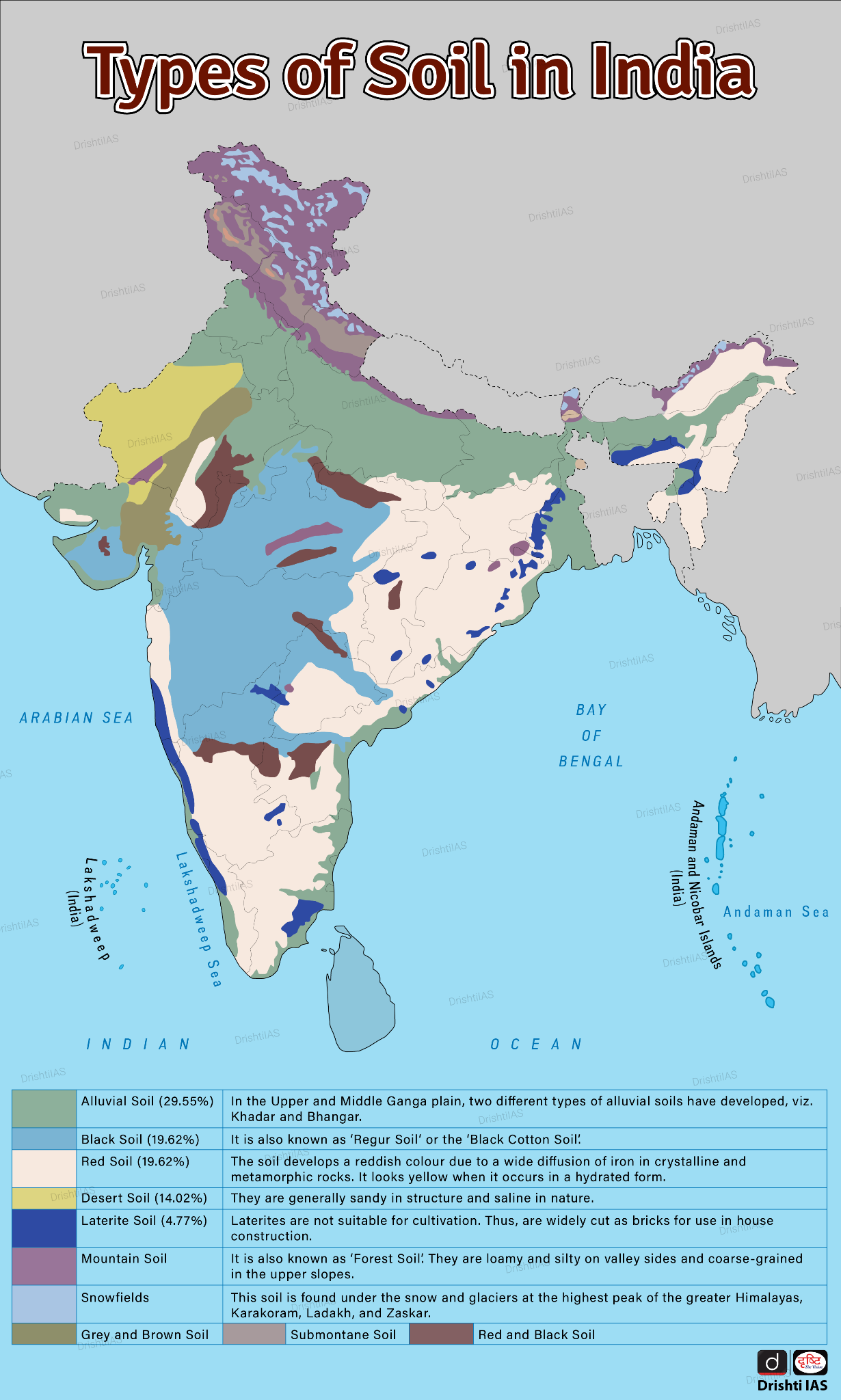
| Read more: Global Soil Conference 2024 and Soil in India |
Centre Declines Reclassification of Denotified and Nomadic Communities
The Centre has decided not to reclassify the 268 denotified, nomadic, and semi-nomadic communities into SC/ST/OBC categories, despite an extensive Anthropological Survey of India study recommending it. This has caused concern as lack of proper classification blocks these communities from accessing benefits, including schemes like SEED.
- About Denotified, Nomadic, and Semi-nomadic Communities
- Denotified Tribes: Denotified Tribes (DNTs) are communities in India unfairly branded as "born criminals" by the British colonial government under the 1871 Criminal Tribes Act, but were "denotified" (decriminalized) by independent India in 1952.
- Nomadic Tribes: Communities that do not have a fixed home and move from place to place constantly for their livelihood. They traditionally carried out occupations like salt trading, fortune-telling, performing arts, or pastoralism.
- Semi-Nomadic Tribes: These communities are partially nomadic. They may have a fixed home or base where they stay for part of the year (usually during the rainy season) but migrate for the rest of the year for work.
- In 2019, the Union Government set up the Development Welfare Board for Denotified, Nomadic, and Semi-Nomadic Communities (DWBDNC) following the Idate Commission (2017) report.
- SEED Scheme (Scheme for Economic Empowerment and Development): Administered by DWBDNC to provide financial, educational, and skill development support.
- Supports self-employment, entrepreneurship, education, and health initiatives.
- Aims to uplift socio-economic conditions of denotified and nomadic communities.
- Uptake is slow due to unclear classification and lack of community certificates.
| Read More: Denotified, Nomadic, Semi-Nomadic Tribes |