
Left Wing Extremism-Free India
For Prelims: Left Wing Extremism (LWE), National Investigation Agency, Dharti Aaba Janjatiya Gram Utkarsh Abhiyan
For Mains: Left Wing Extremism (LWE) in India: causes, spread, and decline, Role of security vs development approach in internal security, SAMADHAN doctrine and counter-insurgency strategies
Why in News?
The Union Home Minister stated that Maoists have been “more or less wiped out” from the Bastar region of Chhattisgarh, historically the strongest bastion of Left Wing Extremism (LWE) in India.
- Declaring that the country has become “Naxal-free”, he highlighted that this progress aligns with the Government of India’s target to completely eliminate LWE by March 2026.
Summary
- India has become “Naxal-free” through a combination of security operations, development initiatives, and strategic policies like the SAMADHAN doctrine.
- However, ensuring lasting peace requires addressing root causes such as tribal rights, governance gaps, and economic inclusion to prevent resurgence.
What is India’s Strategy to Eliminate Left Wing Extremism?
- Policy Framework: Recognizing that insurgency cannot be defeated by military force alone, India transitioned to a holistic, multi-pronged approach codified in the National Policy and Action Plan (2015).
- The overarching goal of this strategy is to achieve a Naxal-free Bharat and transform erstwhile "Red Zones" into "Growth Corridors" by March 2026.
- To achieve this, the government employs a synchronized, three-pillar strategy based on the globally recognized "Clear, Hold, and Build” counter-insurgency doctrine.
- Security Measures: The foremost priority is to re-establish the state's territorial supremacy by neutralizing armed insurgents and destroying their safe havens.
- SAMADHAN Doctrine: Launched in 2017, this is the operational blueprint for security forces.
- SAMADHAN stands for Smart leadership, Aggressive strategy, Motivation and training, Actionable intelligence, Dashboard-based KPIs, Harnessing technology, Action plan for each theater, and No access to financing.
- Intelligence-Led Offensives: Executing massive, targeted kinetic operations using specialized jungle warfare units like CoBRA (CRPF), Greyhounds (Andhra/Telangana), and the District Reserve Guard (DRG).
- Security forces have achieved significant success in countering Left-Wing Extremism through major operations such as Operation Octopus, Operation Double Bull, and Operation Chakrabandha in 2022. Most recently, Operation Kagar (2025) in Chhattisgarh has further strengthened efforts to curb the insurgency.
- Forward Operating Bases (FOBs): Shifting from defensive containment to an offensive posture by establishing heavily fortified police camps deep inside unmapped Maoist strongholds (e.g., Abujhmad).
- This permanently chokes insurgent supply lines and prevents them from regrouping.
- Choking Terror Finance: Utilizing the National Investigation Agency (NIA) and the Enforcement Directorate (ED) to track, freeze, and dismantle the complex extortion (levy) networks that fund the Maoist ecosystem.
- SAMADHAN Doctrine: Launched in 2017, this is the operational blueprint for security forces.
- Accelerated Development (Build): Extremism breeds in geographical isolation and extreme poverty. The state counters this by executing a massive infrastructure push to break the isolation and fill the governance vacuum.
- Physical Connectivity: Implementation of the Road Connectivity Project for LWE Affected Areas (RCPLWEA) to build all-weather roads through dense forests, enabling both rapid troop movement and local economic access to mainland markets.
- Digital Connectivity: Rapid installation of thousands of mobile towers to ensure 100% 4G saturation in LWE districts, breaking the communication blackout and integrating locals into the digital economy.
- Human Capital & Financial Inclusion: Establishing Eklavya Model Residential Schools (EMRS) and ITIs to provide quality education and vocational training, shielding tribal youth from radicalization.
- Concurrently, expanding bank branches and post offices helps bypass the cash-based extortion economy.
- Targeted Village Welfare: Executing saturation campaigns like the Dharti Aaba Janjatiya Gram Utkarsh Abhiyan to ensure basic personal amenities reach the most remote tribal villages.
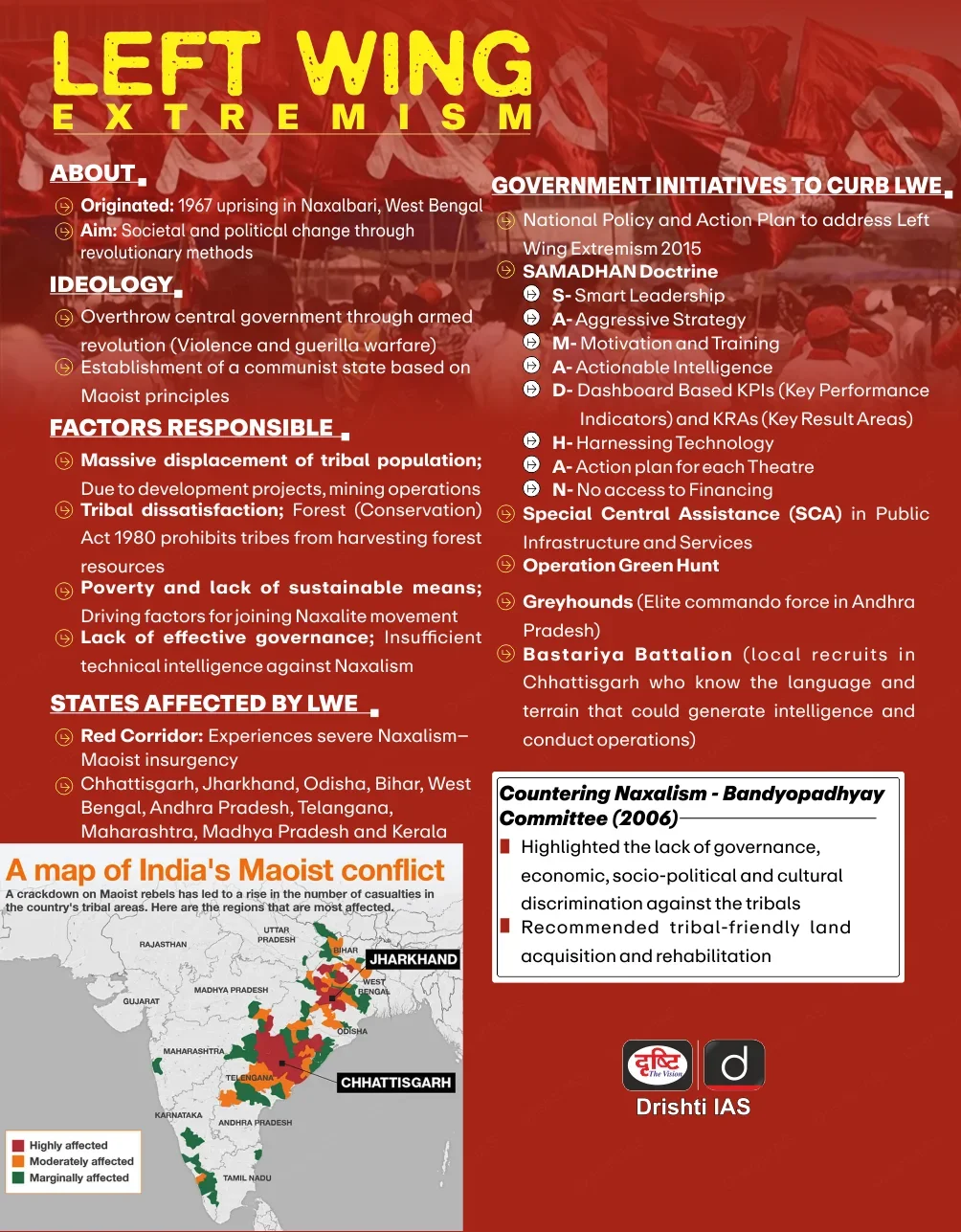
Maoism
- Maoism is a revolutionary form of communism developed by Mao Tse Tung that advocates for the capture of state power through a "Protracted People’s War."
- This ideology prioritizes a "military line," utilizing armed insurgency, mass mobilization, and strategic alliances to overthrow established institutions.
- In India, this manifested as Naxalism (or Left-Wing Extremism), originating from the 1967 Naxalbari uprising in West Bengal.
- The largest and the most violent Maoist formation in India is the Communist Party of India (Maoist) formed in 2004, which along with its various front organizations is banned under the Unlawful Activities (Prevention) Act (UAPA), 1967.
- These groups often use propaganda and misinformation to erode the credibility of state institutions while operating through off-shoots to evade legal liability for their violent insurrection.
What are the Challenges that Remain after the Elimination of Left Wing Extremism in India?
- Security Vacuum & "Vacuum Effect": As Central Armed Police Forces (CAPFs) begin their phased withdrawal, a localized power vacuum is created.
- If state police forces are not sufficiently "augmented" in terms of numbers and training, splinter groups or criminal syndicates often fill this void.
- Transformation into Organized Crime: The Maoists have historically controlled a multi-crore extortion economy involving mining, tendu leaf trade, and infrastructure projects.
- Deprived of ideological leadership, surviving lower-level cadres may transition into armed "mafia" groups to maintain control over these illicit revenue streams.
- "Absentee Administration" Syndrome: The state has built the "hardware" (schools, hospitals, administrative blocks), but the "software" (service delivery) remains weak.
- Ensuring that doctors, teachers, and bureaucrats are physically present and motivated to work in these remote, erstwhile "Red Zones" remains a massive logistical and motivational hurdle.
- Tackling 'Urban Naxalism' and Frontal Organizations: While the "Jungle Squads" (Dalam) may be neutralized, the intellectual and financial "overground" networks in urban centers continue to exploit localized grievances (labor strikes, land acquisition) to keep the Maoist ideology alive.
- Neutralizing this network without infringing on civil liberties is a delicate legal and intelligence challenge.
- Threat of Tactical Counter Offensive Campaigns (TCOC): Historically, desperate and cornered Maoist cadres launch TCOCs during the summer months to inflict heavy casualties on security forces. Tactical alertness remains paramount.
What Measures can Ensure Sustainable Peace and Development in Erstwhile LWE Zones?
- Strengthening State Police (The Hub-and-Spoke Model): The reliance on CAPFs must be replaced by a robust State Police presence.
- This includes the "Police-Station-as-a-Growth-Center" model, where the local police station acts as a facilitator for grievance redressal and welfare delivery, not just an enforcement unit.
- Civic Action Programmes (CAP) should be institutionalized into permanent community-police partnerships to maintain the "Hearts and Minds" (WHAM) advantage.
- Strict Enforcement of PESA and FRA: To prevent the resurgence of grievances, the state must ensure the Forest Rights Act (FRA, 2006) and the PESA Act (1996) are implemented in letter and spirit.
- Empowering the Gram Sabha over "Jal, Jangal, Zameen" is the most potent antidote to Maoist ideology.
- Tribal-Sensitive Development: As mining and industrial projects surge in these mineral-rich areas, the state must adopt a "Tribal-First" development model.
- Ensuring that the District Mineral Foundation (DMF) funds are spent transparently on the direct welfare of the affected tribal families is non-negotiable.
Conclusion
India appears closer than ever to eliminating Naxalism through a mix of security operations and development initiatives, lasting peace will depend on addressing the root socio-economic causes. The transition from a security-driven approach to trust-based governance will be crucial to ensure that Left Wing Extremism does not re-emerge in the future.
|
Drishti Mains Question: Discuss the relevance of the “Clear, Hold, Build” doctrine in India’s counter-insurgency strategy. |
Frequently Asked Questions (FAQs)
1. What is Left Wing Extremism (LWE) in India?
It is a Maoist insurgency aimed at overthrowing the state through armed struggle, rooted in issues like tribal marginalisation and underdevelopment.
2. What is the SAMADHAN doctrine?
It is a counter-insurgency strategy focusing on intelligence-led operations, technology use, and financial disruption of Maoist networks.
3. Which law bans Maoist organisations in India?
The Unlawful Activities (Prevention) Act (UAPA), 1967 bans CPI (Maoist) and its affiliated organisations.
4. What are the key challenges after eliminating LWE?
Challenges include security vacuum, rise of organized crime, weak governance, and urban Maoist networks.
5. How can sustainable peace be ensured in LWE areas?
Through strong state policing, effective implementation of PESA & FRA, and tribal-centric inclusive development.
UPSC Civil Services Examination, Previous Year Question (PYQ)
Mains
Q. What are the determinants of left-wing extremism in the Eastern part of India? What Strategy should the Government of India, civil administration and security forces adopt to counter the threat in the affected areas? (2020)
Q. The persisting drives of the government for development of large industries in backward areas have resulted in isolating the tribal population and the farmers who face multiple displacements. With Malkangiri and Naxalbari foci, discuss the corrective strategies needed to win the Left Wing Extremism (LWE) doctrine that affected citizens back into the mainstream of social and economic growth. (2015)
Samrat Samprati
Why in News?
On the occasion of Mahavir Jayanti (31st March 2026), the Prime Minister inaugurated the Samrat Samprati Museum in Koba, Gandhinagar.
- The museum serves as a dedicated space to preserve Jain history and honour the legacy of Samrat Samprati, the grandson of Ashoka the Great, who played a role in the spread of Jainism analogous to Ashoka’s role in the global propagation of Buddhism.
Who was Samrat Samprati?
- About: He was the fifth emperor of the Mauryan Empire, reigning from approximately 224 to 215 BCE. He was the grandson of the legendary Emperor Ashoka and the son of Kunala.
- Following Ashoka’s death in 232 BCE, historical records suggest the Mauryan Empire was divided between his grandsons, Dasharatha and Samprati.
- Religious Affiliation: While the Mauryan dynasty saw diverse faiths, Chandragupta Maurya (Jainism), Ashoka (Buddhism), and Dasharatha (Ajivika), Samprati is the central figure for the Shvetambara Jain tradition.
- Often referred to as the "Jain Ashoka," Samprati is a pivotal figure in history for his role in the global propagation of Jainism.
How did Samrat Samprati Contribute to the Spread of Jainism?
- Temple Construction and Iconography: Samprati established a robust "ritual culture" of temple worship that gave Jainism a physical and permanent presence across the subcontinent.
- Traditional Jain texts credit him with building 125,000 new temples (derasars) and renovating 36,000 older ones. Many ancient Jain temples in Western India that lack specific donor inscriptions are traditionally attributed to Samprati's reign.
- He is said to have commissioned and consecrated over 12.5 million idols of the Tirthankaras made of stone and metal.
- Missionary Expeditions: Samprati systematically sent missionaries to spread the principles of Ahimsa (non-violence) far beyond the Mauryan heartland.
- According to historical narratives, he first sent Mauryan soldiers disguised as Jain monks into "non-Aryan" (unconquered or tribal) territories. Accounts suggest he sent emissaries to Afghanistan, Nepal, Sri Lanka, Myanmar (Burma), and even parts of Central Asia, attempting to make Jainism an international faith.
- He successfully rooted Jainism in regions like Andhra, Tamil Nadu, Karnataka, Maharashtra, Saurashtra (Gujarat), and Rajputana (Rajasthan).
- State Patronage and Ethical Governance: By ruling from major hubs like Ujjain and Pataliputra, he ensured that Jain institutions received royal patronage and protection.
- Samprati aligned the state’s welfare programs with the Jain principle of compassion (Karuna).
- He established approximately 700 Sada-vratas (Charitable Houses) across the empire. These centers provided free food, shelter, and medical care to the poor, travellers, and the ascetic community.
- Monastic Logistics: He ensured that Jain monks, who travel strictly on foot and rely on alms, had safe routes and access to proper, ritually pure food during their long journeys across the empire.
Major Sects of Jainism
- Shvetambara Sect (“White-Clad”): This tradition is dominant in western and northern India, especially in Gujarat and Rajasthan.
- Their name means “white-clad,” reflecting the practice of monks and nuns wearing simple white clothes.
- They believe that wearing clothes does not hinder spiritual progress, as true liberation depends on inner detachment, not external appearance.
- Shvetambaras accept the Agamas as authentic teachings of Lord Mahavira. A key belief is that women can attain moksha in their present life, and they even regard Mallinath (19th Tirthankara) as a woman.
- This sect is further divided into Murtipujaka (idol worshippers), Sthanakavasi (non-idol worshippers), and Terapanthi (reformist, highly disciplined group).
- Digambara Sect (“Sky-Clad”): The Digambara sect is dominant in southern India, especially Karnataka, and parts of central India.
- The monks practice total renunciation by not wearing clothes, representing complete detachment from material possessions.
- Digambaras believe that the original Jain scriptures (Agamas) were lost and instead rely on texts written by great Acharyas (scholars/monks).
- Unlike Shvetambaras, they hold that women cannot attain moksha directly and must be reborn as men.
- Their key sub-sects include Bisapantha, Terapantha, and Taranapantha or Samaiyapantha.
Frequently Asked Questions (FAQs)
1. Who was Samrat Samprati?
He was a Mauryan emperor (224–215 BCE), grandson of Ashoka, known for promoting Jainism.
2. Why is Samprati called the “Jain Ashoka”?
Because he played a key role in spreading Jainism through state support, temples, and missions, similar to Ashoka’s role in Buddhism.
3. What were the key contributions of Samprati to Jainism?
He built thousands of temples, installed millions of idols, and sent missionaries across regions to propagate Jainism.
4. Which regions saw the spread of Jainism under Samprati?
Jainism expanded across Gujarat, Rajasthan, Karnataka, Tamil Nadu, and beyond India to regions like Afghanistan and Myanmar.
5. How did Samprati support welfare and governance?
He established charitable centres (Sada-vratas) providing food, shelter, and medical care, reflecting Jain principles of Ahimsa and compassion.
UPSC Civil Services Examination, Previous Year Question (PYQ)
Prelims:
Q. With reference to the religious practices in India, the “Sthanakvasi” sect belongs to (2018)
(a) Buddhism
(b) Jainism
(c) Vaishnavism
(d) Shaivism
Ans: (b)
Q. With reference to the religious history of India, consider the following statements: (2017)
- Sautrantika and Sammitiya were the sects of Jainism.
- Sarvastivadin held that the constituents of phenomena were not wholly momentary, but existed forever in a latent form.
Which of the statements given above is/are correct?
(a) 1 only
(b) 2 only
(c) Both 1 and 2
(d) Neither 1 nor 2
Ans: (b)
Q. With reference to the history of ancient India, which of the following was/were common to both Buddhism and Jainism? (2012)
- Avoidance of extremities of penance and enjoyment
- Indifference to the authority of the Vedas
- Denial of the efficacy of rituals
Select the correct answer using the codes given below:
(a) 1 only
(b) 2 and 3 only
(c) 1 and 3 only
(d) 1, 2 and 3
Ans: (b)
Q. Anekantavada is a core theory and philosophy of which one of the following? (2009)
(a) Buddhism
(b) Jainism
(c) Sikhism
(d) Vaishnavism
Ans: (b)
India’s Shift Towards PNG from LPG
Why in News?
India is strategically pushing to replace Liquefied Petroleum Gas (LPG) with Piped Natural gas (PNG) for domestic cooking to reduce import dependence, especially after the blockade of the Strait of Hormuz exposed vulnerabilities in LPG supply chains.
What are the Key Facts Regarding LPG and PNG?
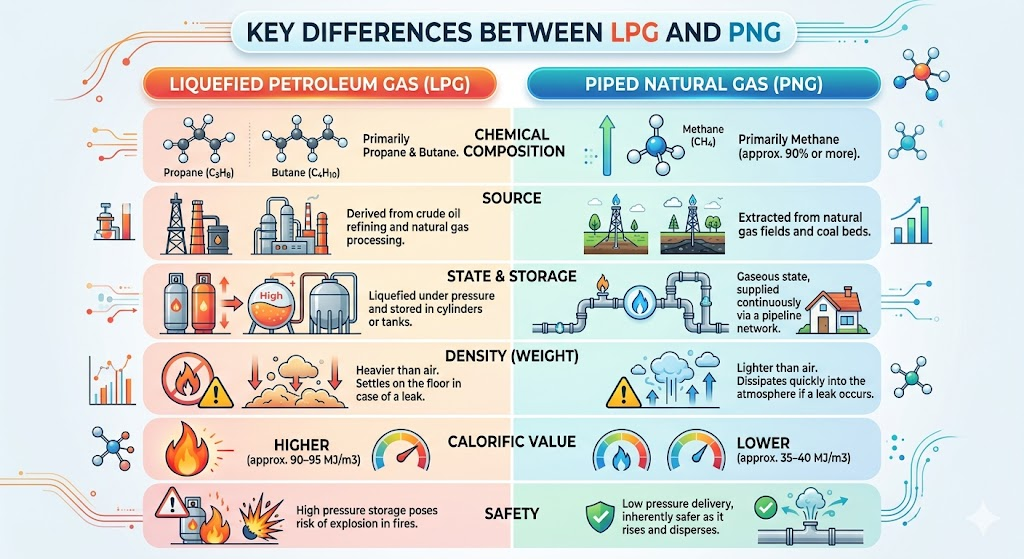
- About: LPG consists of propane and butane. It is liquefied under moderate pressure, stored in cylinders, and is heavier than air.
- PNG is a form of methane and is distributed at low pressure through pipelines directly to homes/industries. It is lighter than air.
- Supply and Logistics: LPG is distributed in pressurized cylinders. This involves a complex supply chain of bottling plants, distributors, and delivery personnel. It requires manual booking.
- While PNG is supplied via a reticulated pipeline network (City Gas Distribution). It provides an uninterrupted 24/7 supply, similar to water or electricity, eliminating the "last-minute booking" anxiety.
- Efficiency: While LPG has a higher calorific value (it heats faster), PNG is more efficient in a continuous flow system. However, using an LPG stove with PNG requires a nozzle change (retrofitting), which can drop thermal efficiency if not done correctly.
- LPG and PNG in India:
- History of LPG and PNG in India: LPG was first introduced in India in 1955 by Burmah Shell Oil Company in Mumbai under the brand Burshane, followed by the first organized distribution in 1965 when Indian Oil Corporation launched its Indane connection in Kolkata.
- A major milestone came with the launch of Pradhan Mantri Ujjwala Yojana in Ballia, which scaled up LPG access for women’s health and rural empowerment.
- Meanwhile, in the case of PNG, Vadodara emerged as the pioneer, becoming the first Indian city to implement a city-wide piped natural gas network for domestic use as early as the 1970s.
- Current Status: India has around 33 crore LPG connections, while domestic natural gas production has the potential to support nearly 30 crore PNG connections if a full transition occurs.
- However, PNG penetration remains limited at about 1.5 crore connections, with a target to expand it to 12 crore by 2034.
- Supply and Production Dynamics: India imports about 60% of its LPG consumption and out of these imports about 90% come through the Strait of Hormuz, which has been impacted due to current happenings. Domestic LPG production has witnessed a 25% increase, driven by government measures.
- On the other hand, domestically, PNG in India comes from gas fields like the Krishna-Godavari (KG) basin, Assam, and Tripura.
- The deepwater Krishna-Godavari (KG) basin off the eastern coast is reportedly the biggest contributor.
- On the other hand, domestically, PNG in India comes from gas fields like the Krishna-Godavari (KG) basin, Assam, and Tripura.
- History of LPG and PNG in India: LPG was first introduced in India in 1955 by Burmah Shell Oil Company in Mumbai under the brand Burshane, followed by the first organized distribution in 1965 when Indian Oil Corporation launched its Indane connection in Kolkata.
Other Forms of Natural Gas
Beyond PNG, natural gas is utilized and transported in several other forms, each serving specific logistical or industrial purposes.
- CNG (Compressed Natural Gas):
- Formation: Natural gas (methane) compressed to less than 1% of its volume at standard atmospheric pressure.
- Primary Use: Fuel for transportation (buses, cars, and autos).
- LNG (Liquefied Natural Gas):
- Formation: Natural gas cooled to approximately -162°C (-260°F), turning it into a clear, colorless liquid.
- Primary Use: Long-distance transport across oceans via specialized tankers.
Frequently Asked Questions (FAQs)
1. What is the primary safety advantage of PNG over LPG in domestic settings?
PNG is lighter than air and disperses rapidly upon leakage, whereas LPG is heavier than air, tending to settle at floor level and creating a higher risk of accumulation and explosion.
2. How does the production of LPG differ fundamentally from Natural Gas?
LPG is a co-product derived from both crude oil refining and natural gas processing, while PNG is primarily methane extracted directly from gas fields or Coal Bed Methane (CBM).
3. Why is the Strait of Hormuz critical to India’s LPG supply chain?
Nearly 90% of India’s LPG imports transit through this narrow chokepoint; any regional conflict or blockade there poses a direct threat to India’s energy security and inflation.
4. What is the significance of the KG-DWN 98/2 Block for India’s energy targets?
Located in the Krishna-Godavari Basin, this block is expected to boost ONGC’s gas output by 15%, reducing the current account deficit by substituting expensive imports with domestic production.
UPSC Civil Services Examination, Previous Year Questions (PYQ)
Prelims
Q. With reference to the Indian Renewable Energy Development Agency Limited (IREDA), which of the following statements is/are correct? (2015)
- It is a Public Limited Government Company.
- It is a Non-Banking Financial Company.
Select the correct answer using the code given below:
(a) 1 only
(b) 2 only
(c) Both 1 and 2
(d) Neither 1 nor 2
Ans: (c)
Mains
Q. Access to affordable, reliable, sustainable and modern energy is the sine qua non to achieve Sustainable Development Goals (SDGs).” Comment on the progress made in India in this regard. (2018)
Helium Crisis and India’s Import Dependence
Why in News?
The 2026 West Asia geopolitical crisis has disrupted global helium supply, exposing India’s heavy import dependence and posing risks to critical sectors like healthcare, semiconductors, and advanced technology industries.
What are the Key Applications of Helium?
- About: Helium is a colorless, odorless, tasteless, inert, and non-flammable noble gas with the lowest boiling and melting points of all elements, allowing it to remain liquid even near absolute zero, and it plays a vital role in modern technology.
- It is the second lightest and second most abundant element in the observable universe.
- Despite being abundant in the universe, helium is relatively rare on Earth because its low density allows it to escape the atmosphere. It is not manufactured synthetically, instead, it is obtained as a by-product during the cryogenic processing of natural gas into Liquefied Natural Gas (LNG).
- Applications:
- Cryogenics & Healthcare: The most critical use of helium is as a cooling agent for Magnetic Resonance Imaging (MRI) machines.
- Liquid helium cools the superconducting magnets in MRIs to temperatures near absolute zero, allowing them to conduct electricity without resistance and create the strong magnetic fields needed for internal imaging.
- Aerospace & Rocketry: Helium is vital for space exploration and satellite launches.
- Pressurizing Fuel Tanks: In liquid-fueled rockets, helium is used to fill the ullage space (the empty space in fuel tanks). As fuel is consumed, helium maintains the pressure to ensure a steady flow to the engines.
- Purging Systems: Because it is inert, it is used to "clean" or purge fuel lines of potentially explosive vapors.
- High-Tech Manufacturing: Helium plays a "behind-the-scenes" role in the gadgets we use daily.
- Semiconductors: It provides an inert atmosphere and rapid cooling during the manufacturing of computer chips.
- Fiber Optics: It is used as a cooling medium during the high-speed drawing of glass fibers used for global internet cables.
- Deep-Sea Diving: Professional and commercial divers use Heliox (a mixture of helium and oxygen).
- Preventing Narcosis: Unlike nitrogen, helium does not have an intoxicating effect under high pressure, preventing "nitrogen narcosis."
- Easier Breathing: Its low density reduces the physical effort required to breathe at great depths.
- Scientific Research & Detection
- Particle Accelerators: Facilities like the Large Hadron Collider (LHC) use liquid helium to keep their magnets at functional temperatures.
- Leak Detection: Because helium atoms are exceptionally small and move quickly, they are used to test for microscopic leaks in high-vacuum equipment and gas pipelines.
- Cryogenics & Healthcare: The most critical use of helium is as a cooling agent for Magnetic Resonance Imaging (MRI) machines.
Disruptions in the Global Helium Supply Chain
- The USA, Qatar, and Algeria are the leading producers of Helium. The West Asia crisis has severely impacted global supply, particularly due to disruptions in Qatar, which contributes around 34% of global helium exports.
- Damage and operational issues at the Ras Laffan complex (Qatar) significantly reduced export capacity.
- Helium's "use-it-or-lose-it" volatility makes long-term storage difficult, meaning global buffer reserves are naturally low and highly sensitive to supply shocks.
India’s Vulnerability
- India is 100% import-dependent on helium, with an estimated demand of 3.4 million cubic meters in 2025.
- Since over 50% of India’s helium imports come from Qatar, such disruptions have immediate and serious consequences.
- The country maintains only 7–10 days of inventory, making it highly vulnerable to supply shocks.
- Although traces of helium are present in natural gas fields in West Bengal and Jharkhand, their concentrations remain below the 0.2% threshold required for economic extraction.
- Consequently, commercial viability is still estimated to be at least 5–10 years away, according to S&P Global Energy.
Frequently Asked Questions (FAQs)
1. Why is helium considered a critical resource?
Because it has unique cooling properties with no viable substitutes, essential for MRI, semiconductors, and aerospace.
2. Why is helium scarce on Earth?
Due to its low density, helium escapes Earth’s atmosphere and cannot be produced synthetically.
3. Why is India vulnerable to helium shortages?
India is 100% import-dependent with only 7–10 days of inventory, making it highly exposed to global disruptions.
4. How has the West Asia crisis affected helium supply?
Disruptions in Qatar (≈34% global supply) and LNG infrastructure have reduced global availability and increased prices.
5. What sectors are most affected by helium shortage?
Healthcare (MRI), semiconductors, aerospace, research, and telecom (fiber optics) face major risks due to dependence on helium.
UPSC Civil Services Examination, Previous Year Questions (PYQs)
Prelims
Q. A team of scientists at Brookhaven National Laboratory included those from India created the heaviest anti-matter (anti-helium nucleus). What is/are the implication/implications of the creation of anti-matter? (2012)
- It will make mineral prospecting and oil exploration easier and cheaper.
- It will help prove the possibility of the existence of stars and galaxies made of anti-matter.
- It will help understand the evolution of the universe.
Select the correct answer using the codes given below:
(a) 1 only
(b) 2 and 3 only
(c) 3 only
(d) 1, 2 and 3
Ans: b
Q. Which of the following adds/add nitrogen to the soil?(2013)
- Excretion of urea by animals
- Burning of coal by man
- Death of vegetation
Select the correct answer using the codes given below:
(a) 1 and 2 only
(b) 2 and 3 only
(c) 1 and 3 only
(d) 1, 2 and 3
Ans: c
Qdenga Vaccine for Dengue
India has approved Takeda's TAK-003 (Qdenga), its first dengue vaccine, cleared by the Subject Expert Committee (SEC) under the Drugs Controller General of India (DCGI) for individuals aged 4 to 60 years marking a historic shift from reactive vector control to preventive public health strategy.
- Qdenga: It is a tetravalent dengue vaccine tested on 28,000+ participants and approved in 40+ countries.
- TAK-003 is a disease-modifying vaccine, not a transmission-blocking one. It reduces clinical severity but does not prevent infection or eliminate outbreaks.
- Unlike earlier vaccines, it does not require prior dengue infection testing, making rollout easier.
- SEC has mandated post-marketing studies across regions and serotype patterns to assess real-world effectiveness in India.
- Key Limitations: Dengue is caused by four serotypes (DENV-1 to DENV-4). While TAK-003 is highly effective against DENV-2 (its genetic backbone), its efficacy is notably lower against DENV-3 and DENV-4, especially in "seronegative" individuals (those never previously infected).
- India's dengue epidemiology is shifting while DENV-3 is rising (contributing 20–30% of cases) in several regions, potentially reducing the vaccine's population-level impact.
- Cost concern: The full two-dose course is estimated to cost between Rs 6,000 and Rs 12,000, posing significant affordability and compliance challenges for rural and low-income populations.
- Indigenous Pipeline: India is developing ‘DengiAll’ (developed by Panacea Biotec and ICMR) which aims for more balanced protection across all four serotypes, potentially available by 2027.
| Read more: DengiAll |
Dannebroge and the Battle of Copenhagen
Marine archaeologists have successfully located and begun excavating the Dannebroge, a 19th-century Danish flagship sunk by the British fleet over two centuries ago.
- The ship was destroyed during the Battle of Copenhagen (1801), a naval clash where the British Navy led by Admiral Horatio Nelson defeated the Danish navy.
Battle of Copenhagen (1801)
- About: The Battle of Copenhagen was a pivotal naval engagement where a British fleet led by Horatio Nelson neutralized the Dano-Norwegian defenses to dismantle a strategic coalition of Russia, Denmark-Norway, Sweden, and Prussia.
- It was triggered by the formation of the League of Armed Neutrality (Russia, Denmark-Norway, Sweden, and Prussia), which Britain perceived as a French-aligned threat to its Baltic Sea trade routes and naval resources.
- Tactical Leadership: While Admiral Hyde Parker held overall British command, Vice Admiral Horatio Nelson (2nd-in-command) led the assault, famously ignoring a signal to withdraw by placing his telescope to his blind eye (inspired by the phrase “to turn a blind eye”).
- Immediate Outcome: A decisive British victory that forced an armistice and led to Denmark’s temporary withdrawal from the neutral league.
- Strategic Collapse: The subsequent assassination of Tsar Paul I of Russia and the accession of Alexander I led to the total collapse of the League of Armed Neutrality, securing British maritime dominance.
| Read More: Baltic Nations |
NCERT Granted Deemed University Status
The Centre has granted the National Council of Educational Research and Training (NCERT) the status of an “Institution deemed to be University under distinct category”.
- Degree-Granting Authority: The new status allows NCERT, along with its 6 regional institutes, to independently offer academic courses and confer degrees.
- Regulatory Compliance: All programs must strictly adhere to the norms and standards prescribed by the University Grants Commission (UGC) and align with the National Education Policy (NEP) 2020.
- Academic Expansion: NCERT is mandated to initiate new research, doctoral, and innovative academic programs. It is also authorized to establish off-campus and offshore campuses in accordance with UGC guidelines.
- Non-Profit Mandate: The institution is strictly bound by conditions that prevent it from engaging in any "commercial" or "profit-making" activities.
- Mandatory Accreditation: The institute must secure institutional accreditation from the National Assessment and Accreditation Council (NAAC) and get its specific programs rated by the National Board of Accreditation (NBA).
- National Rankings: NCERT is now required to participate in the annual rankings issued by the National Institutional Ranking Framework (NIRF).
- Digital Integration: The institution must compulsorily adopt the Academic Bank of Credits (ABC) system, which includes creating student identities and uploading credit scores to digital lockers linked to the ABC portal.
| Read more: Future of Indian Higher Education System |